

Florida Rep. Díaz-Balart Defends Support for Venezuelan Opposition Leader Amid Maduro’s Capture
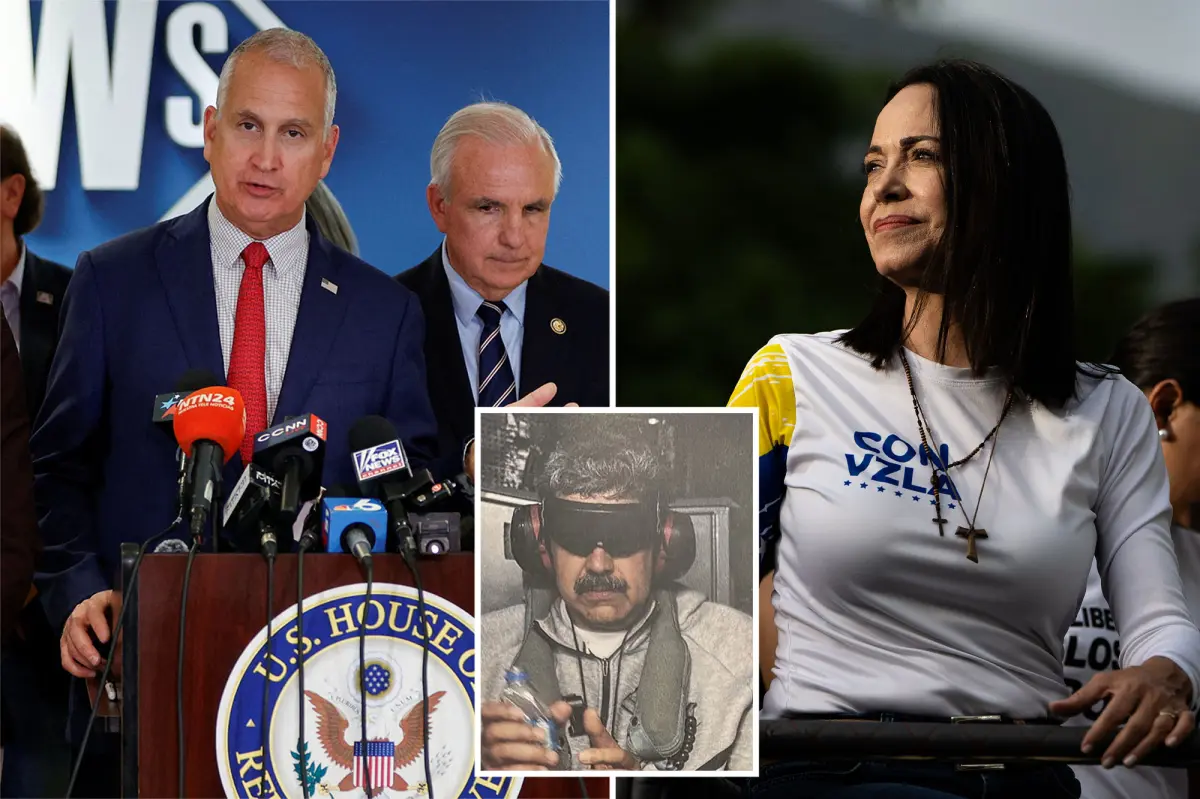
In a heated exchange that captured the complexity of U.S.-Venezuela relations, Florida Representative Mario Díaz-Balart forcefully rejected a reporter’s suggestion that he wasn’t supporting Venezuelan opposition leader Maria Corina Machado following Nicolas Maduro’s capture. The confrontation occurred during a press conference where Díaz-Balart, alongside fellow Cuban-American Representatives Carlos Giménez and Maria Elvira Salazar, addressed the implications of Maduro’s ouster. “Oh, whoa, whoa, whoa,” Díaz-Balart responded with visible frustration. “You’re talking to us? When have we ever not supported her? Do not put words in my mouth. I will not tolerate putting words in my mouth or my colleagues’ mouths. We have been consistent from day one.” His passionate defense culminated in a clear declaration: “The next democratically elected president of Venezuela is going to be Maria Corina Machado.” This statement stood in stark contrast to former President Trump’s earlier remarks expressing doubt about Machado’s leadership potential.
The apparent disconnect between Trump and the Florida representatives highlights the nuanced politics surrounding Venezuela’s future governance. Earlier that day, Trump had cast doubt on Machado’s ability to lead Venezuela despite her significant role in the opposition movement. “I think it’d be very tough for her to be the leader,” Trump stated during a press conference celebrating Maduro’s capture. “She doesn’t have the support or the respect within the country. She’s a very nice woman, but she doesn’t have the respect.” This assessment came despite Machado’s notable achievements, including winning the opposition primary in 2023 and recently being awarded the Nobel Peace Prize—an honor she had publicly dedicated to Trump. The contradiction between Trump’s dismissal and the Florida representatives’ unwavering support for Machado reveals the complex dynamics at play in U.S. policy toward Venezuela’s political transition.
Machado’s journey exemplifies the challenges faced by Venezuela’s democratic opposition. Despite winning the primary to become the opposition’s standard-bearer in the 2024 general election, she was barred from running by Venezuela’s government under Maduro. The situation forced her to flee Venezuela covertly last month, just before the ceremony honoring her Nobel Peace Prize. In her absence, Edmundo González became the opposition candidate but later sought refuge in Spain. The 2024 Venezuelan election’s legitimacy was widely questioned, including by the Biden administration, which rejected Maduro’s claim to victory. These circumstances have created a complex landscape for U.S. policymakers and Venezuelan opposition figures alike, as they navigate the path forward after Maduro’s unexpected removal from power.
The capture of Nicolas Maduro represents a significant turning point in Venezuela’s political landscape and U.S. foreign policy in Latin America. Trump authorized a daring operation in the early hours of Saturday morning that resulted in the capture of Maduro and his wife, Cilia Flores, from the heart of Caracas. The deposed leader was subsequently transported to the United States, where he faces imminent trial for alleged drug trafficking charges. In Maduro’s absence, his Vice President Delcy Rodriguez has assumed the role of acting president in Venezuela. Secretary of State Marco Rubio has reportedly been in communication with Rodriguez about the transition. When asked about potential U.S. military intervention, Trump indicated that such measures wouldn’t be necessary if Rodriguez cooperates with American demands: “No, if Maduro’s vice president — if the vice president does what we want, we won’t have to do that.”
The South Florida Republican representatives have consistently positioned themselves as outspoken critics of the Maduro regime, reflecting the concerns of their substantial Cuban-American and Venezuelan-American constituencies. During their Saturday press conference in Doral, Florida—a community with a large Venezuelan population—Representative Giménez proclaimed, “There will be a new world order. It will be a world order that is bounded by and guided by the principles of liberty and democracy, not tyranny, communism and socialism.” This statement encapsulates the representatives’ long-standing opposition to authoritarian regimes in Latin America, including those in Venezuela and Cuba. Their advocacy is particularly significant given that Maduro’s regime has been a key supporter of Cuba’s communist government, creating an interconnected web of regional concerns for these Cuban-American lawmakers.
The unfolding situation in Venezuela following Maduro’s capture illustrates the complex interplay between U.S. domestic politics, foreign policy, and Latin American governance. The passionate defense by Díaz-Balart and his colleagues of Machado’s democratic legitimacy stands in contrast to Trump’s more pragmatic or realpolitik approach to Venezuela’s leadership transition. This tension reflects broader questions about how the United States should engage with democratic movements in countries experiencing authoritarian rule. As Venezuela stands at a crossroads, with Rodriguez temporarily at the helm and Machado representing democratic aspirations from exile, the international community watches closely. The outcome of this transition may have profound implications not only for Venezuela’s 28 million citizens but also for democratic movements throughout Latin America and U.S. influence in the region. The contrasting perspectives among American political figures suggest that even as Maduro faces justice in the United States, the path forward for Venezuela remains uncertain and contested.