



In the quiet, dense woodlands of North Georgia, as the sun dipped below the horizon, a dramatic and terrifying situation was unfolding on the sheer rock face of Mount Yonah. This formidable peak, standing at 3,166 feet, is a beloved destination for hikers and climbers, offering exhilarating challenges and breathtaking views. That evening, however, it transformed into a prison for a lone free climber who found himself utterly helpless. As the vibrant colors of the sunset faded into a deep, encroaching twilight, the mountain turned cold and shadowy. The climber, an experienced outdoorsman whose identity was never released to the public, had been navigating the rugged west face when he made a critical navigational error. He had chosen a path that led him to a dead end, a vertical wall of smooth granite that offered no purchase above him, while the ground below fell away into a dizzying abyss. He was completely and terrifyingly stranded. With the darkness closing in and the temperature starting to plummet, the initial thrill of the climb had evaporated, replaced by a gnawing, primal fear. Realizing that any attempt to move in either direction could result in a fatal fall, he made the wise but humbling decision to call for help. At around 7:00 PM, his voice, tense and strained, connected with a White County 911 dispatcher, setting into motion a high-stakes rescue operation that would test the limits of human skill and courage.
Meanwhile, at the command post, White County Public Safety officials swiftly mobilized, understanding the immense gravity of the situation. They knew that rescuing someone from a sheer cliff face in the dark was a race against time, requiring both strategic planning and the use of advanced technology. They immediately launched a drone to get eyes on the stranded climber. The whirring aircraft ascended into the rapidly darkening sky, battling the mountain breezes as its powerful sensors scanned the rock face. The drone’s thermal imaging camera was specifically designed to pick up the heat signature of a human body against the cooling backdrop of stone and vegetation. After a tense search, the operator located him. The footage transmitted back to the rescuers was sobering. There, clinging to the mountain, was a man standing on a ledge so impossibly small it was hard to believe it could support a human being. The rocky outcrop measured a mere 20 by 20 inches—about the size of a large computer monitor or a single square foot of a standard office desk. He was poised on this tiny perch, a staggering 260 feet above the forest floor. The video showed him frozen in place, barely moving, fully aware that a single misstep would send him plummeting to certain death. The scene highlighted the terrifying vulnerability of a human being against the immense, unyielding wall of nature. A ground-based rescue was impossible; the cliff was too sheer, the darkness too disorienting. The only viable plan was a technical rope rescue, performed by a highly trained firefighter rappelling down the vertical drop from the summit.
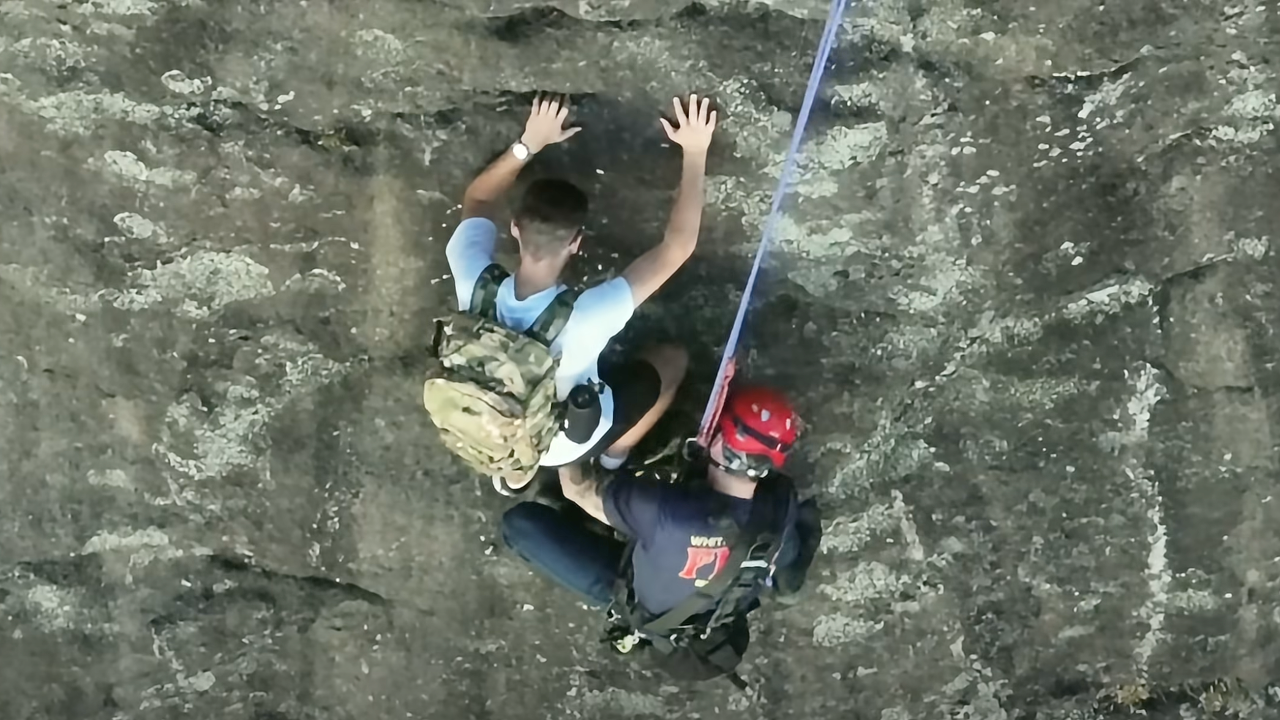
That firefighter was Will Roper. For Roper, the call was a stark transition from the controlled environment of training to the brutal unpredictability of reality. He had spent countless hours practicing on dummies and with fellow crew members in firehouses, mastering the delicate mechanics of rope systems, harnesses, and braking. He knew the procedures by heart. Yet, standing on the edge of Mount Yonah, looking down into the void where a life was waiting to be saved, he felt his heart thundering against his ribs. “It was a little nerve-racking going over the edge,” he later confessed to FOX 5 Atlanta. Stepping backward off a cliff into empty space requires an intense, almost spiritual act of trust—in your own training, in the integrity of the rope, and in the team anchoring you from above. As he lowered himself over the edge, the world below shifted into a dizzying perspective of sharp rock and shadow. Drone footage captured his descent, showing Roper moving with deliberate, practiced precision, navigating the natural variations of the cliff face. He skillfully avoided loose stones and overhangs, relying on years of muscle memory. The wind whipped around him, threatening to swing his body, but he maintained control. As he descended past the 200-foot mark, he could finally see the still figure below him. He maneuvered carefully, not wanting to dislodge any rocks that might fall on him or disturb the delicate equilibrium of the climber’s tiny ledge. Reaching the man, he didn’t just stop; he dropped slightly below the ledge to establish a secure stance, allowing him to work with the climber from a safe, stable angle.
What happened next in the tense, silent void was a surprising, humanizing moment that cut through the sheer terror of the situation. Expecting a panicked victim, Roper was met instead with an eerie calm. The stranded climber was composed, his eyes focused on the firefighter as he descended. As Roper began the intricate process of securing the man into a harness, double-checking every carabiner and strap, the climber looked at him and, with a hint of a smirk, broke the silence. “Have you been rescued before? You’re pretty good at this,” he joked. The unexpected levity caught Roper off guard, and he couldn’t help but laugh. It was a bizarre, beautiful moment of connection, suspended 260 feet in the air, where two strangers found a shared breath of relief and humor amidst a life-or-death scenario. The climber’s calmness spoke volumes. He wasn’t a reckless novice; he was a man with considerable experience on Mount Yonah. He knew the mountain well, but in the fading light, he had simply picked the wrong route, a mistake that could have ended in tragedy. This admission highlighted the unforgiving nature of such heights—experience is a formidable shield, but it cannot always protect against a moment of misjudgment. The exchange reminded Roper that this rescue was about a person, not just a technical challenge. Their brief rapport built a fragile bridge of trust, essential for the dangerous lift that was about to commence. It was a clear indication that the climber trusted Roper completely, calmly accepting his help in the most vulnerable moment of his life.
With the harness securely tightened and the rope system locked, the focus shifted to the extraction. The entire rescue operation had taken only 42 minutes from start to finish—a testament to the incredible efficiency of the team—but for the two men on the cliff, it felt like hours. The team at the top began to pull, and Roper, still attached to his own safety line, worked in tandem to guide the climber up the sheer wall. They had to move as one, balancing the tension on the ropes to ensure the climber didn’t swing wildly into jagged edges or brush against loose sections of rock. The strain on Roper’s arms and legs was immense, but his focus was razor-sharp. He communicated with his team via radio, their voices echoing in the quiet night, a reassuring reminder that the entire apparatus of the fire department was concentrated on this single point on the mountain. The climber remained silent and cooperative, following Roper’s instructions with absolute precision. As they neared the top, the rescuers on hand reached down to grab the climber, pulling him bodily over the lip of the cliff and onto solid ground. Relief washed over everyone as the climber was unhooked and led to safety. He had been standing on a 20-inch-wide ledge, but was now standing on the mountain summit, able to breathe freely. He expressed his profound gratitude to the team, eager to descend the mountain and share his story. The 42 minutes were over, but the echoes of that dramatic experience would linger in their minds, serving as a stark reminder of how quickly a beloved hobby can turn into a terrifying fight for one’s life.
For Firefighter Will Roper, the successful rescue was more than just a job well done; it was the culmination of years of disciplined training finally meeting a real-world purpose. “I’ve done a lot with dummies and a lot with other firefighters in training, but that’s the first time that I’ve ever done it, kind of in the heat of the moment with a live subject,” he explained to FOX 5. The adrenaline buzzed through his veins long after they reached the top. “I’ve been on kind of a high since then, just to have the first rescue,” he admitted, his voice carrying a mix of exhilaration and quiet humility. He expressed immense satisfaction in being able to use his technical skills to directly help a fellow human being in peril. The story of the Mount Yonah rescue is a powerful reminder of the duality of the natural world. It is beautiful, majestic, and invigorating, but it is also savage, indifferent, and unforgiving. While the climber made an error, his decision to stop, call for help, and wait—rather than trying to descend in the dark—was a masterclass in disaster survival. It is a lesson for all outdoor enthusiasts: the mountains do not care how many times you have climbed them; they only deliver consequences. This rescue is a moving spotlight on the unsung heroes who dedicate their lives to emergency response, often training for countless anonymous hours for moments just like this. Roper’s willingness to step off the safety of the summit into the dark unknown, relying on a fraction of an inch of rope and his own calm head, is the epitome of selfless service. As the climber headed home to recount his harrowing tale, Roper returned to his station, carrying with him the immense, quiet pride of a job completed perfectly—a first rescue that neither he nor the man he saved will ever forget.