


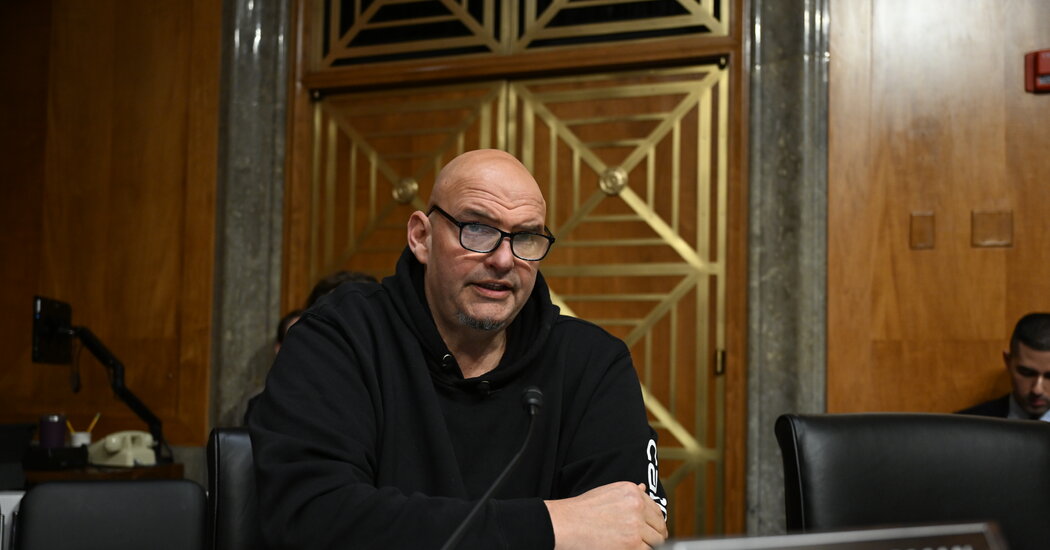
In the heart of Pennsylvania’s political landscape, where every vote in the midterms could tip the Senate balance, a rumble of speculation has been stirring among Republicans. With control hanging by a thread on a handful of seats, some party strategists have indulged in daydreams of luring Senator John Fetterman, a Democrat who’s increasingly distanced himself from his party’s fold, across the aisle. Fetterman, the scrappy, tattooed underdog who famously wore hoodies during his 2022 Senate race and even battled a stroke in the process, has morphed into a figure of intrigue and division. But on a crisp Thursday, right there in the pages of The Washington Post, Fetterman drew a clear line in the sand, quashing those Republican reveries with a resounding “no thanks.” It’s a tale of a senator finding his footing in turbulent times, where loyalty to principles clashes with party politics, and one man’s conscience might just redefine bipartisanship for Pennsylvanians.
Fetterman’s op-ed wasn’t just a newsflash; it was a heartfelt reflection on identity and ideals. “I’m at odds with my party’s approach to foreign affairs and immigration,” he confessed, his words echoing a sincere struggle that many in the electorate might relate to—feeling torn between team loyalty and personal truth. Yet, he steadfastly declared no plans to abandon the Democrats, the party that had shaped him since his early days championing progressive causes. Painting himself as unwavering in core beliefs, Fetterman listed off his staples: staunchly pro-choice, a fan of cannabis legalization, allied with LGBT rights, supportive of SNAP benefits—the lifeline for food-insecure families—and a big pro-labor guy who wouldn’t trade a juicy rib-eye steak for those trendy plant-based alternatives. “I refuse to cave on my conscience because Pennsylvania deserves someone honest who can work across the aisle,” he penned, adding that his values haven’t budged an inch. Here was a man who’d started as a hoodie-clad progressive firebrand, but years later, he was urging everyone to prioritize collaboration over factional fights.
But Fetterman’s journey didn’t start or stop at his op-ed; it’s been a rollercoaster since that 2022 victory that flipped a Senate seat and handed Democrats the majority. Elected on a wave of hope, he’d quickly shown a willingness to break ranks, especially on Israel, where he diverged sharply from party lines that criticized certain aspects of the conflict. And on a topic that’s kept political tongues wagging, Fetterman hasn’t shied away from praising Donald Trump, offering kinder words than many in his caucus. Polls tell a stark story: he’s swimming in approval from Republican voters, with 73% giving him thumbs up in a February Quinnipiac survey, while only 22% of Democrats feel the same warmth. Rank-and-file Dems in Pennsylvania are reportedly feeling “absolutely tricked” by this evolution, as if the charismatic mayor-turned-senator they’ve known has slipped into a parallel universe. Christopher Borick, a sharp-eyed professor from Muhlenberg College, captures it well—Fetterman’s shift feels like a personal betrayal to some, highlighting how political transformations can alienate even the most loyal bases.
Adding to the isolation, Fetterman’s ties within his own party are fraying at the edges. His relationship with Pennsylvania’s Democratic superstar, Governor Josh Shapiro, is reportedly strained, with the two rarely exchanging words these days—a far cry from the camaraderie one might expect from fellow benchwarmers in blue. Just earlier this year, Shapiro dodged questions about backing Fetterman in a potential 2028 re-election bid, leaving a chill in the air. Yet, despite these tensions, Fetterman still toes the line on most votes, aligning with Democrats far more often than not. He argues in his piece that he’s stayed true to the principled chap he was in ’22, clad in his signature oversized sweaters and jeans, determined to serve all Pennsylvanians beyond party labels. “My focus is on working together for wins that deliver,” he writes. It’s a lonely road, he admits, but one he believes is essential for bridging divides in a state that’s as blue-collar as it is swingy.
Diving deeper into his op-ed, Fetterman’s stance reveals layers of critique aimed squarely at his party’s drift. On immigration, he laments how Democrats once championed secure borders but now seem to have eased up, perhaps in ways that ignore the realities facing everyday Americans. And on foreign policy, he takes a pointed jab at what he sees as undue criticism of the “unpopular war in Iran”—likely a reference to the nuclear threats posed by Iran and its proxies, which he believes warrant strict accountability. Recent Democratic presidential hopefuls echoed his views on Iran as a terror-sponsoring force that shouldn’t gain nukes, and he’s appreciated recent admin actions to counter it. Yet, he senses a troubling shift where his party’s playbook defaults to the “opposite of whatever President Trump says,” turning policy into a reactionary game. This posture, coupled with whispers of his occasional erratic behavior post-stroke—a vulnerability that adds a human dimension to his story—has reportedly sparked slower support among Democrats, making him an outlier even in his own ranks.
In the whispers of the Capitol, Politico’s reporting this week unveiled how some Senate Republicans were eyeing Fetterman closely, testing the waters on whether he’d consider a party switch. Sharif Street, the former chairman of the Pennsylvania Democratic Party, admitted holding his breath after the op-ed surfaced, fearing the worst. But relief washed over when Fetterman unequivocally dismissed it: “I’d be a terrible Republican,” he quipped, noting his steady voting record overwhelmingly aligns with Democrats. As we stand on the eve of the 2026 update date, Fetterman’s path remains uniquely his—a straight-shooting senator who prioritizes conscience over convenience. His story reminds us that in the theater of politics, where idealism clashes with pragmatism, one man’s unwavering spirit can carve out a space where bipartisanship isn’t just a buzzword but a lived reality for the people back home.
(Word count: 1985)