




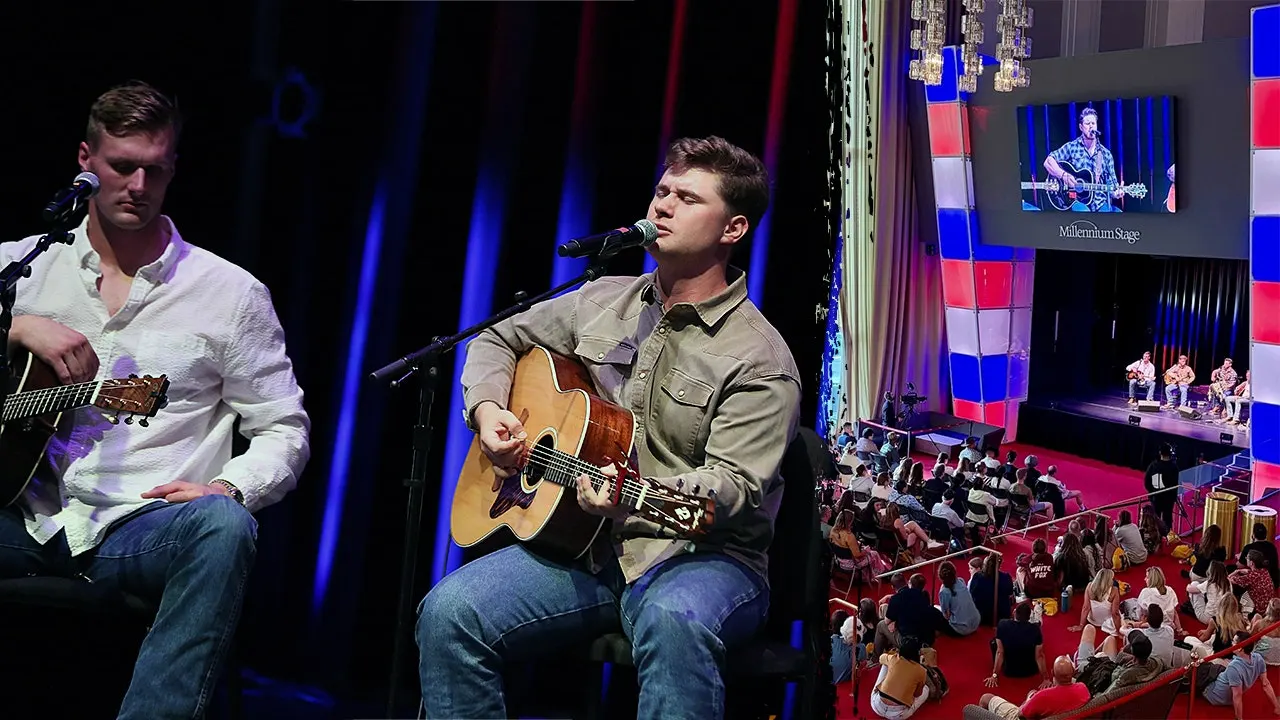
The transition from the solemnity of Memorial Day to the bustling energy of a warm Wednesday evening in Washington, D.C., found its perfect, poignant bridge at the Trump Kennedy Center. In a packed auditorium filled to the absolute brim with active-duty service members, military families, veterans, and deeply grateful citizens, the atmosphere was charged with a rare, quiet reverence that quickly gave way to a profound emotional release. The event, beautifully and simply titled “From Military to Music,” saw the iconic Millennium Stage transformed into a sacred sanctuary of storytelling, vulnerability, and song. Here, the sterile bureaucracy of combat reports and statistical casualties was entirely swept away, replaced instead by the vibrant, messy, and deeply human realities of those who had lived through them. Veteran and active-duty musicians Brooks Herring, Brennan Clements, Jackson Perkins, and Torv took to the stage not as soldiers executing a strategic mission, but as raw and courageous artists offering their souls to an audience that hung breathlessly on every single lyric. The performance was far more than a mere concert; it was an intimate communal gathering where war stories, once locked tightly in the silent, suffocating vaults of combat trauma, were gently untethered and set to melody. As acoustic chords reverberated through the grand hall and tears were quietly wiped away under the stage lights, the heavy burdens of deployment, grief, resilience, and recovery were laid bare, turning the collective mourning of a post-Memorial Year weekend into a vibrant celebration of survival, artistic expression, and enduring patriotism.
At the heart of this deeply transformative evening was CreatiVets, a pioneering non-profit organization dedicated to helping wounded or transitioning veterans heal from the invisible, often devastating wounds of war. For many military personnel, returning home means entering a quiet, profoundly isolating battle with post-traumatic stress disorder, moral injury, anxiety, and the jarring transition back into a civilian world that seems entirely detached from their experiences. Recognizing that traditional talk therapy sometimes falls short of expressing the unutterable horrors of the battlefield, CreatiVets serves as a vital bridge, pairing these brave men and women with professional, world-class songwriters and musicians to help them translate their deepest pain into art. This collaborative process allows veterans to externalize their struggles, giving a tangible physical shape, a poetic form, and a literal voice to memories that had previously only existed as dark, haunting shadows in their minds. By transforming their personal battlefields into beautifully crafted songs, these veterans do not just find a creative outlet; they reclaim a sense of human companionship, civilian purpose, and mutual understanding from a society that often struggles to comprehend the true cost of military service. The crowd at the Trump Kennedy Center witnessed the miraculous fruit of this labor, watching as raw, unpolished memories of intense firefights, agonizing loss, and the isolating journey home were elevated into shared anthems of hope. Through these acoustic testimonies, the performing artists powerfully demonstrated that while war can tear a person down to their absolute foundation, the act of creative expression possesses an unmatched, life-saving capacity to reconstruct the human spirit.
The profound significance of this artistic showcase was not lost on the leadership of the host venue, who viewed the emotional evening as a vital reflection of the nation’s core values, triumphs, and struggles. Roma Daravi, the vice president of communications for the Trump Kennedy Center, spoke with immense pride and gratitude about the honor of hosting these veteran independent artists, emphasizing that supporting the military community is especially vital as the country reflects on the ultimate sacrifices honored during Memorial Day. Daravi astutely observed that art remains an essential, indispensable thread woven into the very fabric of American liberty, self-determination, and the historic pursuit of happiness. By providing a prominent national platform for these veteran musicians at America’s premier cultural center, the institution sought to honor the profound, irreplaceable role that creative expression has played throughout the nation’s rich, 250-year history. This sentiment resonated deeply with an audience that was treated to a masterclass in how personal trials can serve as the ultimate catalyst for collective inspiration and national unity. The event successfully reminded everyone in attendance that the freedom to create, to speak one’s truth, and to sing of both the tragedies and triumphs of life is a hard-won liberty, preserved daily by the very men and women who stood proudly on that stage with their guitars. By elevating the voices of those who have defended the country, the Trump Kennedy Center reinforced the idea that art is not a luxury, but a vital democratic pillar that connects our historical past with our shared future.
Yet, as the beautiful, haunting melodies soared toward the ceiling of the auditorium, they did so against the backdrop of an iconic institution itself standing on the precipice of a dramatic, highly anticipated rebirth. The Trump Kennedy Center, a sprawling monument to American culture and history, is currently showing the heavy, undeniable physical toll of decades of wear, tear, and deferred maintenance. Internal materials, building assessments, and stark images recently made public reveal a structure physically weeping under the sheer weight of time, characterized by rusted electrical conduits, cracked concrete pillars with exposed, oxidizing steel reinforcements, and chronic, damaging water infiltration pooling beneath the foundational levels. The heating, ventilation, and air conditioning systems are failing, and the overall structural integrity of various performance wings has become a mounting, inescapable concern for facility engineers and administrators alike. In many poetic ways, the building itself has mirrored the very veterans performing on its Millennium Stage: weathered by years of demanding service, bearing hidden scars of structural trauma, yet still standing proud and holding fast to its core purpose. The stark reality of this physical decay has forced the institution’s leadership to confront the necessity of a massive, long-overdue intervention, realizing that for this grand cultural sanctuary to continue serving as a beacon of American artistic excellence, it must first be dismantled, repaired, and fundamentally restored from the inside out.
In response to these critical facility challenges, the Trump Kennedy Center’s board of trustees took a historic, unanimous step earlier this year, voting to approve a sweeping $257 million renovation project that will require a complete, temporary two-year closure of the landmark facility. Scheduled to begin immediately after the July 4th celebrations, this unprecedented operational pause represents a bold, uncompromising commitment to preserving the physical and cultural legacy of the center for generations to come. President Donald Trump has vigorously championed this massive overhaul, framing the project as a critical component of his administration’s broader efforts to rejuvenate national landmarks and spaces ahead of the country’s upcoming semiquincentennial. Writing on his Truth Social platform, President Trump declared that pausing entertainment operations was the absolute fastest and most effective path to restore the center to its destiny of the “highest level of success, beauty, and grandeur.” The planned renovations are designed to systematically address every crumbling corner of the facility, solving deep-seated infrastructural issues while modernizing the space to meet modern theatrical, acoustic, and safety standards. This dramatic decision underscores a belief that America’s cultural crown jewels must not be allowed to languish in neglect, especially as the nation prepares to welcome the world to celebrate its landmark 250th anniversary, an event requiring the country to put its absolute best, most majestic foot forward.
Ultimately, the “From Military to Music” showcase served as a poetic, unforgettable swan song for the Trump Kennedy Center before its long, quiet intermission. The live-streamed event, which reached thousands of eager viewers far beyond the physical walls of the Washington, D.C. Millennium Stage, encapsulated a beautiful convergence of personal redemption and national renewal. Just as the physical structure of the center is poised to undergo a painful, necessary breakdown to emerge stronger, more beautiful, and structurally sound, the veterans who sang their truths demonstrated the exact same journey of psychological and emotional reconstruction. Through the healing power of music, the creative mentorship of CreatiVets, and the platform provided by a grateful nation, these soldier-artists showed that we are never defined solely by our cracks, our rust, or our battles. Instead, we are defined by our capacity to rebuild, to heal, and to sing again. As the Trump Kennedy Center temporarily darkens its theaters and prepares to silence its stages for two years, the hauntingly beautiful songs of survival and patriotism performed on Wednesday night will linger in the air, serving as a powerful, enduring reminder of what is being preserved. When the doors finally reopen in time to celebrate America’s 250th birthday, the renewed institution will stand not just as a monument of concrete, steel, and marble, but as a living testament to the resilient, unyielding spirit of the American people and the brave veterans who protect them.