





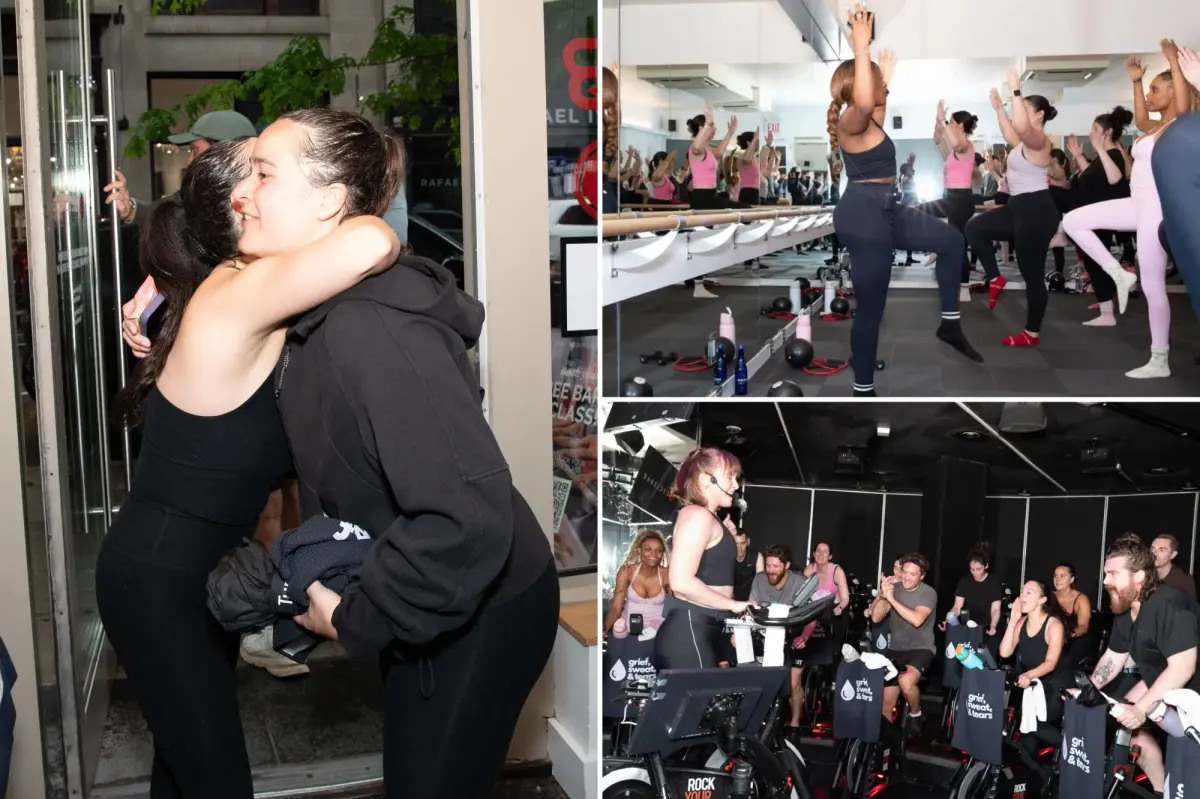
It is an exclusive, highly intimate club that absolutely no one wishes to join, yet its members are bound by a profound, unspoken understanding that transcends ordinary social conventions. This bittersweet reality became beautifully evident during a recent spring evening in New York, where approximately twenty-five men and women gathered for a high-intensity, double-header barre and spin class under the banner of an initiative called “Grief, Sweat, & Tears.” In the immediate aftermath of the grueling workout, as the participants gathered in the lobby to catch their breath, the atmosphere was thick with the familiar, humming energy of a boutique fitness studio—flushed faces, damp athletic wear, and the shared endorphin rush of physical exertion. Yet, instead of trading the superficial small talk typically heard in gym lobbies, these sweaty, smiling strangers were effortlessly diving into the deepest, darkest corners of their personal histories, exchanging stories of profound loss, traumatic passings, and the heavy weight of bereavement. For past attendee Margot Lichtenthal, who lost her father to suicide, the magic of this environment lies in its ability to break down the formidable emotional barriers that usually surround the topic of death. In conventional social settings, mentioning a tragedy often halts conversations, blanketed by awkward, pitying silences that leave the grieving person feeling utterly estranged. However, in this unique space, sharing the raw details of a loved one’s passing feels as natural and unthreatening as discussing the workout’s most challenging intervals, offering a refreshing, vital sense of genuine, unvarnished mutual comprehension that is nearly impossible to find in daily life.
To understand the necessity of such a space, one must look at the way grief isolates the individual, a harrowing reality that Lichtenthal experienced firsthand when her father passed away during the height of the COVID-19 pandemic, a period already defined by profound societal disconnection. In her desperate search for a healthy emotional outlet, she initially turned to solo hot Pilates classes, finding a fleeting sense of physical release amid the sweltering heat, yet she still returned home to a deep, echoing loneliness that even specialized bereavement support groups could not seem to soothe. Everything changed when a cousin introduced her to the pioneering concept of “Grief, Sweat, & Tears,” and though the idea of blending rigorous athletic conditioning with the delicate journey of mourning seemed highly unconventional at first, she felt an intuitive, magnetic pull to experience it for herself. The underlying philosophy of the program is remarkably simple yet deeply scientific: it initiates the healing process through a rigorous physical workout designed to systematically relieve the heavy, somatic symptoms of grief—such as muscular tension, shallow breathing, and bottled-up adrenaline—before transitioning into an open-ended, casual social hour where participants can safely connect. Lichtenthal quickly discovered that pushing her body to its limits alongside others who shared her pain unlocked an emotional vulnerability she had previously struggled to access. The physical exhaustion acted as a key, unlocking a safe, non-judgmental space where she could speak openly about her father without the conversation feeling like an overwhelmingly dramatic or somber event, proving that informal, sweaty camaraderie can be infinitely more therapeutic than traditional, sterile therapy settings.
This innovative merger of grueling physical fitness and emotional recovery is the brilliant brainchild of twenty-nine-year-old Betsy Kaplan, a public relations manager whose own life was permanently altered when her father, Joel, tragicially died by suicide in 2018. While Kaplan diligently pursued traditional talk therapy and remains a passionate advocate for its long-term benefits, she frequently found herself leaving her clinical sessions with an overwhelming buildup of physical tension, anxiety, and restless, nervous energy that words alone simply could not dissipate. She realized that while talking intellectualizes pain, the physical body still clings tightly to trauma, requiring an active, somatic release to truly process the heavy burden of sudden loss. Supported by clinical psychologists who advocate for the powerful catharsis of incorporating complex, heavy emotions into rigorous exercise routines, Kaplan began cold-calling local fitness studios to pitch her visionary concept, only to discover that her idea struck an incredibly powerful, near-universal chord within the community. Her very first event, hosted at the SLT Tribeca studio in mid-January, proved that grief is an omnipresent force hiding just beneath the surface of everyday life, as even the studio coordinators and trainers she collaborated with revealed their own deeply personal stories of loss and immediately embraced the project. Today, the initiative is expanding rapidly, with Kaplan carefully reviewing intake forms where participants share intimate details about those they have lost, managing extensive waiting lists, and fielding invitations from various fitness studios eager to host these transformative classes.
The profound necessity of Kaplan’s mission is echoed deeply by people like Jenna DeNapoli, a twenty-nine-year-old nurse and social media content creator from Long Island, who spent years grappling with the devastating loss of her father to stomach cancer in 2018. Raised in a traditional, tight-knit Italian-American household, DeNapoli was conditioned by a cultural stoicism that dictated feelings should be kept private, therapy was unnecessary, and the inevitable pains of death were simply things one had to stoically figure out on one’s own. This internalized pressure to maintain an unbroken facade only deepened her sense of isolation until she finally began sharing her raw, unfiltered grieving process on her social media platforms, which prompted an old friend to invite her to a “Grief, Sweat, & Tears” session at a local Pilates studio called the Serotonin Club. Despite her initial skepticism and a deep-seated reluctance to identify with a community defined by tragedy, the experience proved to be an overwhelming emotional breakthrough that dismantled her defenses and left her feeling deeply, fundamentally understood for the very first time. By sweating alongside peers who intimately understood the exhausting, non-linear architecture of loss, DeNapoli was able to shed the heavy armor of familial expectation and surrender to the collective healing of the space. It was a poignant reminder that while no one actively wishes to qualify for membership in the “dead parents club,” finding a community of peers who can look you in the eyes and validate your deepest silent struggles is an invaluable gift that can jumpstart a stalled healing process.
Crucially, Kaplan is quick to clarify that “Grief, Sweat, & Tears” was never designed or intended to serve as a clinical replacement for professional psychotherapy or formal psychological support groups; rather, it exists to provide a vibrant, low-pressure alternative to the sterile, often intimidating environments of traditional clinical settings. The movement’s social media presence masterfully reflects this balance, pairing empowering, life-affirming messaging with a refreshing dose of dark, self-deprecating humor—often playfully referencing the “dead dads club”—which helps to demystify, normalize, and even bring a lighthearted relief to the heavy reality of loss. There are no structured sharing circles, forced icebreakers, or mandatory psychological prompts; instead, the organic nature of the gathering allows participants to share as much or as little as they wish, often stepping forward to speak only when they feel moved by a significant milestone, such as a painful holiday or a looming death anniversary. This comforting, pressure-free structure allowed thirty-seven-year-old Anthony Martin, who lost his mother to breast cancer in 2011, to courageously share his story at an event scheduled very close to the anniversary of her passing. Despite experiencing an initial wave of anxiety about opening up to a room full of strangers, Martin found that the immediate, palpable sense of communal empathy and collective physical exhaustion provided an immense sense of relief, helping him transmute his deep-seated anxiety into a profound, grounding connection.
Ultimately, everyone who steps through the doors of a “Grief, Sweat, & Tears” event arrives carrying a heavy, deeply individualized burden of sorrow, but they leave with an entirely renewed perspective on how to carry their grief forward into their daily lives. The classes teach participants to approach their mourning more intentionally and mindfully, shifting their perspective from trying to hurriedly patch over their emotional wounds to actively learning how to expand their lives around their losses. As interest in these transformative events continues to skyrocket, with eager advocates reaching out daily to request new chapters in major metros like Chicago and Dallas, Kaplan remains deeply grounded in her core mission of fostering authentic, localized human connection. By creating an energetic, deeply compassionate space where individuals are encouraged to sweat, cry, laugh, and speak without fear of judgment, she is slowly dismantling the societal taboos that shroud death in silence and shame. The true success of the movement is not measured merely by packed class rosters or expanding social media numbers, but in the quiet, beautiful moments that unfold in the lobby after the music stops: the warm, lingering hugs shared between people who were strangers just an hour prior, the rapid exchange of phone numbers, and the organic creation of lifelong support systems born from the powerful, healing combination of shared grief, sweat, and tears.