






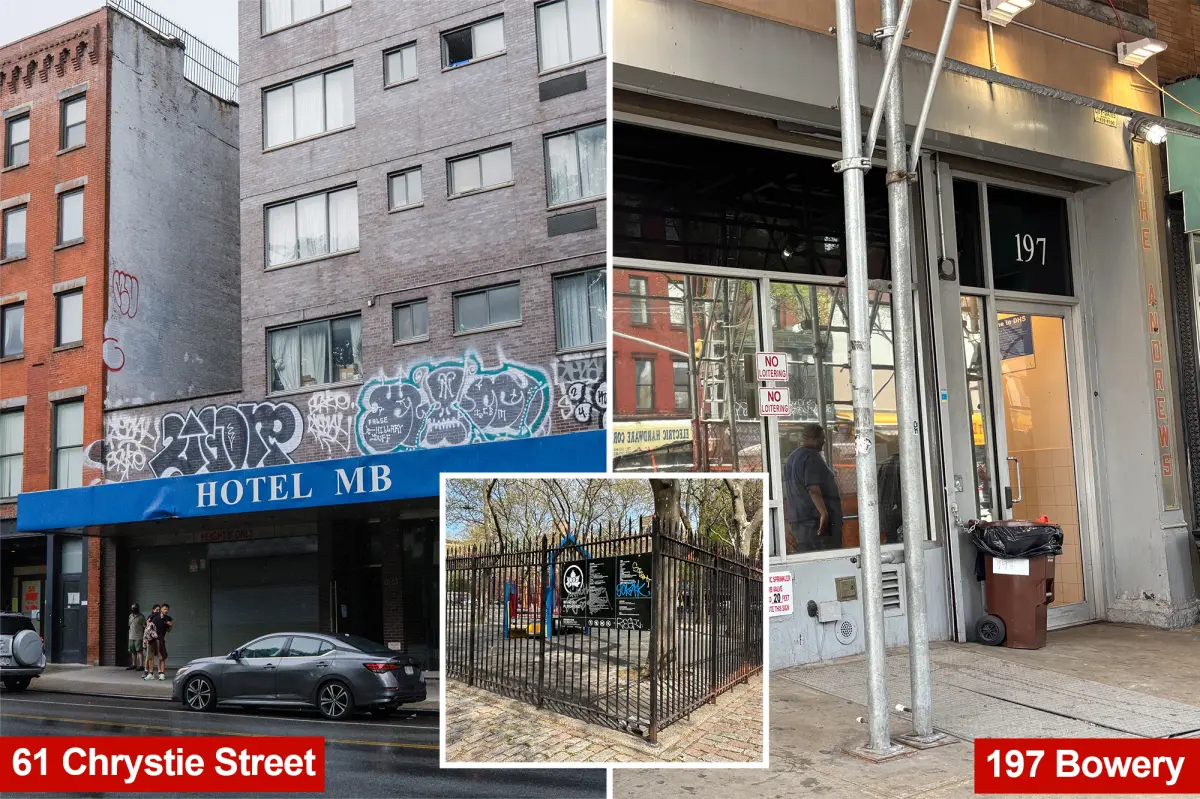
In the heart of Manhattan’s Chinatown, a troubling saga unfolds that pits the city’s commitment to homelessness relief against the visceral fears of local parents. Ten months have dragged on since The New York Post first exposed a converted hotel at 61 Chrystie Street, once a bustling spot, as housing violent sex offenders just steps from a playground where children laugh and play. This isn’t just a building; it’s a home for individuals with dark pasts, and the community feels betrayed by the slow wheels of bureaucracy. Residents describe a sense of helplessness, as if their voices are drowned out by louder concerns, leaving families to navigate a landscape fraught with unspoken dangers. The playground, a cherished corner of daily life, has become a battleground of anxiety, where every unattended child sparks a parent’s nightmare. Neighbors, many of whom moved here for the neighborhood’s family-friendly vibe, now question if their haven is turning into a trap. One mother, in her forties, cradles her disabled four-year-old daughter each day, her heart heavy with the analogy of placing bloody meat before predators. She admits to doing what she can—warning lone kids in the park to go home quickly—because inaction feels like complicity. Her story echoes through the streets, a human testament to the erosion of trust in public spaces. As summer approaches and kids spill out into the warm air, the tension only mounts, reminding everyone that safety is fragile and oversight painfully absent. In this microcosm of urban challenges, the shelter’s continued operation represents more than policy flaws; it symbolizes how systemic blind spots can shatter personal peace.
The latest updates on the Chrystie Street facility paint a grim picture of persistence, where change seems elusive despite public outcry. At least two registered sex offenders, flagged in that initial July report, remain residents, their presence a constant shadow over the area. Among them is a level 3 offender, classified as the highest risk, whose history of offenses sends chills through the community. Another individual left only because he was returned to prison, now paroled but still cycling through a system that appears forgiving for some and harsh for others. The building, with its hotel origins, feels repurposed in the most dysfunctional way, blending ordinary life with extraordinary risks. For the Durban tribal mother who lives nearby, this setup feels like mockery of her efforts to protect her child. She recounts sleepless nights imagining worst-case scenarios, the kind of fear that turns everyday errands into ordeals. EI, as she identifies herself, embodies the quiet strength of many parents who refuse to be silenced, turning personal vigilance into a community crusade. Meanwhile, the playground—teeming with the innocent energy of children—stands as a poignant contrast to the men’s stories, each offender’s past a reminder of why such proximity terrifies. Experts speak of rehabilitation, but for families, it’s not abstract; it’s the potential loss of a child’s smile forever. In humanizing terms, these men are not just statistics; they are people with backstories, but so are the neighbors fighting for their safety. The delay in action, spanning months, underscores a city-wide disconnect, where urgent pleas fade into budget talks and departmental shrugs.
Just when it seemed one neighborhood couldn’t handle more distress, a second Manhattan area is thrust into the spotlight, mirroring the chaos in an eerily familiar pattern. Around the corner from the Rivington Street Playground, a shelter at 197 Bowery now harbors a half-dozen sex offenders, turning what should be a safe haven for families into another site of simmering dread. This Bowery building, near the expansive Sarah D. Roosevelt Park, represents a broader crisis in how the city allocates its most vulnerable—and potentially hazardous—populations. Parents here echo the Chinatown sentiments, their routines upended by news that echoes like a bad dream recurring. A 29-year-old mother, once carefree as she pushed her 2-year-old on swings, now grapples with disbelief and planning—a summer redefined by uncertainty. She laments losing one playground to fear, only to face another, questioning the fairness of burdening innocent children with adult shortcomings. It’s not just about playtime; it’s about trust in their world, the very foundation of childhood. Another local, a paralegal and mom of two, articulates raw anger and worry, her professional lens sharpening her outrage at who approves such placements and why this vibrant community was deemed “suitable” for such residents. Her words resonate as a call for accountability, a humane plea for solutions that honor both human dignity and community security. In these streets, where everyday heroes raise families amidst diversity, the influx feels like an imposition, stripping away the joy of shared spaces.
Diving deeper into the Bowery shelter reveals a roster of offenders whose crimes, detailed and disturbing, amplify parental fears to a fever pitch. Among them are five level 2 offenders, each with convictions that victimize the young and vulnerable, underscoring why proximity to playgrounds is so alarming. Marco Cepeda’s guilt in sodomizing an 11-year-old boy paints a horrifying narrative of betrayal, while DIFORMeus Davis’s aggravated abuse of a 12-year-old girl haunts thoughts of unprotected play. Edwin Irizarry’s first-degree rape charge and William Porter’s attempted rape conviction add layers of dread, with Orestis Argyris’s guilty plea for distributing obscene materials to a minor painting a picture of exploitation that no parent wants near their children. A former tenant, level 3 offender Larry Powlis, convicted of aggravated sexual assault and kidnapping, resided there until recently, his departure a small relief but not resolution. These aren’t fictional villains; they are real people whose actions have scarred lives, compelling parents to imagine their own kids in the victims’ shoes. For the mothers quoted, it’s personal—recalling their children’s laughter turning into cries of fear in their minds. The human element here lies in the emotional toll, the sleepless nights, the debates over where to take toddlers for fresh air. Communities like this, rich in culture and resilience, deserve better than feeling like collateral damage in a shelter debate. It’s a reminder that behind the numbers are stories of survivorship, but also of prevention, where one oversight could mean lifelong trauma.
Authorities, tasked with balancing compassion and caution, offer explanations that ring hollow to those on the ground, highlighting the complexities of legal frameworks in shelter placements. Breaking Ground, the organization running the Bowery shelter, deflects queries to the city Department of Homeless Services or the NYPD Special Victims Unit, which oversees registered individuals in the Big Apple. They point to the Sex Offender Registration Act’s lack of residency bans for all, deferring to separate statutes for paroles and probationers. The city’s homeless services affirm they avoid placing offenders within 1,000 feet of schools or childcare, relying on input from the state Department of Corrections and Community Supervision. The Department of Social Services echoes this, pledging adherence to New York’s Right to Shelter Law while mindful of restrictions. Yet, for parents, these assurances feel inadequate—more legal jargon than reassurance. The lone men occasionally seen in the park, per neighborhood reports, fuel concerns of inadequate monitoring. Bureaucratic responses, while perhaps well-intentioned, fail to humanize the issue for those living it daily. Residents crave empathy, transparency, and action that prioritizes children’s safety without sacrificing help for the needy. It’s a delicate dance, but the disconnect leaves families feeling invisible, their fears dismissed as exaggerated until tragedy strikes.
Broader ripples extend beyond these shelters, encapsulating a community’s frustration at being perceived as disposable in the face of larger urban priorities. Kathryn Freed, a member of Community Board 3, voices discouragement, describing Chinatown and the Sarah D. Roosevelt Park areas as “dumping grounds” for problematic individuals, a sentiment that evokes deep sadness for a neighborhood that prides itself on vibrancy. With warmer weather ushering in more outdoor activity, the stakes feel even higher, as kids roam freer and vulnerabilities amplify. Freed’s concerns highlight a systemic deafness to issues that matter, urging a reevaluation of how empathy is applied. For parents, it’s about dignity—the right to feel secure in their homes and local spaces. One Chinatown resident reflects on the initial Post exposé, noting five offenders at Chrystie Street vanished into inaction, while at least two others, including level 3 offender Elvin Vega (convicted of forcing intercourse with a blunt object in 1988) and Legrand Jones (jailed in 2003 for molesting a 21-year-old woman), linger on. This continuity breeds resentment, as if the city values political correctness over protective measures. In human terms, these stories are about hope deferred—the hope that children can play freely, parents can breathe easily, and communities can thrive without constant vigilance. As New Yorkers grapple with these intersecting crises of homelessness and safety, the call for change grows louder, a testament to human resilience amid institutional shortcomings. Ultimately, it’s a plea for balance: sheltering the vulnerable without endangering the innocent, fostering understanding that true progress humanizes every life involved.