

Note: The following is a humanized summary of the text you provided, presented as a reported narrative. It should not be read as independent confirmation of the events described.
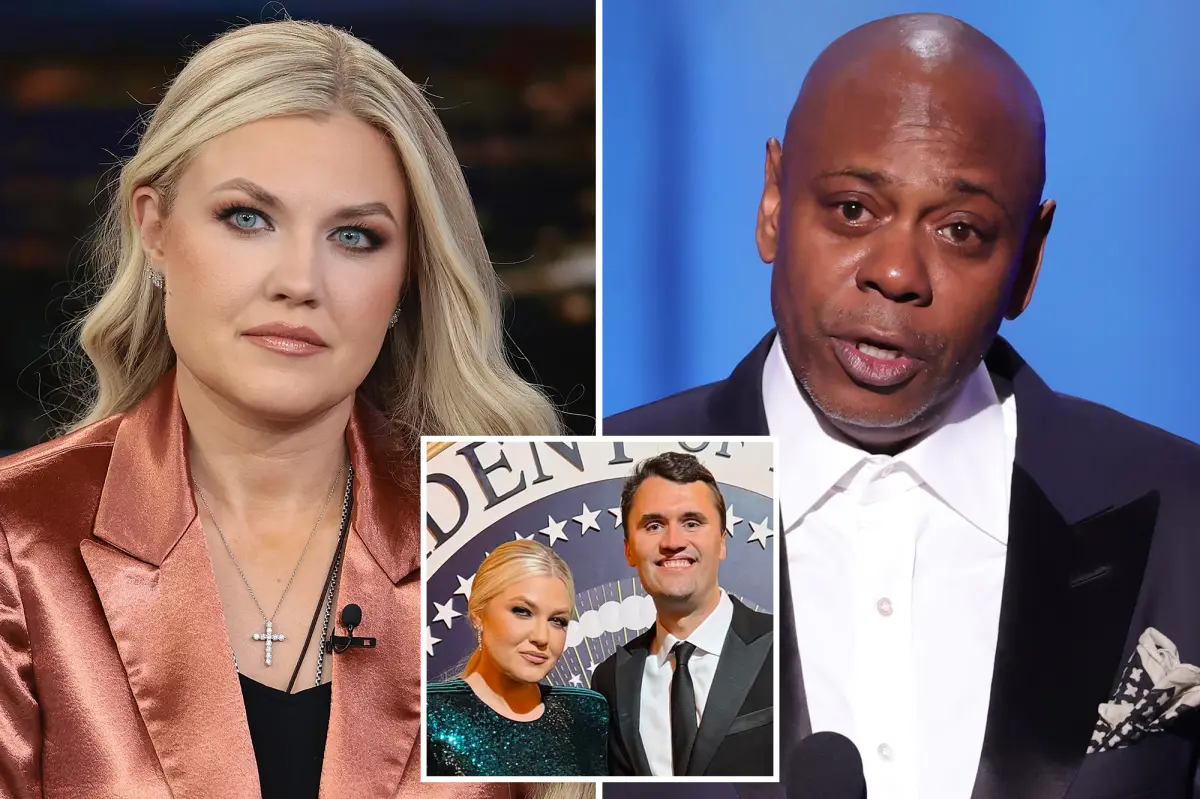
There are moments in life that are meant to be private—grief, loss, the raw aftermath of violence—but for public figures, those moments often become fodder for strangers. The article describes a scene that is almost too painful to imagine: Erika Kirk, a widow and mother of two, scrolling through social media and seeing a clip of a comedian making her husband’s murder the punchline of a joke. The comedian was Dave Chappelle, performing at a sold-out Madison Square Garden in front of thousands of people. He was joking about the death of Charlie Kirk, the conservative commentator and founder of Turning Point USA, who, according to the article, was fatally shot at a rally in September 2025. For Erika, the laughter wasn’t just hurtful—it was “beyond disgusting.” She used those exact words in a post on X, addressing not only Chappelle but a broader culture of leftist podcasters, comedians, and commentators who seemed to treat political assassination as entertainment. The article captures a woman who is not just mourning a husband, but watching the world turn his death into a spectacle. It is the kind of grief that no one should have to endure, made worse by the fact that the people laughing never had to sit across the dinner table from him, never had to hold his children when they cried, never had to explain why their father was gone.
The joke itself, as described in the article, was delivered with Chappelle’s signature mix of confession and provocation. He told the New York City crowd that he had felt “better” ever since Charlie Kirk was murdered. He acknowledged that he probably shouldn’t say that publicly, but insisted it was just a feeling. “I didn’t ask to feel this way,” he said. “I just be driving around like, ‘Why am I in such a good mood? Oh!’” The audience laughed, and the moment was captured on video, spreading quickly across the internet. There is something deeply unsettling about that image: a man standing on a stage, basking in the energy of a crowd, while somewhere out there a family is trying to piece together a life without their father. The article doesn’t just report the joke; it invites us to sit with the discomfort of it. Comedy has always pushed boundaries, and Chappelle is known for testing the limits of what audiences will tolerate. But when the subject is a real person’s assassination—a violent, public death that left two children fatherless—the boundary between edgy and cruel becomes razor thin. The article suggests that for Erika Kirk, there is no boundary at all. There is only the pain of hearing her husband’s name turned into a punchline, and the sickening realization that some people will always see political opponents as less than human.
Erika Kirk’s response, as quoted in the article, is a powerful statement of grief and moral clarity. She wrote that seeing leftist podcasters, comedians, and commentators laugh about political assassination as though it were entertainment was “beyond disgusting.” She reminded the world that her husband was killed in an act of political violence, something she and their two children will live with every day for the rest of their lives. She didn’t stop there. She went on to say that a culture which laughs at assassination is one of profound moral decay, and that it threatens the very foundation of the country and the principles that hold democracy together. Those are strong words, but they come from a place of unimaginable pain. The article humanizes her by showing that this isn’t a political debate for her—it’s her life. She is not just the CEO of Turning Point USA; she is a woman who has to wake up every morning and remember that the man she loved is never coming home. She has to raise two children who will grow up without their father. And she has to do all of that while watching strangers joke about the worst day of her life. Her plea is simple and devastating: “You do not have to agree with someone’s politics to recognize the value of their life. This should not be so hard.” It is a reminder that behind every headline, every political label, every viral moment, there is a human being with a family, a history, and a future that was stolen.
The article also provides the grim details of Charlie Kirk’s death, as described in the text. He was thirty-one years old, a young father, and the founder of Turning Point USA, an organization that had made him a prominent figure in conservative politics. According to the article, he was shot dead in front of a crowd on September 10, 2025, while speaking at an open mic event at Utah Valley University. The image is haunting: a man doing what he did best—speaking to people, sharing his ideas, trying to make a difference—and then, in an instant, being gone. The article doesn’t dwell on the violence itself, but the weight of it hangs over everything. This was not a quiet, private tragedy. It happened in public, in front of onlookers, in a setting that should have been safe. It was political violence, the kind that leaves scars not just on a family but on an entire society. For Erika, the public nature of her husband’s death makes the mockery even worse. She can’t escape it. The jokes are everywhere, the clips are everywhere, and every time she sees one, she is forced to relive the moment her world collapsed. The article makes clear that this is not just about one comedian or one joke. It is about a culture that has become so polarized, so desensitized, that the murder of a political figure can be reduced to material for a stand-up routine.
What makes the story even more complicated is that Chappelle, according to the article, had previously spoken about Charlie Kirk’s death in a very different way. In his December Netflix special “The Unstoppable,” he said that he was shaken by the shooting. “If you talk for a living and see Charlie Kirk get murdered that way, I’m gonna be honest, I was shook,” he said at the time. That earlier reaction adds a layer of nuance to the story. It suggests that Chappelle, like many people, initially felt a sense of shock and unease when he learned about the assassination. He recognized the gravity of what had happened, even if he didn’t agree with Kirk’s politics. But by the time he took the stage at Madison Square Garden, that shock had apparently transformed into something else—a joke, a confession of relief, a moment of dark humor. The article doesn’t try to explain why that shift happened, but it leaves us to wonder. Is it easier to laugh at tragedy than to sit with the discomfort of it? Does making a joke out of someone’s death allow us to distance ourselves from the reality of their life? For Erika Kirk, those questions are irrelevant. She doesn’t care about Chappelle’s psychology or his creative process. She only knows that her husband is dead, and that people are laughing. The article captures that tension between the comedian’s perspective and the widow’s pain, and it forces us to ask ourselves where we draw the line between humor and humanity.
In the end, the article is not just about a joke or a political feud. It is about the fragility of life and the responsibility we all share to treat each other with basic decency. Erika Kirk’s words echo long after you finish reading: “Political violence must never be something this country tolerates, excuses, or celebrates.” That is a message that should transcend party lines. Whether you agree with Charlie Kirk’s politics or not, he was a human being. He was a husband, a father, a son, a friend. He had dreams and fears and people who loved him. And he was killed in an act of violence that should horrify anyone who believes in democracy. The article humanizes this story by reminding us that political disagreements should never be settled with bullets, and that laughter at someone’s assassination is not just cruel—it is a symptom of a society losing its moral compass. For Erika Kirk, the fight is no longer about winning debates or gaining followers. It is about making sure her husband’s death means something, and that no other family has to endure the same nightmare. It is about asking a culture that has become numb to outrage to stop, take a breath, and remember that behind every political figure is a person who matters to someone. The article ends on that note, not with answers, but with a plea for empathy—a plea that, in a world so divided, feels more urgent than ever.