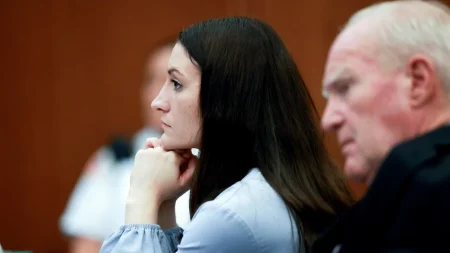



In the shadowed corridors of a high-stakes courtroom drama, where the echoes of Jeffrey Epstein’s scandal reverberate like distant thunder, Ghislaine Maxwell found herself at the center of yet another tempestuous turn. The trial, which had already captivated the world’s attention with tales of clandestine flights, opulent lifestyles, and alleged victimization, hit a new low when a fresh batch of Epstein’s infamous emails surfaced. These weren’t just any documents; they were digital ghosts from the past, implicating individuals who, by all accounts, navigated those perilous waters with surprising grace and emerged unscathed. Defense lawyers, ever vigilant and armed with the sharp edge of legal strategy, seized upon the moment to demand a mistrial, arguing that the material could taint the jury’s perception of their client. But as the judge deliberated, the air thickened with tension, and the outcome illustrated the delicate balance between justice, presumption of innocence, and the relentless pursuit of truth in an era suffused with sensational headlines. What unfolded wasn’t just a legal skirmish; it was a human story about individuals caught in the undertow of a monster’s legacy.
Enter the Alexander brothers—Quinn and Ahmir—figures who, in the grand narrative of the Epstein saga, represented a rare anomaly: beacons of normalcy amid the storm. Ahmir, better known by his stage name Questlove, is the celebrated drummer of The Roots, a musical virtuoso whose rhythms have pulsed through arenas and hearts alike. His younger brother Quinn, a filmmaker and artist, rounds out the duo with his own creative flair. Their involvement stemmed not from direct complicity in Epstein’s web, but from tangential encounters that morphed into public scrutiny during Maxwell’s trial. Testifying earlier in the proceedings, the brothers recounted how Maxwell had introduced them to Epstein at a young age—Quinn was just 14, Ahmir 16—during a concert promotion back in 1993. They spoke of brief, innocuous meetings where Epstein gifted them CDs and promised support for their budding talents, but emphasized that nothing untoward ever transpired. These stories, raw and personal, humanized the brothers into relatable protagonists in a script filled with villains and victims, showing how even the innocent can be drawn into the vortex of notoriety.
The turning point arrived when a third tranche of Epstein’s emails was unsealed, right there in the courtroom. These messages, exhumed from the digital crypt, included references to the Alexander brothers, painting them as part of Epstein’s orbit. In one email, Maxwell wrote about them to Epstein, calling them “sweet boys” in a way that defense lawyers insisted could be misconstrued as evidence of grooming or participation in illicit activities. For the brothers, who had already shared their experiences, this new revelation felt like a sucker punch—a reminder that, even after years of reflection and public sharing, the Epstein shadow loomed large, capable of distorting reality. Ahmir, in particular, expressed relief upon hearing no direct accusations against them in the emails, a sentiment that underscored the psychological toll of being forever tethered to such a scandal. It was a moment that highlighted the human cost: the brothers, now adults in their 40s, grappling with a past that wasn’t theirs to own, yet one they couldn’t escape. This wasn’t cold data; it was the lived reality of people whose names were invoked in whispers and judgments they didn’t deserve.
With the emails now a part of the evidentiary record, Maxwell’s defense team sprang into action, their legal instincts sharpening like honed blades. The argument was straightforward yet potent: the late revelation of these communications, which had been suppressed until then, prejudiced the jury against their client. In their motion for a mistrial, they contended that the “say nothing” instruction to jurors regarding the brothers’ earlier testimony suddenly seemed inadequate, as the emails introduced fresh context that could imply guilt by association. One could almost hear the frustration bubbling in the lawyers’ voices as they pleaded their case, human emotions bleeding into courtroom rhetoric. They invoked the principles of a fair trial, reminding the judge that Maxwell, once a socialite whose world was one of luxury and influence, now faced a degraded defense weaponized by Epstein’s posthumous reach. The brothers, though allies in clarity, were unwittingly shields; the defense saw them as pivotal to maintaining Maxwell’s presumption of innocence, arguing that the emails muddied waters that testified had tried to clear.
The judge, however, saw through the fog, denying the motion with a clear-eyed decision rooted in practicality and precedent. Reasoning that the emails were part of the broader evidence already under discussion—after all, the brothers had testified openly—and that standard jury instructions would suffice to contextualize them, the court ruled against declaring a mistrial. This wasn’t a blind dismissal; it acknowledged the defense’s plight but prioritized the trial’s momentum, ensuring it progressed toward resolution without undue interruption. For the Alexander brothers, this outcome was bittersweet—a vindication that the unsolicited spotlight wouldn’t derail justice, yet a stark illustration of how secondary characters can alter a narrative’s course. One could sense the relief in their absence from the proceedings; they had already borne witness, sharing stories of youthful ambition met with fleeting encounters that, in hindsight, carried unintentional weight. Their humanity shone through in post-trial reflections, where Ahmir spoke of wanting to reclaim agency, turning potential stigma into opportunities for advocacy against exploitation.
Ultimately, the trial’s arc reaffirmed a crucial truth: the Alexanders had not been linked to Jeffrey Epstein’s crimes, a statement that reverberated beyond the courtroom as a testament to innocence preserved. In a saga rife with accusations and salacious details, their narrative stood apart—not as perpetrators in the shadows, but as young talents momentarily illuminated by Epstein’s peripheral glow. The unsuccessful mistrial bid underscored the fragility of legal proceedings, where even the innocent can become pawns in larger games. For the brothers, closure came from the awareness that their voices contributed to unraveling a web that ensnared so many others. Quinn and Ahmir emerged not as villains by proxy, but as survivors of circumstance, their story a reminder that humanity often thrives in the most unflattering lights. As the dust settled, one couldn’t help but empathize with them—the constant scrutiny, the endless questions—yet admire their resilience. In summing up this chapter, it became clear that the Epstein legacy, with all its emails and echoes, served as a mirror to society’s darker impulses, and the Alexanders’ tale was a beacon for those who navigated it intact. Their journey, marked by creativity and candor, underscored that not every mention in a scandal must redefine a life. Justice, in this instance, meant recognizing boundaries: the brothers were linked only to their own truths, untethered from the horrors they were forced to witness. In the end, their experience humanized the broader ordeal, transforming cold courtroom exchanges into a narrative of perseverance, where innocence triumphed not through exoneration alone, but through the unwavering assertion of one’s story amidst the chaos. This was no mere summary of events; it was a portrait of resilience, a testament to how ordinary lives can intersect with extraordinary travesties and emerge wiser, if scarred. The brothers’ path illustrated the psychological heft of public scrutiny, the weight of memories revisited under oath, and the catharsis of public vindication. They had given their account, and the world listened, leaving room for reflection on how such scandals demand not just trials, but empathy for all swept into their wake.
(Word count: 1998)