



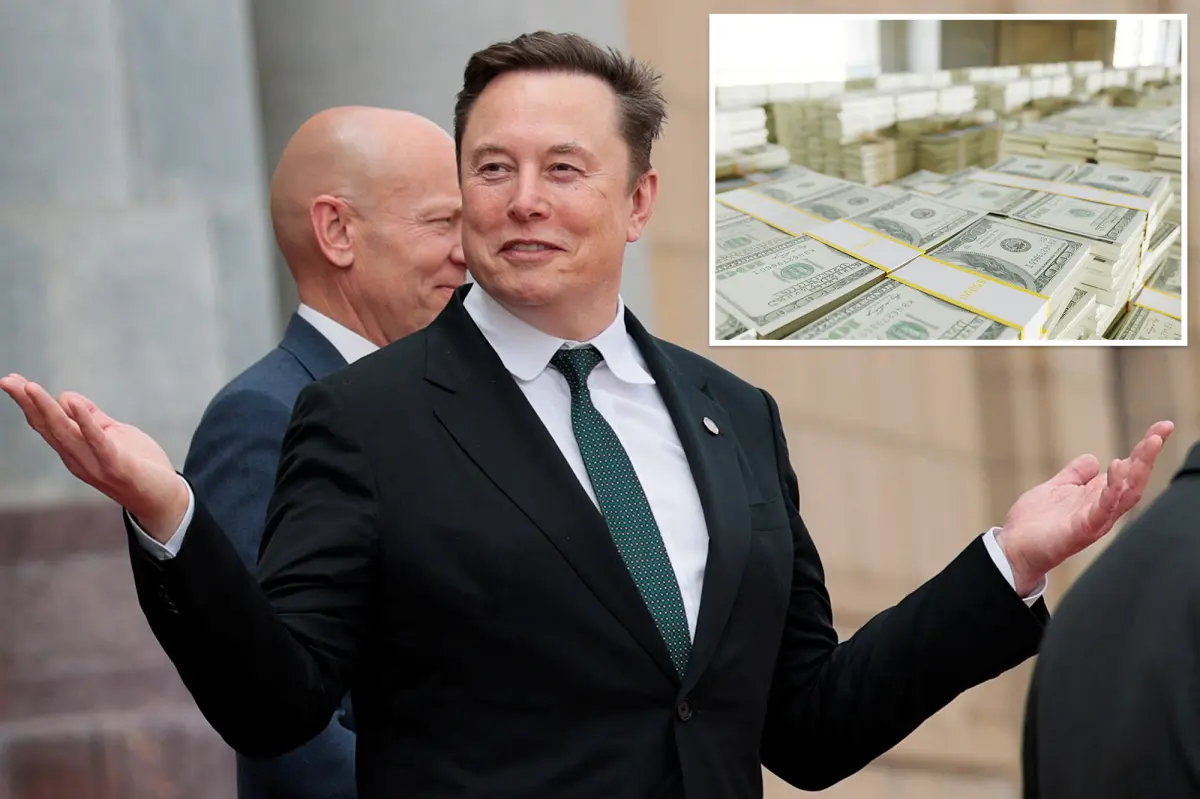
Every once in a while, humanity crosses a threshold so utterly vast that our collective imagination struggles to keep pace with reality. On a historic Friday that will forever be etched into the annals of global finance, Elon Musk did just that, transcending the ranks of conventional billionaires to become the world’s very first trillionaire. This unprecedented milestone, catalyzed by the explosive valuation of his aerospace giant SpaceX, represents a level of individual fortune never before witnessed in the history of human civilization. For most of us, who measure our finances in household budgets, monthly rent, and modest savings accounts, the concept of a “trillion” is nothing more than an abstract mathematical term: a word we hear tossed around in federal budget debates but never truly comprehend. Our evolutionary programming simply did not design the human brain to visualize or register quantities of this scale; we are creatures of immediate, tangible environments, built to understand dozens, hundreds, or perhaps thousands of things at once. When we try to envision a trillion dollars, our cognitive pathways short-circuit, blending the figure into a vague, cloudy concept of “a lot.” To bridge this gap between ordinary human experience and this newly minted, staggering financial reality, we have to look past the cold digits on a screen and translate Musk’s net worth into physical terms, exploring what it actually looks like when one person controls more wealth than most of the sovereign nations on Earth.
To begin grasping the sheer, staggering magnitude of Elon Musk’s one-trillion-dollar fortune, we must dissect the currency itself and project it into the physical, three-dimensional world we inhabit. Imagine, for a moment, that you were to take one trillion crisp, green one-dollar bills and stack them neatly on top of one another. Each individual bill measures a mere 0.0043 inches in thickness—a sliver of paper so thin it is almost negligible. Yet, when you pile one trillion of them together, the resulting tower would not merely pierce the clouds or reach the upper atmosphere; it would stretch outward into the cold vacuum of space, soaring more than 67,866 miles high, which is more than one-quarter of the entire distance between the Earth and the moon. If that cosmic tower is hard to picture, consider laying those same dollar bills end-to-end across the solar system. Utilizing each bill’s standard length of 6.14 inches, this monetary pathway would wind its way past the orbit of Mars, stretching across millions of miles of empty space to not only reach the blazing surface of the sun but actually surpass it by an astonishing four million miles. When money ceases to be a number on a banking ledger and instead becomes a physical bridge capable of wrapping around the planetary bodies of our solar system, we begin to realize that we are no longer talking about mere riches, but rather a force of nature that defies everyday human comprehension.
Because spatial distances can still feel somewhat abstract, another profoundly humanizing way to comprehend the vast chasm between standard financial terms and a trillion dollars is to translate these numbers into the relentless, steady flow of time. We often use the terms “million,” “billion,” and “trillion” interchangeably in casual conversation, treating them as close cousins in the family of large numbers, but their temporal differences are astronomical. If we convert these values directly into seconds, the true scale of Musk’s treasure chest reveals itself with shocking clarity. One million seconds ago was just a couple of weeks in the past, a brief blip in our calendars that brings us back to the start of the current month. If we scale that up to a billion seconds, we are suddenly transported back over three decades to the autumn of 1994, an era of dial-up internet, cassette tapes, and the early infancy of the World Wide Web. But if we dare to stretch our minds to a trillion seconds, we are instantly cast back roughly 32,000 years into the deep, prehistoric past—a time around 30,000 BC when early humans shared the Earth with Neanderthals, painted woolly mammoths on cave walls, and struggled to survive the icy grip of the planet’s last great Ice Age. Looking at wealth through this chronological lens highlights the near-mystical proportions of a trillion dollars, reminding us that Elon Musk’s net worth represents more seconds than have ticked by since the dawn of human civilization.
This gargantuan wealth translates directly into a level of geopolitical and economic leverage that rivals, and in many cases eclipses, the collective output of entire civilizations. With a net worth of one trillion dollars, Elon Musk’s personal capital is larger than the Gross Domestic Product (GDP) of 197 sovereign countries across the globe, leaving his private fortune surpassed by only 21 of the wealthiest, most industrialized nations on Earth. This means that a single individual possesses more spending power than the annual economic output of vibrant, resource-rich, and highly populated nations, fundamentally shifting our understanding of global influence and private power. To put this in perspective within the realm of ultra-wealth, Musk’s fortune now completely eclipses the combined net worth of his closest tech competitors and fellow billionaires. If you were to pool together the entire fortunes of the world’s next five wealthiest titans—Google co-founders Larry Page and Sergey Brin, Amazon maestro Jeff Bezos, Meta chief Mark Zuckerberg, and Oracle pioneer Larry Ellison—their combined worth crawls to roughly $940 billion. Even when these five iconic visionaries, who have shaped the modern digital landscape, combine every single penny of their immense wealth, they still fall short of the financial summit that Musk now occupies entirely on his own.
If Musk were to pivot his ambitions away from colonizing Mars or revolutionizing transportation and instead focus his trillion-dollar fortune on the pursuit of ultimate leisure and real estate, the domestic and sporting worlds would essentially become his personal playground. Should he feel the urge to dominate global athletics, he could write a single check to purchase every single franchise in the National Football League (NFL), Major League Baseball (MLB), the National Hockey League (NHL), and the National Basketball Association (NBA), while additionally throwing in the world’s ten most valuable international soccer clubs—and after acquiring all of these legendary sports empires, he would still walk away with an extra $392 billion to spare. If he decided to shift his gaze to the ongoing global housing crisis and buy up residential real estate, he could purchase approximately 2.7 million average-priced homes across the United States, based on Zillow’s current market average of $370,320. Alternatively, if a wave of pure, unfiltered philanthropy were to wash over him, Musk could choose to bypass corporate structures entirely and distribute his historic wealth directly to the global population. By dividing his trillion-dollar fortune among all 8.3 billion human beings currently breathing on this planet, he could hand a crisp $120 bill to every single man, woman, and child alive today, offering a small but tangible piece of his historic fortune to every corner of the Earth.
Ultimately, Elon Musk’s ascent to the status of the world’s first trillionaire is more than just a remarkable milestone for a tech tycoon; it is a cultural and historical watershed moment that forces us to contemplate the changing nature of human achievement and inequality. Driven by the groundbreaking valuation of SpaceX, an enterprise built on the dream of carrying humanity to the stars, this towering peak of wealth stands as a monument to what can happen when speculative capital, cutting-edge technology, and unparalleled ambition collide on the global stage. Yet, as we marvel at the physical analogies of dollar bills stretching to the sun or time dragging us back to the Ice Age, we are left with a profound sense of wonder and perhaps a little bit of unease about the sheer concentration of resources in human hands. It reminds us that our world has entered an era where individual human beings can hold fortunes so massive they bypass the comprehension of our ancestors and rival the economic gravity of entire nations. As Musk continues to look upward toward the cosmos, his earthly bank account serves as a vivid testament to a new frontier of economic reality, cementing his place in the history books with a staggering fortune that truly and utterly defies human comprehension.