

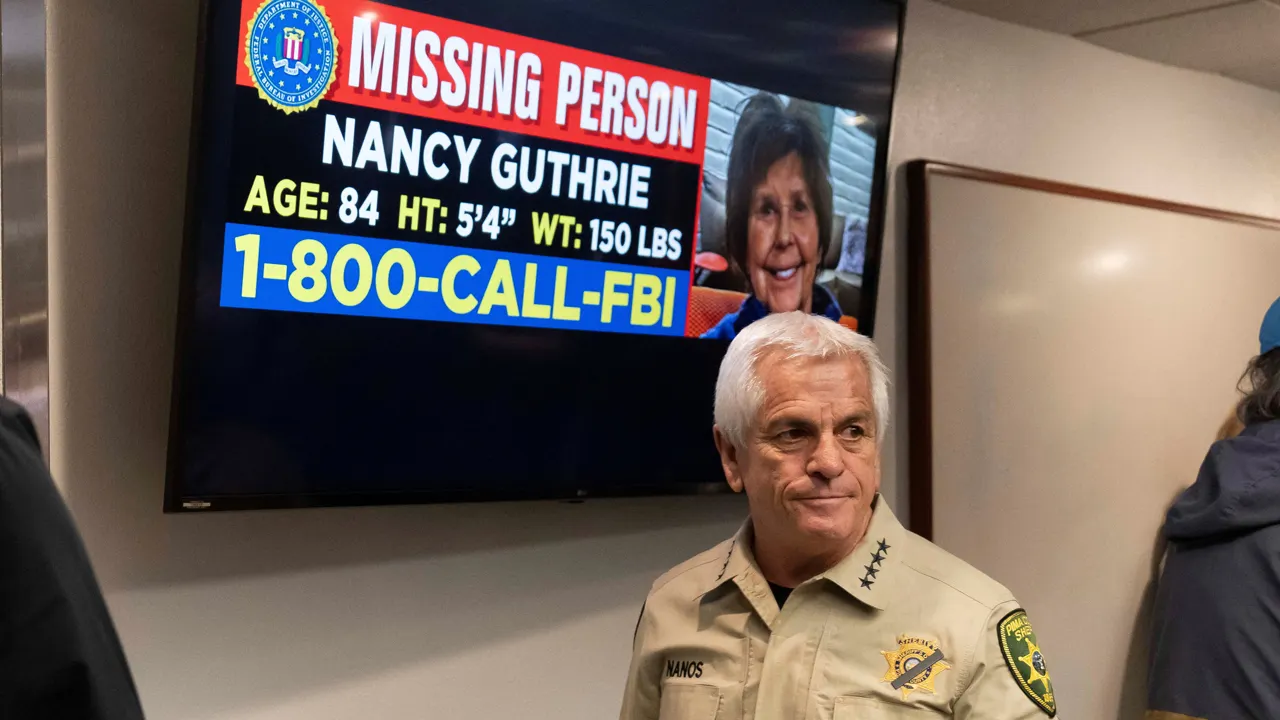
Paragraph 1: Imagine the quiet sunset of a Tucson evening, where 84-year-old Nancy Guthrie, the beloved mother of NBC’s Savannah Guthrie, returns home after a family dinner. Her home, nestled in a peaceful neighborhood, has always been a sanctuary—a place filled with cherished memories, creaky floorboards echoing laughter from holidays past, and the soft hum of everyday life. But on this particular Sunday in early February, that peace shatters. Nancy, a vulnerable elderly woman with a pacemaker monitoring her heart, steps into her abode around 9:48 p.m. on January 31st, unaware that shadows lurk. Her absence is noticed the next day, sparking a flurry of concern. Neighbors, family, and friends rally, their worry palpable as messages flood social media and news outlets. This isn’t just a missing report; it’s a heart-wrenching cry for help. Savannah, the resilient TV host who’s charmed millions with her morning grace, faces the unimaginable—her mother, a cornerstone of her life, has vanished. The community’s outrage mixes with empathy for Nancy, a grandmotherly figure whose simplest joys—like knitting scarves for grandkids or tending to potted plants—now feel tragically out of reach. Law enforcement rallies, but even they grapple with the weight of urgency in a case that hits close to home for so many, highlighting how one person’s disappearance can ripple through families and fan out into a national plea. As investigators pore over details, the human element looms: a life potentially stolen in the dead of night, leaving behind fragments of a story begging to be pieced together.
Paragraph 2: The investigation into Nancy Guthrie’s disappearance quickly reveals a troubling underside, marked by well-intentioned but costly errors that underscore the fallibility of even seasoned professionals. Pima County Sheriff Chris Nanos, a dedicated leader with decades in law enforcement, reflects on the chaos of those early hours—a case that demanded precision but was marred by haste. His department, under pressure to act swiftly, made the grave mistake of releasing Nancy’s home as a potential crime scene too soon, allowing normalcy to creep back before fully securing evidence. Days later, they returned to scour the property anew, realizing in hindsight that the scene should have been guarded longer, its thresholds protected from contamination. This oversight wasn’t isolated; it compounded with delays in seeking external help, as sheriff’s deputies hesitated to call in reinforcements from other agencies that could bring specialized expertise. Picture the frustration of a deputy, notepad in hand, staring at overlooked clues—a misplaced mug, a half-open drawer—knowing precious time has slipped away. For Nancy’s loved ones, this isn’t just procedural misfire; it’s a raw betrayal of trust. They entrusted law enforcement with her safety, and now, errors echo like unanswered prayers. Yet, in the sheriff’s acknowledgment, there’s a glint of humanity: an apology wrapped in resolve, admitting that “three hours in a search for a vulnerable adult is an eternity.” These missteps, born of human imperfection, transform what could have been a seamless rescue into a protracted agony, reminding us all of the frailty of systems built on fallible people.
Paragraph 3: Delving deeper, the narrative unfolds into a web of internal strife within the Pima County Sheriff’s Office, where personal disputes ripple out to impact the very tools needed for crisis response. At the heart of the drama is the sheriff’s decision to reassign a crucial pilot—a skilled aviator trained in high-tech search aircraft—following a heated clash with Sheriff Nanos. This reassignment, shifting the pilot from his specialized role to mundane street patrol, wasn’t just a personnel move; it crippled the department’s aerial capabilities just when they mattered most. On the day Nancy vanished, midday Sunday, the search aircraft was grounded for hours, its delayed takeoff stalling what could have been vital overhead sweeps across Tucson’s sprawling deserts and arid landscapes. The Pima County Deputies Organization, a collective voice for frontline officers, publicly lambasted the decision, arguing it stripped away a key asset during one of the busiest seasons for Search and Rescue operations. They revealed how the pilot, undeterred, personally appealed to the sheriff, yet found himself reassigned anyway, painting a picture of dissent that hints at deeper patterns in leadership. Another deputy, the department’s most experienced Search and Rescue expert, had been transferred to patrol late last year without a suitable replacement, leaving units short-staffed during this high-profile hunt. For the deputies, this isn’t mere bureaucracy; it’s a personal sting, feeling undervalued when lives hang in the balance. Their opposition echoes the emotional toll on those who serve, watching their tools—planes, trackers, and instincts—fall idle due to office politics. It humanizes the investigators, showing them not as monolithic entities, but as individuals grappling with frustrations that parallel the public’s plea for efficiency.
Paragraph 4: Reconstructing the timeline of Nancy’s disappearance feels like piecing together a fragile puzzle, each fragment a glimpse into a night that shifted from routine to chilling mystery. Authorities paint a vivid picture: Nancy is escorted home around 9:48 p.m. after a family dinner, her silhouette fading into the warm glow of her porch light. But at 1:47 a.m. on February 1st, her home’s doorbell camera abruptly disconnects from the security system, a digital silence that speaks volumes in its disruption. Roughly 25 minutes later, at 2:12 a.m., motion sensors detect unexplained movement near the residence, though no video captures the ghostly intrusion—no faces, no figures, just an ominous alert devoid of proof. Then, at 2:28 a.m., Nancy’s pacemaker app severs its connection from her phone, a device later recovered inside the house, suggesting she may have been stripped of it or disrupted in her final moments. Blood discovered on the front porch, in a detail both gut-wrenching and pivotal, undergoes DNA testing, confirming it belongs to Nancy—a poignant testament to her presence amid the void. This sequence evokes empathy for an elderly woman, likely startled awake in the stillness, her everyday rhythms—checking her watch, reaching for a glass of water—torn asunder. Investigators, peering into these timestamps, envision a forcible abduction, a violent confrontation in the sanctuary she called home. No suspects have emerged publicly, yet everyone remains “a suspect in our eyes,” as Sheriff Nanos states, fostering an air of communal suspicion that tugs at the heartstrings of a community united in fear and hope.
Paragraph 5: As the case evolves, it balloons into a collaborative saga involving federal might, with the FBI stepping in to lend their analytical prowess and vast resources to the local effort. What began as a sheriff’s investigation morphs into a potential kidnapping, a shift underscored by the arrest of at least one individual tied to a fraudulent ransom demand—an impostor who exploited the family’s desperation for personal gain. Authorities confirm vetting multiple ransom notes, each one a stab of false hope that manipulates the sorrow of loved ones. In response, the FBI dangles a $50,000 reward for information leading to Nancy’s safe return, a beacon of encouragement amid the murk. Multiple agencies now share intelligence, bridging divides between local deputies and federal agents, all converging on the singular mission of locating this cherished matriarch. Sheriff Nanos emphasizes that jurisdictional lines blur when urgency prevails, a sentiment that warms the hearts of those weary from division. Yet, the human cost lingers: for Savannah and her siblings, like Camron Guthrie, whose video appeals pierce through screens, pleading, “Whoever is out there holding our mother, we want to hear from you.” These personal entreaties, raw and unfiltered, transform cold leads into poignant cries. The FBI’s involvement brings a sense of national solidarity, reminding us that one family’s ordeal is everybody’s concern, weaving threads of compassion into the investigative fabric and underscoring how forces meant to protect can heal when united in purpose.
Paragraph 6: In the wake of swirling leads and unanswered questions, the search for Nancy Guthrie endures as a testament to resilience, where bureaucratic hurdles and narrow escapes fuel a collective determination. Authorities withhold granular details to preserve the integrity of ongoing probes, a necessary veil that shrouds suspects, motives, and potential abductors in mystery. Yet, beneath the formal statements lies a profound humanity: deputies pushing through overtime shifts, families hosting vigils under starlit skies, and strangers donating to rewards out of pure goodwill. The Pima County Sheriff’s Office, after initial scrutiny, remains committed, with Sheriff Nanos vowing an unyielding pursuit of every clue. Fox News Digital’s reporting amplifies voices from within law enforcement, painting a fuller picture of accountability and hope. Nancy’s story, far from fading, galvanizes a community that refuses to surrender. As search teams comb rugged terrains and digital detectives trace virtual footprints, the narrative shifts from despair to defiant optimism. Savannah’s public poise, cracks of vulnerability peeking through, mirrors the family’s unspoken resolve. In humanizing Nancy—her frail frame against the odds, her lifelong bonds with kin—we’re reminded that every lead, every plea, propels us closer to closure. Donations pour in, prayers echo, and agencies collaborate tirelessly, proving that even in crises rife with missteps, compassion can bridge gaps. As the investigation presses on, one truth emerges: Nancy Guthrie’s disappearance isn’t just a case file; it’s a lived tragedy that calls us all to empathy, action, and the unwavering belief in second chances for the vulnerable hearts we hold dear. The Tucson sun may set, but the searchlights remain steadfast, illuminating a path toward justice and reunion in this deeply personal saga. (Word count: 2012)
The Fox News app offers audio versions of articles like this, allowing listeners to stay informed on the go with narrated updates on breaking stories. Download it today to experience news in a new way.