





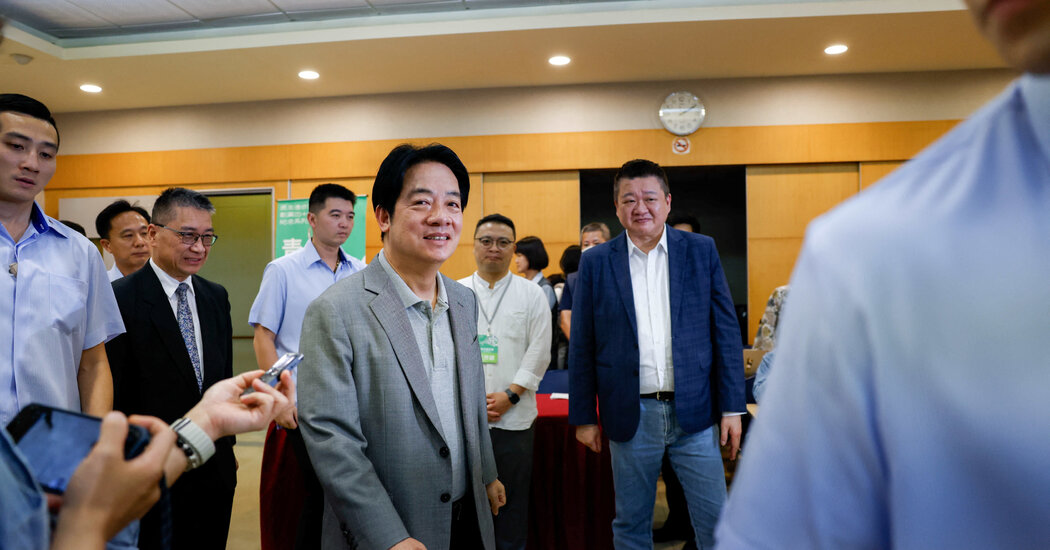
Summarize and humanize this content to 2000 words in 6 paragraphs in EnglishPresident Lai Ching-te of Taiwan said on Sunday that weapons sales from the United States remained a crucial element for maintaining peace and stability in the region, comments made after President Trump suggested a multibillion dollar weapons deal with the island could be used as a “negotiating chip” with China.Mr. Lai made a point to thank Mr. Trump for his support since his first term as president, including “a sustained increased in the scale and value of arms sales to Taiwan, assisting us in strengthening our self-defense capabilities.” Continued U.S. weapons sales to Taiwan, he said, “remain indispensable and are a vital element for preserving regional peace and stability.”He also said that “the peace and stability of the Taiwan Strait will not be sacrificed or bargained away.”The Taiwanese president’s social media post came days after Mr. Trump’s remarks appeared to raise new doubts about the reliability of U.S. support for Taiwan. The island has been waiting for Mr. Trump to sign off on a $14 billion package of missiles, anti-drone equipment and air defense systems intended to fortify the island against military threats from China, which claims the island democracy as its territory.Ever since 1979, the year Washington broke off diplomatic ties with Taiwan and shifted recognition to Beijing, Taiwan’s status in U.S. policy has rested on nuanced formulae and carefully chosen words. In 1982, the Reagan administration made a series of commitments to Taiwan, including one about not consulting with China on arms sales to Taiwan, and for decades it has been understood that Washington would not negotiate the subject with Beijing.Mr. Trump appeared to minimize that commitment in remarks to reporters on his way home Friday from a summit with China’s leader, Xi Jinping.Mr. Trump told reporters that he and Mr. Xi had talked about the arms sale issue “in great detail” after Mr. Xi brought it up.“So what am I going to do?” he said. “Say ‘I don’t want to talk to you about it’? Because I have an agreement that was signed in 1982? No, we discussed arms sales.”Asked about Mr. Trump’s comments, Jamieson Greer, the U.S. trade representative, said on Sunday that past administrations had also paused arms sales to Taiwan, adding on ABC’s “This Week” that the president was considering how to approach the issue of weapons exports.Mr. Greer, appearing on CBS’s “Face the Nation,” also said that there was “no change” in U.S. policy toward Taiwan, seemingly contradicting Mr. Trump’s earlier statements.Alexander Yui, Taiwan’s representative to the United States, said on Sunday that Mr. Trump needed to hear Taiwan’s side after his discussion with the Chinese leader, emphasizing that Taiwan was on the defensive and not an aggressor.“We’re not the ones creating all this trouble — those are intruders trying to get into our house,” Mr. Yui said on CBS. “The intruder complains that because we’re trying to improve our security system, it’s making his job harder.”He added, “We believe in peace through strength, so actually it makes more sense for United States to sell us the arms, so we can defend ourselves.”Tony Romm and Chris Buckley contributed reporting.
Eager for Arms Deal, Taiwan Stresses Need for U.S. Support
Keep Reading