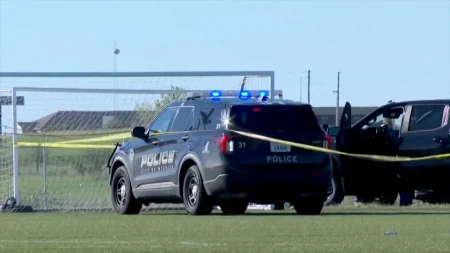


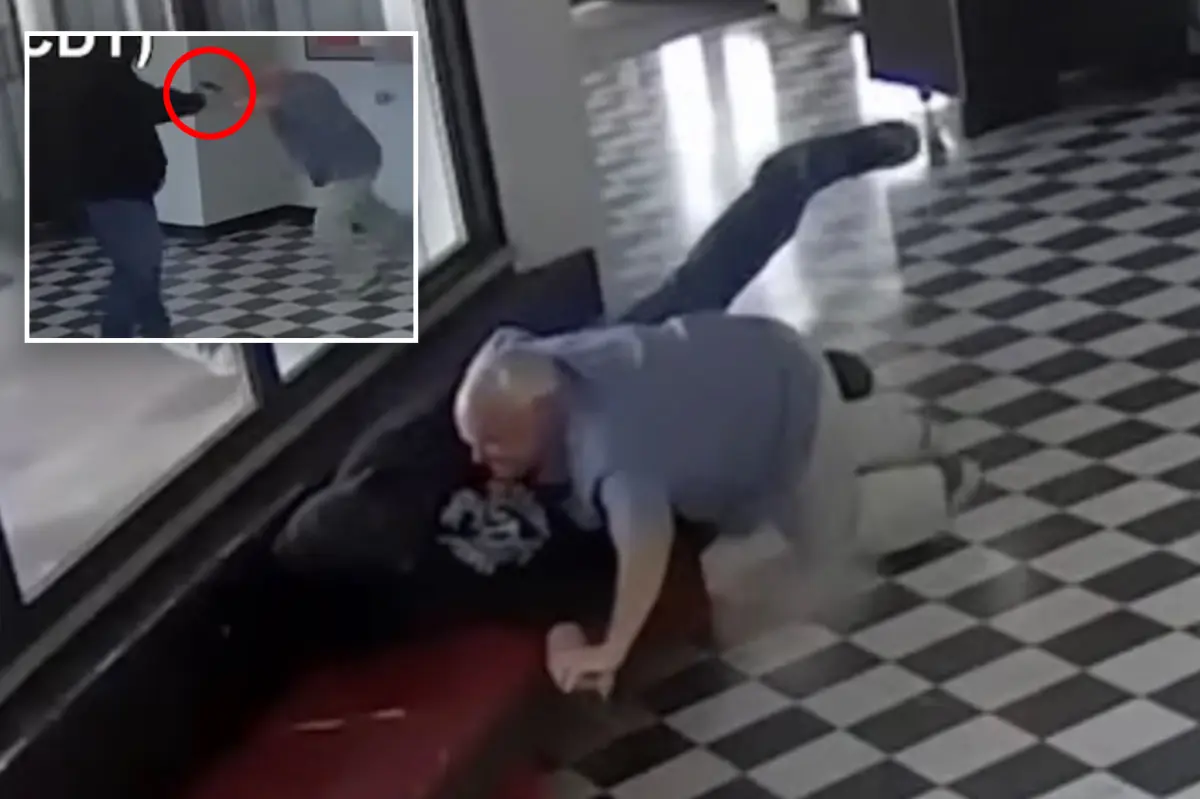
In the heart of Oklahoma’s rural landscape, where small-town values and community bonds run deep, a nightmare unfolded one Tuesday afternoon at Pauls Valley High School. It was supposed to be just another day—students buzzing with energy, hallways echoing with laughter, and teachers guiding lessons that shaped young minds. But then, the unimaginable happened: a young man, fueled by dark obsessions, stormed the school with guns in hand, targeting the very symbol of authority—Principal Kirk Moore. Surveillance footage captured the harrowing scene in the lobby, where Moore, a 60-year-old veteran educator with over 35 years dedicated to the district, charged forward like a lion defending its pride. Armed with courage alone, he tackled 20-year-old Victor Lee Hawkins, who allegedly carried two loaded semi-automatic pistols, mimicking the horrors of the Columbine massacre. This wasn’t just a heroic act; it was a father’s instinct, a mentor’s resolve, and a community guardian stepping into the breach to shield his kids from carnage.
As the footage rolled, the terror was palpable—Hawkins, a former student, ordered everyone to the ground, his voice trembling with intent. He singled out individuals, aiming first at one student who pleaded desperately, “Please, don’t!” But fate intervened; his weapon jammed, buying a precious second. Hawkins pivoted, gun trained on another terrified teen, yet before he could pull the trigger, Moore burst onto the scene. The principal had heard the commotion from down the hall—sounds of chaos that no educator ever wants to confront. He rushed in, seeing Hawkins point a pistol at one student’s head. In that blink of an eye, Hawkins fired, the bullet grazing Moore’s right leg, sending pain searing through his body. But Moore didn’t hesitate; he lunged, shoving Hawkins toward a bench and pinning him down with the force of a man who refused to let evil triumph. He grabbed the gunman’s right hand, wrestling until the pistol clattered to the floor. A bystander—a man in a red shirt and beige pants—sprinted in, helping to kick the weapon away, their teamwork a testament to ordinary people rising as heroes in extraordinary times.
Delving into Hawkins’ twisted motivations revealed a young man steeped in resentment and fascination with violence. Court documents and interviews painted a chilling picture: he harbored deep animosity toward Moore, whom he reportedly disliked intensely. “I didn’t like Principal Moore,” Hawkins confessed to investigators, his words cold and calculated, as if rehearsed from some macabre script. He had come specifically “to kill” the principal, aspiring to replicate the 1999 Columbine shooting that claimed 14 lives and scarred the nation’s psyche. He’d stolen the guns from his own father, carrying them into the school with a plan to unleash fury on the innocent. Yet, in the aftermath, stories emerged of Hawkins’ fractured life—personal struggles, perhaps unresolved anger, that drove him to this brink. It wasn’t just about guns; it was about hate festering in silence, a boy gone terribly wrong, obsessed with the infamy of mass shooters. This humanized the tragedy, reminding us that behind the monster is a person shaped by pain, who chose destruction over redemption, leaving families to grapple with the “what ifs” of intervention and hope lost.
The response from Pauls Valley’s community was overwhelming, a wave of gratitude that underscored the humanity in their unity. Oklahoma State Bureau of Investigation agent Hunter McKee couldn’t hide his admiration, praising Moore and the staff as lifesavers. “The actions of the staff and the principal stepping in as soon as they saw a subject with a firearm saved lives today,” he said, his voice carrying the weight of relief. Superintendent Brett Knight, who owed his own career to Moore’s mentorship, tearfully called him a “hero.” “He’s been a mentor to me, kinda the one who helped when I was first hired,” Knight shared with 9News, recounting memories of Moore as a guiding light amidst the unknowns of a new job. Councilman Kahn Nirschl echoed this sentiment, expressing profound appreciation: “He undoubtedly saved lives today through his actions.” These testimonials weren’t formal; they were heartfelt, peppered with personal anecdotes—from Moore’s tireless dedication to community events to his quiet wisdom in staff meetings. In that moment, the school became a family, rallying around their wounded leader, proving that even in fear’s shadow, love and bravery prevail.
Hawkins’ arrest painted a stark contrast to the heroism unfolding. Charged with shooting with intent to kill and multiple firearm offenses, he faced a May 8 court date that loomed like judgment day. Authorities detailed how he’d admitted to emulating Columbine, his plan unraveling under the weight of Moore’s bravery. Yet, beyond the legal charges, there were whispers of a troubled youth—a recent loss in his family, perhaps, with Anne Marie Hochhalter’s death in February adding to the zeitgeist of grief from past tragedies. Hochhalter, paralyzed in a shooting years ago, had passed away, her story a haunting reminder of violence’s ripple effects. Hawkins’ actions weren’t isolated; they echoed broader issues of mental health neglect and easy access to weapons. In human terms, he was a 20-year-old grappling with demons, turning to hate instead of help, while society grappled with how to prevent such spirals from claiming more lives. His confession laid bare the fragility of the human spirit, urging conversations about prevention, support, and understanding.
As the dust settled, Moore’s recovery became a beacon of hope for the shattered community. Hospitalized post-incident, he assured loved ones he was “healthy and recovering,” his resilience shining through despite the injury. Friends and colleagues visited, sharing stories of his laughter during faculty meetings or his patience with unruly students. This wasn’t just about physical healing; it was emotional, too—the principal reflecting on nearly losing his life, on the students he protected. Pauls Valley began healing collectively, with vigils, counseling sessions, and unity rallies, where people hugged tighter and spoke of change—stricter gun laws, mental health resources. Moore’s story became inspirational, a reminder that one person’s courage can ripple outward, fostering dialogue and dreams for a safer tomorrow. In the end, this incident, while heart-stopping, humanized heroes among us, urging us to cherish everyday bravery and mend the wounds of a broken world. His legacy wasn’t just in tackling a gunman; it was in inspiring a community to rise, stronger, more connected, forever grateful for the man who refused to back down.