





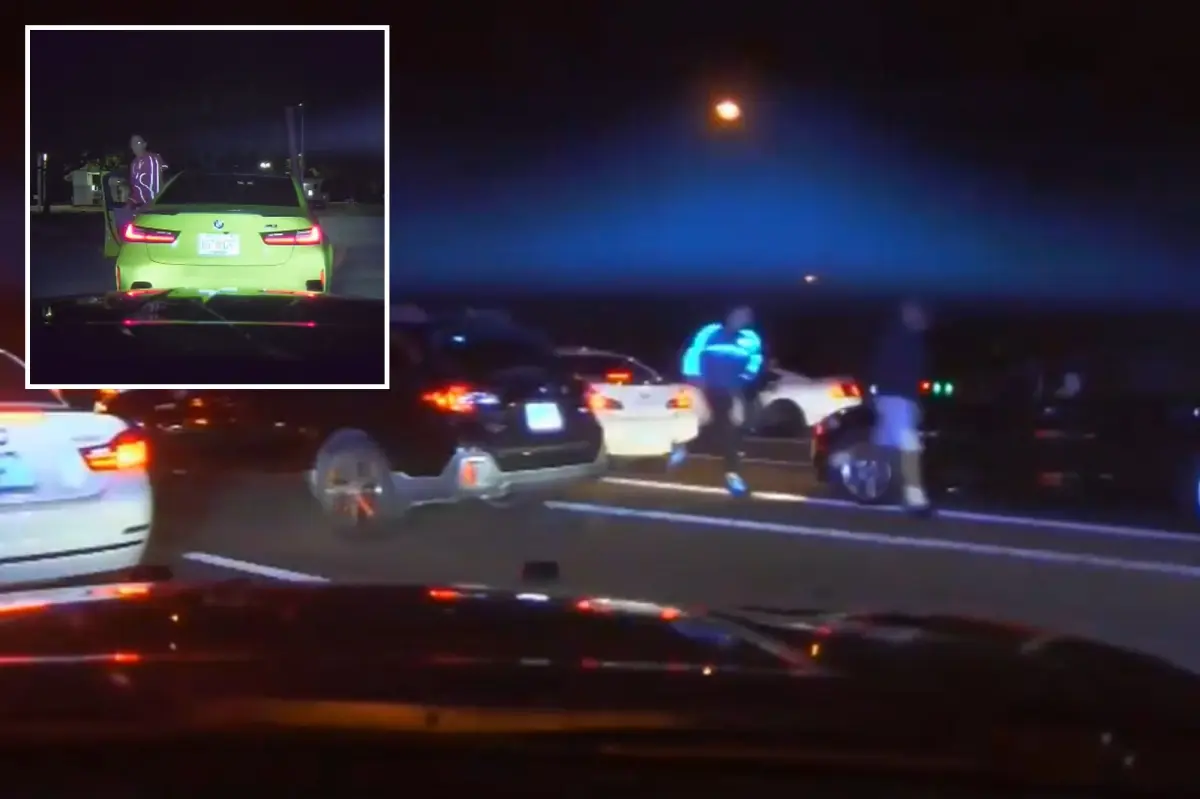
In the dead of night, when the interstate is supposed to be a quiet, predictable ribbon of asphalt carrying tired travelers, shift workers, and families safely to their destinations, Interstate 75 near Thonotosassa, Florida, was suddenly transformed into an anarchic arena of rubber and steel. At approximately 1:30 a.m. on a warm Saturday, a newly released Florida Highway Patrol dashcam video captured the terrifying, high-stakes reality of a modern law enforcement nightmare: a massive, highly coordinated street takeover. The footage opens with a lone state trooper racing down the darkened highway, the interior of the cruiser bathed in the rhythmic, anxious pulse of red and blue emergency lights while sirens wail urgently against the night wind. As the officer approaches mile marker 266, the open road abruptly vanishes, replaced by an astonishing, surreal sea of hundreds of stationary vehicles completely choking all northbound lanes of the major thoroughfare. It is a scene of utter bedlam; thick, acrid plumes of white tire smoke hang heavily in the humid night air, and headlights illuminate a chaotic, shifting crowd of young people scattered across the asphalt like spectators at an illegal colosseum. The moment the flashing lights of authority pierce through the thick haze, the festive, lawless atmosphere instantly dissolves into raw panic. Pedestrians who had been cheering on dangerous stunts begin scrambling in every direction, weaving desperately between tightly packed sedans and modified sports cars, while drivers scramble back behind their wheels and throw their vehicles into gear to escape. For the responding trooper, the initial challenge is immense and deeply nerve-wracking: navigating a heavy patrol car through an unpredictable, hostile crowd of hundreds of stopped vehicles, knowing that any sudden movement from a panicked bystander could result in tragedy, all while trying to lock eyes on the fleeing instigators who are already starting to scatter into the darkness of the surrounding Florida night.
Among the fleeing crowd, one vehicle quickly catches the trooper’s eye—a vibrant green BMW driven by 25-year-old Yulian Lugo, which aggressively weaves out of the gridlock and onto the open pavement ahead. What follows is a heart-stopping display of high-speed evasion that pushes the absolute limits of machine, asphalt, and human reaction time. As the trooper finally clears the bottleneck of the stopped crowd, he stomps on the accelerator, commencing a relentless pursuit of the sports car. Lugo, apparently desperate to avoid capture and willing to risk everything, unleashes the full horsepower of his vehicle, rocket-launching down the interstate at speeds that authorities later reported reached a staggering 140 miles per hour—about twice the legally posted speed limit. To anyone watching the dramatic dashcam footage, the sheer velocity is dizzying; the dashed white lines of the highway blur into a solid, unbroken stream, and the landscape becomes a dark, indistinct smear of trees and road signs. The trooper, possessing advanced pursuit training but still subject to the laws of physics and the terrifying unpredictability of public roads, maintains pursuit, balancing the imperative of bringing a reckless driver to justice with the overwhelming responsibility of keeping innocent bystanders safe. Every curve in the road becomes a high-stakes gamble, and every lane change carries the potential for a catastrophic, fatal collision, illustrating the immense pressure and split-second decision-making required of law enforcement in the heat of a high-speed chase. The intensity of the pursuit is palpable as the trooper communicates with dispatch, his voice steady despite the adrenaline surging through his veins, knowing that a single miscalculation by either driver could result in a horrific crash that would echo far beyond this stretch of highway.
The high-speed drama of the open highway quickly transitions into a tense, claustrophobic game of navigation as Lugo abruptly exits the interstate, plunging into the winding, quiet streets of a nearby residential neighborhood. Here, the roar of the engines and the screaming tires must have echoed violently off the facades of sleeping homes, a jarring and frightening intrusion into the suburban peace. Sensing that escape is no longer a viable option in the tight, unfamiliar residential grid, Lugo finally relents, pulling his green BMW to the side of the road and bringing the high-octane chase to a sudden, anti-climactic halt. The dashcam captures the stark shift in energy as the trooper, weapon drawn to ensure his own safety after such extreme evasion, commands Lugo out of the vehicle and quickly secures him in handcuffs. Shortly thereafter, the car’s doors open again, and three passengers—a 24-year-old and two 18-year-olds—step out into the flashing blue light, their bravado completely evaporated. Defeated and quiet, they are directed to sit on the hood of the patrol vehicle, looking like subdued teenagers caught in a serious mistake rather than the daring street racers they had emulated moments earlier. This quiet scene on the hood of a police cruiser serves as a stark humanizing moment, highlighting the sudden, cold splash of reality that awaits young people when the adrenaline of reckless behavior wears off and the severe legal consequences begin. The contrast between the chaotic, 140-mph chase and the silent, dejected surrender in a quiet suburban driveway underscores the ultimate futility of fleeing from the law. As the dust settles, the quiet of the night returns, but for the four young men sitting in the flashing police lights, the realization of what they have done begins to sink in, replaced by the grim anticipation of booking procedures and jail cells.
The aftermath of this midnight thrill ride was swift and legally devastating for all involved, serving as a harsh reminder that the law eventually catches up with those who disrupt public order. Lugo was booked into the Hillsborough County Jail on severe felony charges, including aggravated fleeing to elude and active participation in a street takeover, offenses that carry life-altering penalties, heavy fines, and the potential for significant prison time. His three passengers did not escape accountability either; each was arrested and charged with misdemeanor highway racing, ensuring that their participation in the disruptive gathering would leave a permanent mark on their criminal records and future prospects. Investigators later detailed how the entire incident had erupted, revealing that the massive blockage of I-75 was a calculated effort by hundreds of car enthusiasts who used their vehicles as physical barriers to perform dangerous burnouts and drift exhibitions in the middle of a major transit artery. This phenomenon of “street takeovers” is not merely about a love for automobiles; it is a highly coordinated, social media-fueled subculture where participants chase online notoriety and viral fame at the expense of public safety. For the hundreds of regular commuters, truck drivers, and families trapped in the resulting gridlock, the takeover was not a harmless spectacle, but a terrifying hostage situation on the highway, where they were forced to watch spinning, smoking vehicles operated by drivers with little regard for human life. The sheer disregard for the community’s well-being is what elevates these events from simple traffic infractions to serious criminal enterprises that demand a strong, uncompromising response from judicial authorities. By holding every participant accountable—not just the drivers, but the passengers and spectators who enable them—the justice system aims to dismantle the collective bravado that fuels these dangerous gatherings in the first place.
The chaotic scene on Interstate 75 is far from an isolated incident, representing instead the latest battleground in an escalating war between Florida law enforcement and a growing trend of unauthorized, flash-mob-style street events. Throughout the summer, police departments across the Sunshine State have been forced to adapt to these highly mobile, digital-first disruptions that utilize social media to organize instantly and vanish just as quickly. In June, the St. Augustine Beach Police Department managed to stay one step ahead of the curve, utilizing sophisticated electronic monitoring to detect and successfully thwart a planned “teen takeover” before it could even materialize on their scenic coastal streets, proving that proactive intelligence is key. Meanwhile, in Orlando, police previously released disturbing footage of a different kind of takeover, showing hundreds of riders on e-bikes swarming downtown corridors, blithely running red lights, blocking heavy traffic, and even recklessly delaying a responding ambulance on an emergency call. These incidents underscore a frustrating shift in youth rebellion, where public infrastructure is viewed as a personal playground, forcing municipal and state authorities to deploy extensive resources to reclaim the streets. Law enforcement agencies have vowed a continuous, aggressive crackdown, recognizing that these gatherings represent a significant public safety hazard that threatens to turn routine commutes into disaster zones. The battle is no longer just on the asphalt; it is in the digital sphere, where officers must monitor online forums and chat groups to prevent these chaotic events from endangering the public. The psychological toll on communities is profound, as residents lose faith in the safety of their local roads, wondering if their next drive home will be interrupted by a lawless blockade. This has forced a paradigm shift in policing, pushing agencies to collaborate, share intelligence, and utilize every technological tool at their disposal to ensure that public roads remain safe, open, and orderly for everyone.
Ultimately, the story captured by the trooper’s dashcam is a cautionary tale about the high cost of seeking instant gratification and social media validation. What began as an exciting, forbidden gathering of car enthusiasts ended with four young lives derailed by criminal charges, an impounded high-performance vehicle, and a community left shaken by the sheer audacity of the disruption. The human toll of these events extends far beyond those who end up in handcuffs; it affects the police officers who must risk their lives in high-speed pursuits, the taxpayers who fund the emergency responses, and the everyday citizens whose basic freedom of movement is hijacked by reckless behavior. There is a profound difference between a healthy appreciation for car culture—which historically thrived in controlled, safe environments like race tracks and organized meets—and the hostile occupation of public highways. As Florida and other states grapple with this epidemic, the images of a green BMW fleeing at 140 mph and young passengers sitting dejectedly on a police car hood serve as a powerful reminder of the fragile boundary between fun and felony, and the enduring necessity of law, order, and mutual respect on the roads we all share. It is a call to action for parents, educators, and the car community itself to steer young enthusiasts away from the dangerous allure of street takeovers and toward legal, safe venues where their passion can be celebrated without endangering lives. Only through a combination of strict law enforcement, community engagement, and a cultural shift away from rewarding reckless behavior online can we hope to bring an end to this dangerous trend. The road ahead requires vigilance, but the safety of our families and the integrity of our public highways depend on our collective refusal to tolerate such chaos, ensuring that the asphalt remains a path of connection rather than a site of reckless destruction.