

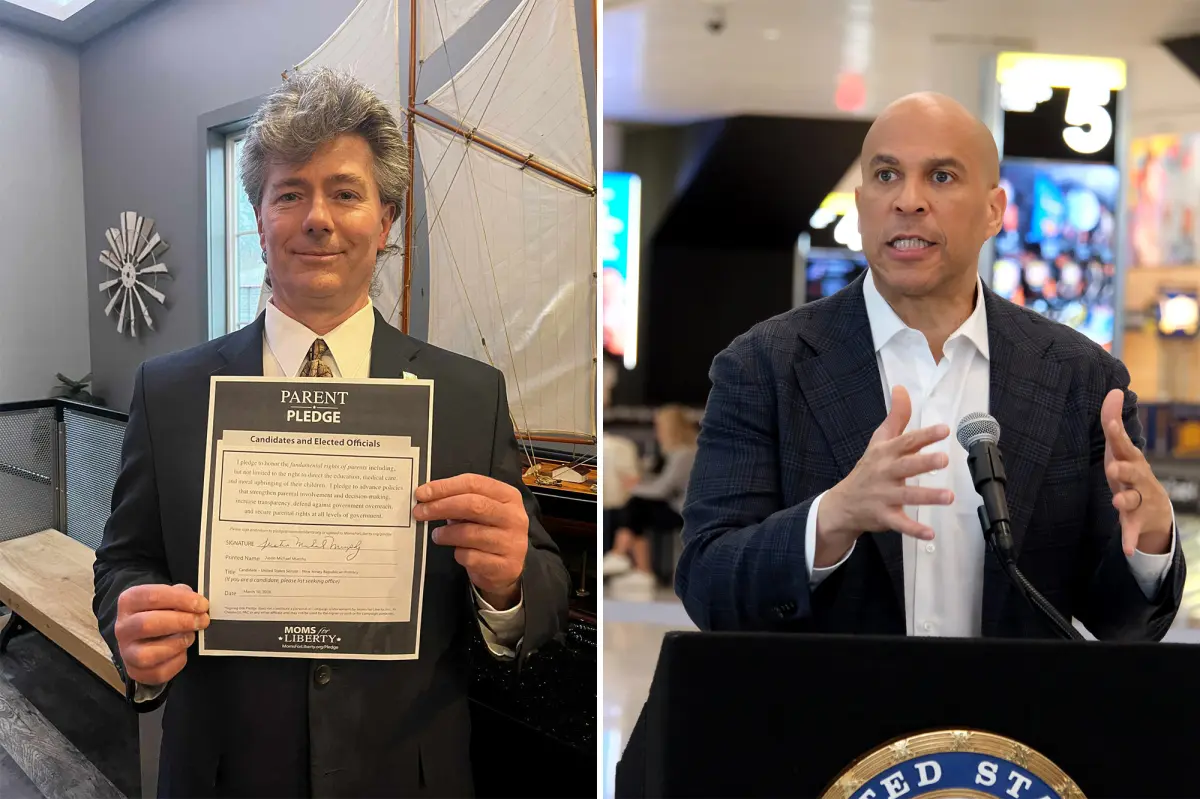
As the crisp autumn air settles over the Garden State, the stage is set for a compelling political showdown that encapsulates the contrasting visions currently vying for the heart and soul of American politics. Senator Cory Booker, the charismatic, energetic, and widely recognized titan of New Jersey’s Democratic Party, is officially embarking on his campaign for a hard-fought and highly anticipated third term in the United States Senate. Having sailed through the primary completely unopposed, Booker enters the general election arena with the formidable backing of an established political apparatus and a deeply loyal, highly enthusiastic base of supporters. Known for his trademark warmth, boundless energy, and an almost poetic rhetorical style, Booker has spent over a decade cultivating a public persona defined by empathy, civic love, and a tireless commitment to systemic reform. From his early days as a crusading mayor of Newark—where he famously lived in public housing to better understand the struggles of his constituents—to his current status as a senior statesman in Washington, Booker has championed progressive causes such as criminal justice reform, environmental protection, and economic opportunity for historically marginalized communities. For him, this upcoming election is more than just an effort to retain his seat in the Capitol; it is a vital test of his enduring political appeal and a crucial platform to showcase his leadership, especially as national commentators continue to position him as a formidable contender for the 2028 Democratic presidential nomination. Throughout his tenure, he has mastered the art of digital connection, using social media to build direct, personal relationships with younger generations of voters who crave authenticity in their leaders. Booker’s campaign is sure to be characterized by his signature style of retail politics, greeting voters with genuine warmth, shaking hands in crowded diners, and arguing that his vision of a more equitable and compassionate society is precisely what New Jersey, and indeed the entire nation, needs during these turbulent times.
In sharp contrast to Booker’s uncontested primary victory, the Republican ticket will be spearheaded by Justin Murphy, a relentless and determined challenger who clawed his way through a crowded, fiercely competitive field to claim his party’s nomination. Murphy emerged victorious from a grueling four-way primary battle, securing roughly 33 percent of the vote and outstripping a diverse array of formidable opponents, including respected surgeon Robert Lebovics, dedicated Army veteran Richard Tabor, and seasoned former television reporter Alex Zdan. This hard-won triumph represents a major personal and political milestone for Murphy, who had previously engineered an unsuccessful campaign for the 2024 Republican Senate nomination. Rather than being discouraged by past defeat, Murphy used that experience to build a more resilient grassroots network, demonstrating a gritty determination that has deeply endeared him to New Jersey’s conservative base. A devoted family man and a former member of the Tabernacle Township Committee, Murphy’s political roots are firmly planted in the communities of South Jersey, where he has long presented himself as an authentic, practical voice for ordinary working-class families who feel ignored by the political establishment. On his campaign trail, Murphy proudly dedicates his political journey to the brave men and women serving in the United States Armed Forces, expressing his profound belief that the American military is the greatest force for good in the global arena, second only to religious institutions. This combination of deep patriotism, personal faith, and a relentless underdog spirit forms the core of Murphy’s political brand, as he begins the monumental task of translating his localized popularity into a cohesive, statewide coalition. The multi-candidate race required him to spend months traveling the state, hosting town halls in firehouses and church basements, shaking hands, and building the kind of deep personal trust with voters that cannot be manufactured through television advertising alone.
At the very core of Murphy’s political message is a deeply traditional, conservative platform designed to resonate with New Jerseyans who feel increasingly alienated by the swift cultural and economic shifts of the modern era. Murphy has positioned himself as a passionate defender of parental rights in education, arguing that families, rather than state bureaucrats, should have the final say in the moral and intellectual development of their children. His policy stances are sharp and uncompromising; he stands as a vocal opponent of the legalization of marijuana and other recreational drugs, voicing concerns about the societal costs, public safety risks, and the impact of substance abuse on local communities. When it comes to immigration, Murphy advocates for the “aggressive deportation” of criminal migrants, a stance that aligns him with national efforts to enforce stricter rule of law and secure the nation’s borders from systemic vulnerabilities. On the global stage, he views China as the preeminent geopolitical and economic threat facing the United States, urging policies that decouple critical supply chains and protect American intellectual property. Economically, Murphy’s vision is heavily inspired by the populist themes of Donald Trump’s movement, particularly through his enthusiastic support for boosting domestic oil and gas production to achieve energy independence, lower utility bills, and stimulate the manufacturing sector. By framing these complex policies through the lens of kitchen-table anxieties—such as the rising cost of groceries, public safety in suburban neighborhoods, and the preservation of traditional values—Murphy seeks to present himself as a common-sense protector of the American Dream, offering a stark ideological alternative to the state’s progressive status quo. He speaks frequently about the financial burdens placed on small business owners who must navigate complex state regulations, promising to fight for a deregulatory agenda that unleashes true economic potential for all citizens.
Despite Murphy’s unwavering passion and the ideological clarity of his campaign, the stubborn mathematical and demographic realities of New Jersey’s electorate present a mountain that will be exceptionally steep to climb. The Garden State has a well-earned reputation as a reliable bastion for the Democratic Party, a status underscored by the authoritative, nonpartisan Cook Political Report, which confidently classifies Booker’s Senate seat as “solidly Democratic.” This assessment is rooted in raw data: roughly 38 percent of all registered voters in New Jersey are formally aligned with the Democratic Party, while registered Republicans account for just 25 percent of the electorate. This 13-point registration deficit leaves the remaining 36 percent of unaffiliated voters as the ultimate arbiters of the state’s political destiny, though historical voting patterns suggest that these independent voters frequently tilt leftward during high-tension federal elections. This progressive lean was vividly illustrated in the 2024 presidential race, where New Jersey voters comfortably backed Vice President Kamala Harris over Donald Trump, and again in the 2025 gubernatorial contest, where Democrat Mikie Sherrill successfully held off a spirited challenge from Republican Jack Ciattarelli. Additionally, running a statewide campaign in New Jersey requires navigating two of the country’s most expensive media markets—New York and Philadelphia—putting an immense fundraising burden on any challenger trying to build name recognition. For Murphy to overcome these structural, financial, and demographic hurdles, he must execute a flawless campaign that not only mobilizes his conservative base to historic levels but also commands the attention and trust of a vast majority of independent suburbanites, a challenge of Olympian proportions in today’s highly polarized environment. Furthermore, the state’s diverse population requires a nuanced approach to campaigning, as urban centers, sprawling suburbs, and rural farmlands all have highly distinct priorities and concerns that must be addressed simultaneously.
To truly appreciate the monumental scale of the uphill battle confronting Justin Murphy, one must look back at the historical record of New Jersey’s political representation, which reveals an incredibly long drought for the state’s Republican Party. Astoundingly, the voters of the Garden State have not sent a Republican to the United States Senate since 1972, when the moderate and respected Clifford Case won his final term in office. Over the course of the subsequent five decades, a continuous succession of energetic and well-funded Republican challengers have stepped forward, only to see their aspirations dashed against the state’s formidable alignment of diverse urban centers and highly educated, increasingly progressive suburban counties. This historical shift is particularly striking when one considers that the leafy suburbs of North and Central Jersey were once the proud heartland of moderate northeastern Republicanism; however, over the decades, these critical voting blocs have steadily drifted into the Democratic column, turned off by the national GOP’s conservative evolution. This fifty-year dry spell has created a psychological hurdle as much as a structural one, fostering a sense of voter inertia that makes a Republican victory seem almost unimaginable to many state political observers. Booker himself has been a direct nominee and beneficiary of this entrenched status quo, cruising to victory in his 2020 re-election bid by a walloping 17 percentage points, demonstrating the deep-seated comfort level that New Jerseyan voters have developed with his leadership. For Murphy, then, this campaign is a fight against the very momentum of modern history, requiring him to persuade a skeptical, habit-bound electorate that the time has finally come to shatter a half-century-old political paradigm. This historical context changes the nature of the race from a simple political campaign into a profound cultural struggle over the identity of the state itself.
As the campaign enters its final, high-velocity stretch leading into November, the contest between Cory Booker and Justin Murphy will offer voters a fascinating, high-contrast study in leadership, values, and the direction of the country. For Senator Booker, the coming months are an invaluable opportunity to reinforce his deep connection with his home state, demonstrating that his lofty national profile has never distracted him from the immediate, everyday needs of his New Jersey constituents. Whether he is advocating for federal infrastructure funding to repair aging transit networks or pushing for localized economic developments, Booker will look to secure an overwhelming mandate that validates his progressive worldview and keeps his potential 2028 presidential aspirations burning bright. Conversely, for Justin Murphy, this race is a defining moment to prove that a passionate, populist message centered on faith, family, and economic freedom can cut through historical partisan alignments, especially during a time when many families are feeling the pinch of inflation and economic uncertainty. The campaign trail will witness a dramatic contrast in styles: Booker’s slick, practiced charisma and optimistic message of unity versus Murphy’s energetic, blunt-talking grassroots appeal to patriotic values and conservative principles. As both men tour the state’s diverse landscapes—from the crowded shores of Cape May to the dense urban neighborhoods of Hudson County—they will be engaging in the most fundamental, human element of our democratic system: looking voters in the eye, hearing their struggles, and asking for their sacred trust. Ultimately, when New Jerseyans step into the voting booths this November, they will be doing far more than selecting a representative for Washington; they will be making a profound statement about their collective identity and deciding which vision of the American dream will guide them into the future. In an era often marked by intense division and political exhaustion, this election offers a vital reminder of the power of the individual vote.