



In the high-stakes, pressure-cooker environment of American politics, the dividing line between a candidate’s public service and their deeply private struggles is often obliterated by the relentless demands of the 24-hour news cycle. In Maine, this harsh reality has crashed down upon Graham Platner, the presumptive Democratic nominee for a pivotal Senate seat, whose fiery, progressive campaign had assumed the mantle of a genuine grassroots movement. For months, Platner’s supporters viewed him as a beacons of hope—a battle-tested veteran capable of toppling the formidable, moderate Republican incumbent, Senator Susan Collins, in a state that has historically prized independent-minded leaders. Yet, the momentum of this idealistic crusade has suddenly slammed into a wall of deeply personal revelations regarding Platner’s private life, specifically his history of exchanging sexually explicit messages with multiple women outside his marriage. These disclosures have transformed what was once a triumphant march toward Capitol Hill into a messy, agonizingly public drama about marital infidelity, trust, and the heavy psychological toll of war. As the details of his past indiscretions have spilled out of the private sphere and onto the front pages of national newspapers, they have triggered a profound wave of anxiety throughout the Democratic Party, forcing allies and opponents alike to grapple with the uncomfortable relationship between a politician’s moral character, their mental health, and their fitness to hold office.
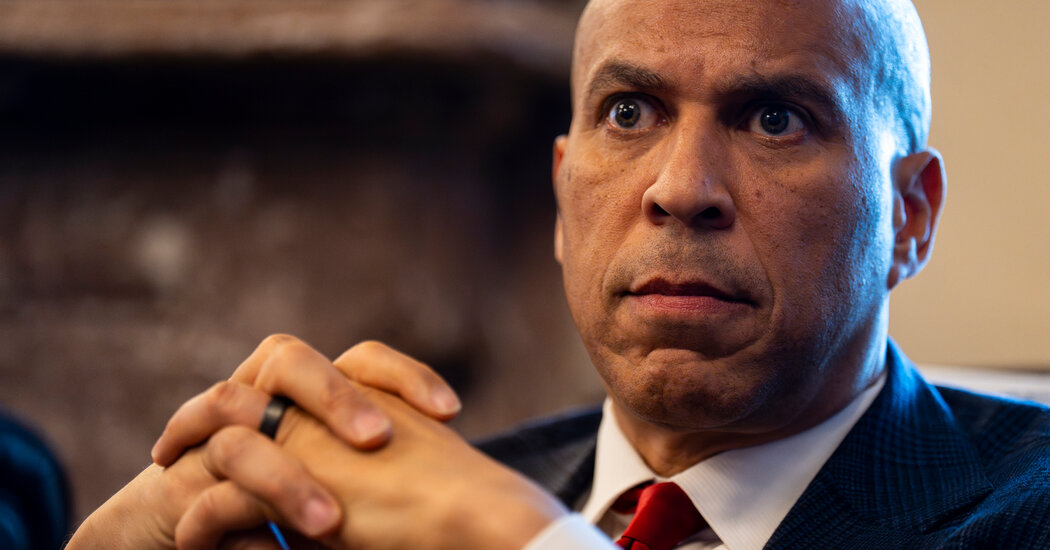
The political fallout from Platner’s personal crisis reached a boiling point on Sunday morning, when some of the Democratic Party’s most prominent national figures were forced to confront the scandal on live television. Senator Cory Booker of New Jersey, a former presidential contender widely viewed as a future leader of his party, did not mince words when asked about the situation on ABC’s This Week. With the control of the United States Senate hanging in a delicate balance, Booker confessed to having serious “concerns” that the messy revelations about Platner’s personal conduct could severely damage their chances of winning this crucial seat. For Booker and his colleagues, the stakes of the election could not be higher; he argued passionately that the country desperately needs a robust legislative check on what he described as an “out-of-control president” whose economic policies are actively driving up the daily costs of health care, child care, and gasoline for working-class families. Yet, despite the urgency of the progressive legislative agenda, Booker made it clear that Platner cannot simply bypass the controversy, asserting that the candidate “has questions to answer” and that the grueling crucible of a political campaign is precisely where those tough answers must be demanded. This public display of unease from a heavyweight like Booker highlighted a growing fracture within the party, contrasting sharply with the cautious silence of Senator Andy Kim of New Jersey—who quietly distanced himself by stating he had never met Platner and would respect the eventual will of Maine’s voters—and the passionate defense offered by Senator Chris Murphy of Connecticut. On CBS’s Face the Nation, Murphy fiercely championed Platner’s character, urging voters to remember that the candidate is a decorated combat veteran who has suffered from Post-Traumatic Stress Disorder (PTSD) after putting his life on the line for his country. Murphy pleaded for empathy, arguing that while Platner had obviously made serious mistakes, the race in Maine remained a clear-cut choice between a flawed but honorable patriot who has dedicated his life to protecting others, and an opponent dedicated to protecting partisan corruption.
At the very heart of this political storm lies a deeply intimate story of a marriage trying to survive under the unforgiving glare of the national spotlight. The public controversy originally erupted after reports surfaced that Platner’s wife, Amy Gertner, had previously approached the campaign’s political director, Genevieve McDonald, to express her deep fears that her husband’s secret interactions with other women would eventually destroy his political ambitions. McDonald, who served with the campaign until October, revealed that Gertner had confessed to her that Platner had exchanged sexual messages with as many as a dozen women, a devastating secret that she feared would inevitably become a massive political liability. While current campaign officials have sought to downplay the scale of the infidelity, acknowledging communications with up to six women and emphasizing that all such behavior had ceased entirely before the official launch of the campaign, the exposure of these private struggles has laid bare the immense strain placed on political families. Yet, rather than retreating in silence or reacting with anger, Amy Gertner chose to confront the scandal head-on by releasing a deeply personal, direct-to-camera video message to the public. In her raw and emotionally honest address, Gertner fiercely defended her husband and condemned the media’s focus on their private difficulties, delivering a powerful defense of marriage as an imperfect, evolving partnership. “No marriage is perfect, and I don’t want a perfect marriage,” Gertner declared with quiet defiance. “I want my marriage, and I want to be married to Graham.” Her willingness to publicly embrace her husband’s vulnerability, while acknowledging the messy reality of their relationship, added a profound layer of human complexity to a narrative that political operatives had sought to reduce to a simple, black-and-white scandal.
To fully comprehend the human dimension of Graham Platner’s struggle, one must examine the profound psychological scars carried by many of the nation’s military veterans. Long before he was a political candidate, Platner was a soldier who stood in harm’s way, experiences that left him with a severe diagnosis of PTSD—a condition that Senator Murphy emphasized as a crucial context for understanding the candidate’s life story. The transition from the battlefield to civilian life, let alone into the ruthless arena of a statewide political campaign, is fraught with immense mental health challenges that are frequently misunderstood by the general public. For many veterans, the invisible wounds of war manifest in self-destructive behaviors, a desperate struggle to find coping mechanisms, and deeply fractured personal relationships. While a diagnosis of PTSD does not excuse personal misconduct or the betrayal of marital vows, it does offer a vital window into the complex, often turbulent psychological landscape of a man who spent years defending his country only to find himself fighting a secondary, internal war at home. By thrusting Platner’s mental health struggles into the center of the political debate, the campaign in Maine has raised challenging questions about how society views veterans who run for public office. It forces voters to decide whether a candidate’s struggle with the psychological aftermath of military service should be met with compassion, understanding, and a belief in redemption, or if those very struggles make them too vulnerable to withstand the ruthless pressures of high office.
The weaponization of Platner’s private life by his political opponents highlights the clinical, often heartless mechanics of modern campaign strategy. As soon as the damaging reports were published by The New York Times and The Wall Street Journal, the campaign arm of the Senate Republicans immediately seized upon the news, aggressively circulating the stories to paint Platner as a hypocrite unfit for public trust. For the Republican establishment, these revelations provided a golden opportunity to protect Senator Susan Collins, a moderate Republican survivor of many political battles who is running in a state that Donald Trump lost by seven points in 2024. In the calculus of national campaigns, personal pain and marital strife are quickly reduced to political ammunition designed to alienate swing voters and suppress base turnout. The cold efficiency with which the opposition transformed a family’s private healing process into a series of attack ads serves as a stark reminder of why so many qualified individuals choose to avoid public service altogether. For the staff members within the Platner campaign, who had watched their candidate build a passionate progressive movement based on economic justice and authentic representation, the sudden shift from policy debates to crisis management has been both exhausting and demoralizing. They have been forced to navigate the incredibly narrow path between defending their candidate’s human right to personal growth and redemption, and answering the legitimate, hard-nosed questions of voters who demand high ethical standards from their elected representatives.
Ultimately, the destiny of Graham Platner’s campaign will not be decided by national party leaders, talk-show pundits, or opposition researchers, but by the voters of Maine, who are now tasked with weighing a candidate’s public promise against his private flaws. Maine has a long, proud history of resisting national political trends and valuing authenticity, independence, and resilience above raw partisan loyalty. As voters head to the polls, they will have to decide whether Platner’s progressive vision for checking an out-of-control presidency and fighting for lower costs of living outweighs the disappointment of his personal conduct. His story is a poignant, cautionary tale about the immense demands of the modern political stage, where the pursuit of power often demands the sacrifice of personal privacy and the public dissection of a family’s deepest vulnerabilities. Whether Platner can rebuild the trust of the electorate and channel his personal struggles into a message of shared human resilience remains to be seen. In a political system that is increasingly polarized and unforgiving, his race stands as a critical test of whether there is still room in American public life for redemption, or if the mistakes of a person’s past will always overshadow their capacity to serve.