



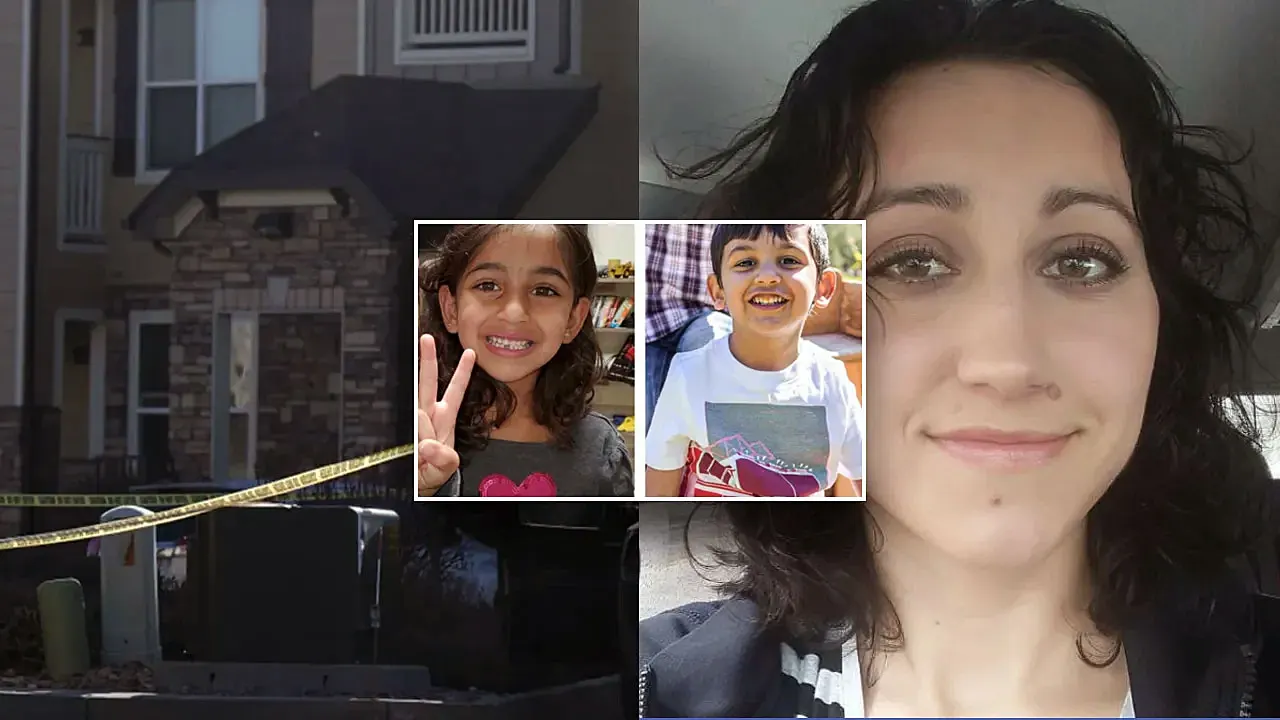
A Mother’s Tragic Journey: Kimberlee Singler’s Murder Case Unfolds
In a case that has shocked communities across two continents, 37-year-old Kimberlee Singler has been extradited from the United Kingdom to Colorado to face murder charges in the deaths of her two young children. The December 2023 tragedy, which authorities describe as “unthinkable” and “heart-wrenching,” involves allegations that Singler drugged and killed her 9-year-old daughter and 7-year-old son while also injuring her 11-year-old daughter during what prosecutors believe was a custody dispute. Colorado District Attorney Michael Allen recently announced Singler’s return to U.S. soil during a press conference, calling it a “momentous day” in the pursuit of justice for the young victims. The mother now faces multiple charges, including two counts of first-degree murder, with her first court appearance scheduled in the coming days.
The case took a complex turn when Singler initially reported the incident as a home invasion. She told police that an unknown man had broken into her apartment and committed the violent acts, positioning herself as another victim of the attack. Her surviving 11-year-old daughter initially supported this version of events, leading investigators to initially treat Singler as a victim rather than a suspect. However, as the investigation progressed, the daughter changed her account, contradicting her mother’s story. This revelation, combined with physical evidence gathered at the scene, shifted the focus of the investigation directly to Singler. When police later attempted to arrest her based on this new evidence, she had already fled the country, triggering an international manhunt that would eventually lead authorities to an upscale London neighborhood where she was apprehended on December 30, 2023.
Colorado Springs Police Chief Adrian Vasquez has described the extradition as a “significant milestone” in a case that has deeply affected the community and the officers involved. “Crimes as horrific as this are simply heart-wrenching,” Vasquez stated during the announcement of Singler’s return. “They’re just simply sad. No person, much less a child, should ever have to go through something like this.” The emotional weight of the case was evident in the police chief’s comments, reflecting the profound impact that crimes against children have on even seasoned law enforcement professionals. The investigation revealed disturbing evidence that contradicted Singler’s burglary claim, including spent rounds, a blood-stained knife, and empty bottles of sleeping pills discovered in a trash can at the residence. Perhaps most heartbreaking was the discovery of the two deceased children in bed together, a scene that has undoubtedly left an indelible mark on the investigators.
The international aspects of this case added layers of complexity to the pursuit of justice. Both the Federal Bureau of Investigation and Colorado Springs police traveled to London to coordinate Singler’s apprehension after she fled the United States. Following her arrest in the UK, Singler fought vigorously against extradition, maintaining her innocence despite the mounting evidence against her. Her legal team presented arguments based on European human rights laws, contending that Colorado’s mandatory sentence of life without parole for first-degree murder convictions would violate these protections. This legal strategy highlighted the tensions that can arise when different judicial systems with varying perspectives on criminal punishment intersect in international cases. Despite these efforts, a UK judge ruled in January 2025 that Singler could be extradited to the United States to stand trial, and her subsequent appeal was denied last month, clearing the way for her return to Colorado.
The timeline of events reveals a particularly disturbing aspect of this case—the alleged premeditation involved. According to authorities, what initially appeared to be a random act of violence was actually connected to an ongoing custody dispute. This contextual detail adds another layer of tragedy to an already devastating situation, suggesting that family court conflicts escalated to an unimaginable conclusion. The 911 call reporting a supposed burglary at Singler’s address now appears to have been part of an elaborate cover-up, as investigators later determined that the evidence at the scene was inconsistent with a break-in. Instead, the physical evidence—including the murder weapons and medication—pointed to a carefully orchestrated crime rather than the chaotic scene typically associated with a home invasion. The surviving child’s eventual testimony contradicting her mother’s account proved crucial in piecing together what truly happened that December night.
As this case moves forward through the Colorado judicial system, it serves as a stark reminder of the complex intersection of family dynamics, mental health, and criminal justice. While Singler will have her day in court to present her defense, the community continues to grapple with the senseless loss of two young lives. The surviving 11-year-old daughter now faces the difficult journey of healing from both physical injuries and profound emotional trauma, having lost her siblings and now confronting her mother’s alleged role in the tragedy. Local support systems and victim advocates have undoubtedly mobilized to provide resources for the surviving child and extended family members affected by this case. Meanwhile, the international cooperation between U.S. and UK authorities demonstrates the global commitment to ensuring that jurisdiction boundaries do not prevent justice from being pursued when children’s lives are taken. As District Attorney Allen noted, Singler’s extradition represents just one step in what will likely be a lengthy legal process, but it’s a critical one in the pursuit of accountability for two young lives cut tragically short.