


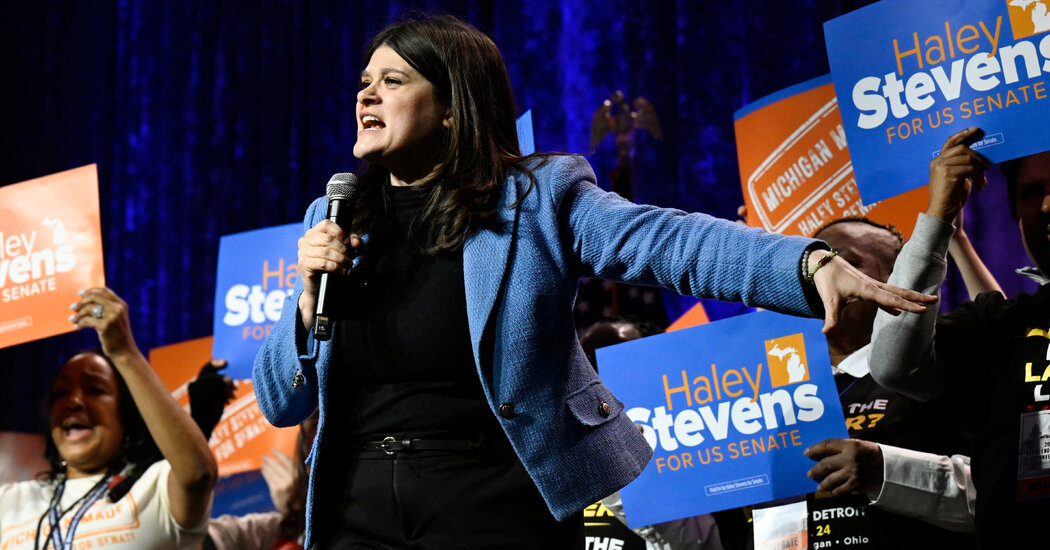
Behind the heavily guarded, mahogany doors of elite fundraising salons, politics is rarely about the grand, public speeches broadcast on cable news; instead, it is a game of quiet whispers, subtle nods, and strategic alliances. For Senator Chuck Schumer of New York, the Democratic minority leader, the quest to reclaim the Senate majority is an all-consuming mission that requires a delicate balance between public neutrality and private intervention. Officially, Schumer has taken no sides in Michigan’s highly competitive, deeply divided Democratic Senate primary. But beneath this thin veneer of official impartiality lies a calculated, high-stakes effort to shape the race’s outcome. In intimate conversations with some of the party’s most influential and deep-pocketed donors, Schumer has been anything but neutral. According to insiders close to these private communications, the veteran political tactician has been explicitly urging major contributors to open their wallets for Representative Haley Stevens, a four-term moderate congresswoman whom he views as the party’s best hope. Schumer’s calculations are built on a pragmatic, cold-eyed assessment of electability: in a battleground state that Donald Trump captured in the 2024 presidential election, he believes a moderate voice is the only path to victory. This behind-the-scenes kingmaking highlights the ongoing tension between the Democratic establishment, which prioritizes safe, centrist candidates, and a passionate grassroots base that increasingly demands bold, progressive change. By working in the shadows, Schumer seeks to direct the party’s donor class and institutional infrastructure toward his preferred candidate, bypassing the public scrutiny and potential backlash that an official endorsement would inevitably trigger from the more liberal wings of his own caucus.
The race itself has transformed Michigan into a vibrant, sometimes volatile battlefield reflecting the broader identity crisis within the modern Democratic Party. The three candidates seeking to succeed retiring Senator Gary Peters offer voters starkly different paths forward. Representative Haley Stevens, the establishment’s chosen champion, represents pragmatism and legislative experience, though she has recently struggled under the high-pressure glare of the spotlight. During a recent debate, Stevens appeared visibly shaken, dodging tough questions about her campaign contributions and stumbling over the complex procedural mechanics of the Senate filibuster, exposing the vulnerabilities that come with being a targeted frontrunner. Rising quickly to capitalize on these missteps is Dr. Abdul El-Sayed, a dynamic progressive public health official who carries the enthusiastic backing of Senator Bernie Sanders and recently secured a massive boost with an endorsement from the powerful United Automobile Workers union. El-Sayed’s campaign is fueled by grassroots energy, local door-knocking, and a vision of systemic economic reform that resonates deeply in Michigan’s post-industrial towns. Positioned between them is Mallory McMorrow, a charismatic state senator endorsed by Senator Elizabeth Warren, who has carved out a distinct lane by championing progressive values while maintaining a pragmatic, steel-town sensibility. In a bold move that highlights her independence and directly challenges the party’s hierarchy, McMorrow is the only candidate in the race who has openly declared that she would not vote for Schumer to continue as the Senate Democratic leader, turning the primary into a referendum on the party’s Washington establishment.
The practical effect of Schumer’s quiet encouragement has been a massive, sudden influx of financial resources designed to insulate Stevens from her progressive challengers. In the high-stakes world of modern American politics, money is the ultimate equalizer, and Schumer’s nod acts as an invisible greenlight for wealthy donors and powerful political action committees to swing into action. This preference is not a sudden development; as early as last October, the establishment quietly signaled its intentions when Stevens was the sole Michigan candidate invited to an exclusive donor retreat at a luxurious vineyard in Napa County, California—an event later canceled due to the federal government shutdown. Almost overnight, supporters of Stevens initiated at least four distinct outside spending campaigns, quickly transforming the Michigan airwaves into a relentless barrage of political advertising. Foremost among these efforts is a sudden deluge of television and digital advertisements worth over $10 million, a staggering sum designed to saturate the media market in the final weeks leading up to the August 4th primary. Remarkably, a significant portion of this war chest—approximately $6.5 million—originates from a mysterious, newly formed nonprofit organization called the Center for Democratic Priorities. This group, which emerged just last year, operates in the shadows of American campaign finance law, refusing to disclose its donors or answer public inquiries about its sudden, massive intervention in the Michigan primary. For the average voter, this avalanche of dark money can feel overwhelming, transforming a local democratic process into a proxy war funded by anonymous national interests. For El-Sayed and McMorrow, who rely heavily on grassroots, small-dollar campaigns, this financial wall represents a formidable obstacle that threatens to drown out their organic messages of reform beneath a sea of professionally produced television ads.
Beyond the sheer volume of campaign cash, the Michigan primary has exposed raw, deeply emotional policy divisions that reflect a shifting national consciousness, particularly regarding American foreign policy and foreign aid. Haley Stevens has positioned herself as a staunch ally of the traditional pro-Israel establishment, actively utilizing the fundraising services of the American Israel Public Affairs Committee (AIPAC). She stands alone among the Democratic contenders in her unwavering support for continued U.S. military aid and weapons sales to Israel, a position that has endeared her to moderate donors but sparked fierce criticism from progressive activists. This alliance became a flashpoint during the debates, where Stevens struggled to defend the ethics of her campaign financing to an increasingly skeptical audience. In sharp contrast, both Dr. Abdul El-Sayed and Mallory McMorrow have tapped into a growing wave of anti-war sentiment within the Democratic base, explicitly promising that, if elected, they would vote to halt all American weapons sales to the Israeli military. This debate carries immense weight in Michigan, home to one of the largest and most politically active Arab-American and Muslim populations in the United States, as well as a robust student activist network. For many voters in communities like Dearborn and Detroit, this foreign policy debate is not an abstract ideological argument; it is a deeply personal issue that directly impacts their families, their values, and their view of America’s role in the world, making the primary a high-stakes test of how the Democratic Party will balance traditional alliances with evolving moral demands.
This high-octane intervention in Michigan is not an isolated event, but rather a key chapter in Chuck Schumer’s broader, calculated playbook to maintain absolute control over the Democratic Senate caucus and secure a working majority. Over the course of his two decades at the helm of the party’s campaign apparatus, Schumer has perfected the art of the quiet primary intervention, systematically favoring moderate, business-friendly candidates who he believes are less vulnerable to Republican attack ads in conservative-leaning states. This year, his quiet strategy has largely succeeded across the country; in Iowa, for instance, a Schumer-aligned group funneled over $10 million to help propel Paralympic gold medalist Josh Turek to primary victory without Schumer ever having to issue a formal, controversial endorsement. He successfully cleared the primary fields for his handpicked recruits in Alaska, North Carolina, and Ohio, effectively shutting down progressive challengers before they could gain traction. However, this centralized approach is not foolproof, as evidenced by a stunning and humbling defeat in Maine. In that race, Schumer threw his considerable weight behind Maine Governor Janet Mills, only to watch her campaign collapse and suspend operations after failing to overcome the grassroots momentum of Graham Platner, a charismatic progressive oyster farmer who captured the imagination of local voters. This sudden defeat served as a vivid reminder to the party’s leadership that despite millions of dollars in establishment backing and sophisticated political operations, the ultimate power still resides with everyday citizens who are weary of backroom deals.
As the August 4th primary rapidly approaches, the human stakes of the Michigan race could not be higher for the candidates, the voters, and the future of the nation. The eventual Democratic nominee will face Representative Mike Rogers, a formidable and well-funded candidate running unopposed in the Republican primary, in a grueling general election battle that national observers agree will help determine which party controls the United States Senate. For Democrats, the path to a Senate majority is incredibly narrow: they must successfully defend every single seat they currently hold while launching offensive campaigns to flip Republican-held seats across the country. In this context, losing Michigan—a seat currently held by the departing Senator Gary Peters—would be a devastating, perhaps fatal blow to the party’s national aspirations. This reality explains why the Democratic establishment has mobilized so aggressively, spending millions of dollars to protect Haley Stevens and ensure a moderate, battle-tested general election candidate. Yet, as voters prepare to head to the polls, the race remains a deeply human drama about representation, trust, and the soul of the Democratic Party. Whether Schumer’s carefully calculated strategy of high-finance containment will prevail over the raw enthusiasm of El-Sayed’s grassroots movement or the defiant independence of McMorrow’s campaign remains to be seen. Ultimately, the future of the Senate will not be decided by shadow nonprofits or powerful senators in Washington, but by ordinary Michigan workers, students, and families making their voices heard in quiet voting booths across the Great Lakes State.