




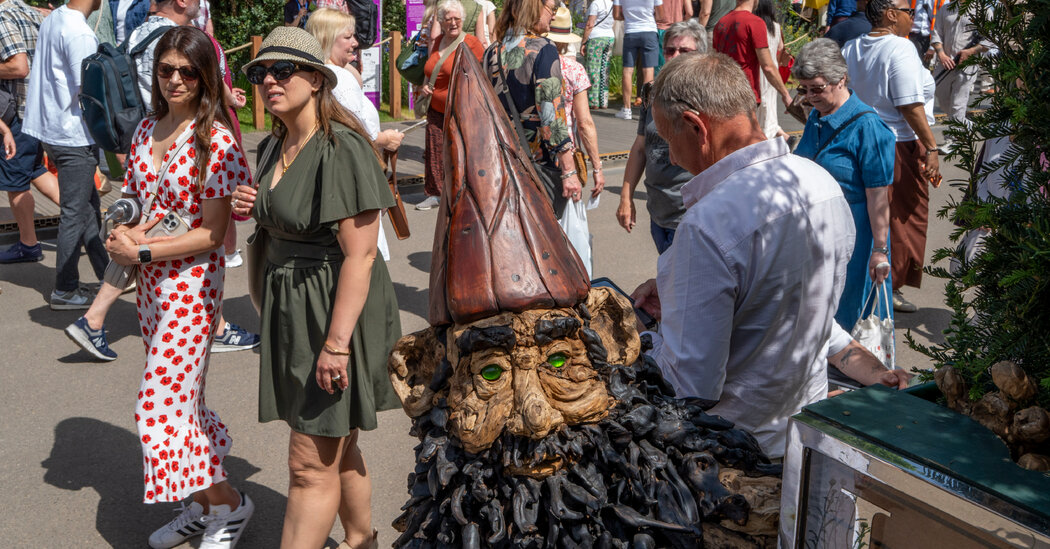
Royal Roses and Rebellious Gnomes: The Beautiful British Madness of the Chelsea Flower Show
1. A Royal Horticultural Rendezvous and the Unexpected Return of the Outlawed Lawn Ornament
On the pristine, sun-dappled lawns of the Royal Hospital Chelsea, the opening day of the world’s most prestigious botanical exhibition commenced with its trademark blend of aristocratic pageantry, cutting-edge landscape design, and high-profile glamour. Observers watched as King Charles III, a lifelong champion of organic husbandry and environmental stewardship, leisurely navigated curated beds of vibrant goldenrod, ancient mulberry trees, and sprawling rhubarb stalks. Walking alongside the monarch was global cultural icon David Beckham, who draft-marked his own permanent stamp on the horticultural calendar this year with the debut of a delicate, newly engineered white shrub rose bearing his name. Yet, despite the presence of royalty and international celebrity, the most talked-about figure on the manicured grass was not a king, an athlete, or a gold-medal garden designer, but rather a pint-sized, long-uninvited guest that had spent decades relegated to the outer wilderness of British taste: the humble garden gnome. In a historic and highly controversial move, the Royal Horticultural Society—the undisputed arbiter of elite green-fingered taste and the governing charity behind the show—temporarily lifted its decades-long ban on these polarising figurines for the 2026 exhibition. The decision, though strictly limited to a one-year charitable campaign aimed at sparkling children’s interest in the soil, instantly ignited a fierce nation-wide debate among traditionalists and modernists alike, exposing the delicate, often hilarious fault lines running straight through the heart of the classic English garden aesthetic.
2. The Great Gnome Debate: Redefining Kitschy Charm and Elite Gardening Aesthetics
The sudden presence of these painted ceramic lawn custodians on elite soil immediately divided the horticultural establishment, prompting a lively discourse on where whimsical kitsch ends and high design begins. Since their introduction to Britain from Germany in the nineteenth century, gnomes have occupied a highly contested space in the British class system, often dismissed by academic horticulturists as cheap, working-class suburban trinkets that clutter the clean lines of sophisticated landscape architecture. Reflecting the uncompromising perspective of the old guard, Robert Brett, the esteemed curator of the Royal Horticultural Society’s flagship garden at Wisley,西南 of London, was utterly unequivocal during a VIP tour, flatly rejecting the notion that such whimsical figures have any place in serious gardening. “Do we have gnomes at Wisley? Am I interested in gnomes? No,” Brett remarked with a dry, professional finality that echoed down the manicured avenues. On the opposing side of this floral culture war stood beloved British comedian Tom Allen, who took a more democratic and playful view of the matter, having enthusiastically participated in the charity initiative by painting a gnome in a dapper, custom-designed suit and tie. Allen argued passionately that the modern world, with its cold architectural minimalism and clinical perfectionism, is desperately in need of the eccentric, the slightly passé, and the unpretentious joy that these little clay figures have historically brought to millions of ordinary backyard plots.
3. High-Art Playfulness and a Charitable Crusade Under a Royal Canopy
This temporary truce in the gnome wars was not merely a publicity stunt but a highly successful philanthropic endeavor, with some of the world’s most recognizable artists, actors, and musicians transforming these clay outcasts into high-value collector’s items. A miniature gnome outfitted with a tiny, meticulously painted electric guitar, customized by legendary Queen guitarist Sir Brian May, set the auction block alight, ultimately selling for a staggering £3,700—nearly $5,000—to benefit youth gardening education. Other luminaries, including Oscar-winning actress Cate Blanchett, lent their artistic visions to the cause, proving that even the most refined cultural tastemakers could find delight in the subversion of classic high-culture rules. Offering a masterclass in compromise, Alan Titchmarsh, the iconic television broadcaster and vice president of the Royal Horticultural Society, suggested that when it comes to integrating kitsch into pristine landscapes, subtlety, rather than gaudiness, remains the gold standard. This philosophy of understated humor was perfectly realized within a sanctuary-like display garden sponsored by King Charles III’s own charitable foundation, where an incredibly discreet, mossy-backed gnome was positioned so cleverly that most visitors walked right past him; he stood with his back turned to the main viewing pathway, gently obscured by a lush canopy of wild ferns. This subtle nod to playfulness stood in sharp contrast to the reactions of traditionalist purists like London-based plant enthusiast Barbara Hayward, who shuddered at their inclusion, firmly declaring that such over-the-top elements simply do not belong at a world-class exhibition.
4. The Ticking Clock: Decorum Dissolves into Festive Chaos at the Ultimate Botanical Bazaar
While the gnome debate provided plenty of intellectual fodder for the opening days, the true, unfiltered spirit of British gardening was fully unleashed on the exhibition’s final afternoon, when the atmosphere of quiet reverence evaporated in an instant. Since its inception in 1913, the Chelsea Flower Show has functioned as a pristine living museum of horticultural perfection, displaying everything from sweeping show gardens that cost hundreds of thousands of pounds to construct, to innovative balcony layouts designed to maximize urban micro-spaces. But every year, in the final hour of the final day, this elite sanctuary of tranquility undergoes a breathtaking transformation during the legendary and highly anticipated Chelsea plant sell-off. As the hand of the clock strikes the appointed hour, a resounding brass handbell echoes across the grounds, triggering a collective ten-second countdown that signals the immediate dissolution of British politeness and the start of a joyous, high-stakes shopping frenzy. Suddenly, thousands of visitors—socialites in exquisite floral silk dresses, retired military officers in tailored linen jackets, and dedicated home gardeners in practical straw hats—cast aside their formal reserve, surging forward into the display beds to secure their own piece of horticultural history. In a matter of minutes, pristine award-winning exhibitions that took weeks of microscopic care to construct are systematically dismantled by hand, as historical decorum gives way to a triumphant, wonderfully chaotic botanical free-for-all.
5. Green-Fingered Triumphs and Courteous Combat Amidst Floating Orchids and Prized Clematis
In this fast-paced, open-air marketplace, paper banknotes are waved urgently overhead, credit card terminals click continuously, and long, determined queues form in seconds for prized specimens like historic Winston Churchill daffodils. Among the sea of eager buyers was London resident Nuala Orton, who had secured the coveted first position in a massive queue snaking away from an award-winning aquatic show garden, her eyes locked securely on a regal, towering Japanese purple iris variety known colorfully as “Dinner Plate Jell-O.” While some displays of extreme rarity—such as an extraordinary collection of 680 delicate Chinese orchids—were pre-allocated for preservation at the Royal Botanic Gardens, Kew, over a hundred were made available to the public, sparking polite but intense bidding wars among orchid collectors. Nearby, at the Raymond Evison nursery stand, which famously supplies the royal household with its world-class climbing clematis, crowds gathered to purchase some of the 2,500 prize vines shipped to London from the Channel Island of Guernsey. Andrew Sheerin of the Evison nursery described the atmosphere as a delicate balance of intense determination and traditional manners, explaining that while the clematis plants were being sold at a massive discount of just £10 each to avoid the arduous logistical nightmare of shipping them back, the sellers maintained a absolute commitment to fair pricing and pre-sale promises because, after all, “this is Chelsea, so we have to remain polite.”
6. Stray Petals and Triumphant Journeys: Carrying the Spirit of Chelsea Back to the Real World
As the final bell fell silent and the gates of the exhibition ground swung closed, the surrounding streets of London’s affluent Chelsea district were transformed into a surreal, moving forest of displaced flora. Eager commuters and weary showgoers stumbled toward public transport, their arms wrapped tightly around massive ceramic pots, while the concrete floors of the nearby Sloane Square underground station were quickly carpeted with a colorful layer of crushed green leaves and stray purple petals. Dedicated buyers like Avril Jennings, who had traveled all the way from Liverpool, admitted to the sheer difficulty of resisting the temptation of the sell-off, having previously navigated the long train journey home with two fully grown rose bushes in tow. Perhaps the most striking image of the evening was Londoner Richard Perry, who walked tall down the street cradling an enormous, brilliant blue delphinium that stood nearly seven feet high, a botanical bargain he had purchased for just £30 with the intention of delivering it to his elderly parents in the English Midlands. “First, I’ve got to sneak onto the tube,” Perry laughed, adjusting his grip on the towering stalk as he prepared to descend into the subway. “There is a strict height limit on what you can legally carry down there, so my strategy is to hold it at a very dramatic angle and hope the station master is a fellow gardener.” In this final, beautiful image of a giant flower journeying through the metropolitan underground, the true essence of Chelsea was laid bare: a unique national passion where royal patronage, high design, eccentric gnomes, and a little bit of beautiful British madness come together to celebrate our eternal connection to the living earth.