


Charles Foehner: A Queens Senior’s Fight for Survival Leads to Prison
In a story that blends self-defense, gun ownership controversies, and the complexities of the American legal system, 65-year-old Charles Foehner, a retired doorman from Kew Gardens, Queens, has begun serving a four-year prison sentence for criminal weapons possession. His case began in the early morning hours of May 31, 2023, when a routine trip to buy cigarettes turned deadly. Walking back to his apartment around 2 a.m., Foehner was confronted by 32-year-old Cody Gonzalez, who demanded a cigarette and Foehner’s phone. Fearing for his safety, the senior citizen pulled out a revolver, initially pointing it at the ground in hopes of deterring the would-be mugger. When Gonzalez—who had a history of mental illness and prior arrests—lunged at him with what Foehner believed was a knife (later determined to be a pen), the older man fired a single fatal shot. “I didn’t want to hurt anyone. He left me no choice,” Foehner later explained to The Post, the regret evident in his voice. The entire confrontation was captured on building security cameras, and Foehner immediately called 911 and cooperated with authorities.
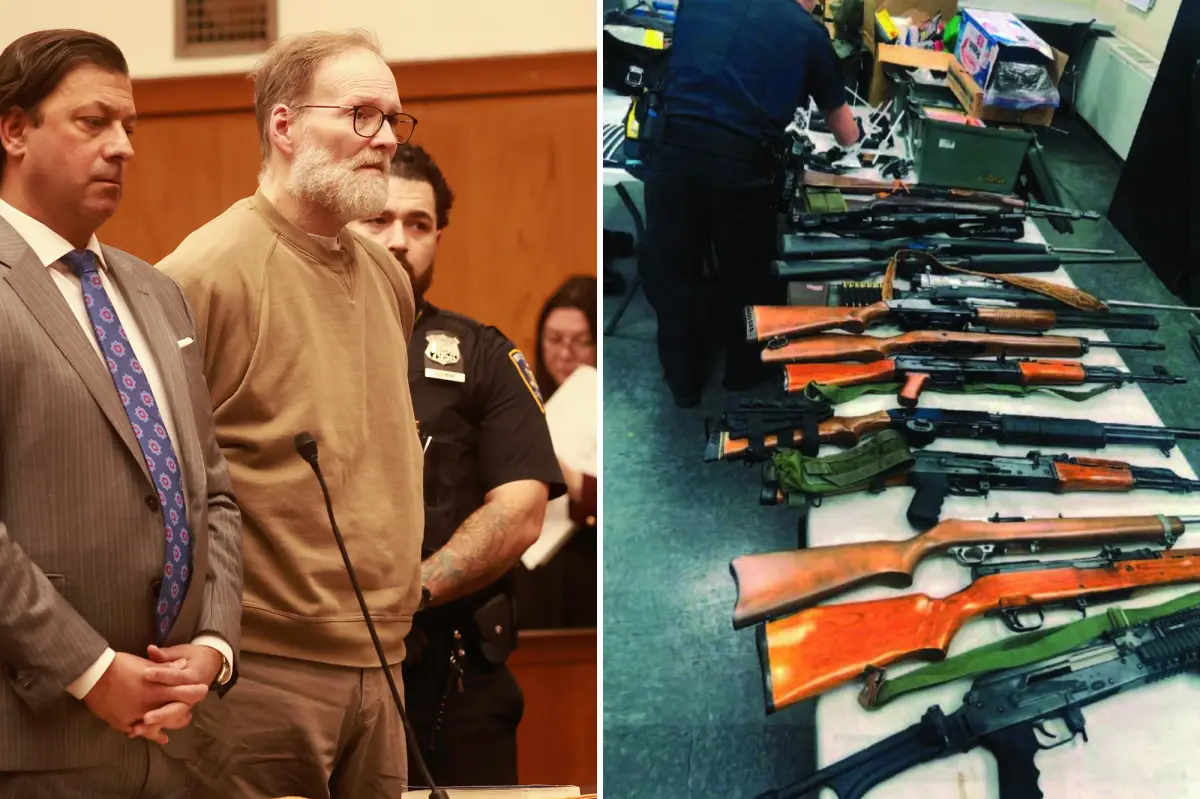
While prosecutors never charged Foehner with Gonzalez’s death, recognizing the elements of self-defense in the situation, the investigation led to a startling discovery inside his Queens apartment. What police found can only be described as an arsenal: 26 unlicensed and unregistered weapons, more than 13,000 rounds of ammunition, 152 large-capacity feeding devices (10 of which were loaded), and two bulletproof vests. The collection included an array of handguns, rifles, and shotguns from various manufacturers—Smith & Wesson revolvers, Glock pistols, Mossberg shotguns, and even semi-automatic rifles. Queens District Attorney Melinda Katz’s office released photos of the recovered weapons stockpile, which Foehner described as a collection he had built over time, explaining himself as a “lifelong gun enthusiast” and a “doomsday prepper.” Despite the impressive and concerning inventory, Foehner maintained, “Until that night, I never pointed a gun at anybody. I never had to. I’m not a gun bully… I don’t want power over anyone.”
The day after the shooting, Foehner was arrested and charged with criminal possession of weapons. After moving to Pennsylvania following the incident, he eventually struck a deal with prosecutors, pleading guilty to one count of criminal weapons possession in November 2023. On Wednesday, Queens Supreme Court Justice Toni Cimino officially sentenced him to four years in prison, to be followed by five years of post-release supervision. As he reported to the Eric M. Taylor Center in the Bronx to begin his sentence, Foehner’s case highlights the complex intersection of self-defense, gun rights, and legal responsibilities—particularly in states with strict firearms regulations like New York. For a man who described himself as believing in “the social contract,” the consequences of both his defensive actions and his extensive unauthorized gun collection have irreversibly altered his life.
In the weeks before his incarceration, Foehner spent his remaining freedom visiting friends and family, particularly focusing on time with his devoted wife, Jenny Foehner-Speed, and his 8-year-old dog, Biscuit, who was recently diagnosed with cancer. These final days of liberty carried the poignancy of someone preparing for a long separation from everything familiar—a stark reality for the senior citizen who had never before been incarcerated. Now behind bars, Foehner has expressed that his primary objective is simply to “survive” his four-year sentence. With pragmatism that suggests he’s accepted his fate, he’s also mentioned hopes of learning welding skills and possibly becoming a tutor during his incarceration, finding ways to make productive use of his time while separated from his home and loved ones.
The human dimension of Foehner’s case extends beyond just the legal facts. As a retired doorman in his mid-60s, he represents an unlikely prison demographic. His situation prompts questions about proportional justice, especially considering that he was never charged with homicide in what authorities apparently considered a legitimate act of self-defense. The substantial weapons cache, however, represented numerous violations of New York’s strict gun laws, putting authorities in a position where they couldn’t overlook such extensive unauthorized firearm possession. For Foehner, the weapons represented security and preparation for worst-case scenarios—a mindset not uncommon among “preppers” who anticipate societal breakdown or natural disasters. For law enforcement, however, the same collection represented a potential public safety risk and multiple felony violations.
Despite his legal troubles, Foehner has shown a capacity for reflection and responsibility rarely seen in criminal cases. “Whatever the circumstances are, a guy is dead because of me,” he acknowledged, wrestling with the moral weight of taking a life, even in self-defense. “Maybe I should have taken the beating [that night], but who knows where the beating stops,” he added, articulating the impossible calculation many face in split-second decisions about personal safety. This philosophical grappling suggests a man coming to terms with both the necessity of his actions and their tragic outcome. While accepting that punishment was appropriate for his illegal weapons possession, Foehner maintained that imprisonment might be excessive given the circumstances and his age. His case ultimately stands as a complex human story—one of fear, protection, preparation gone too far, and the heavy consequences that can follow even when acting in perceived self-defense. As he serves his sentence, Foehner joins thousands of Americans whose lives have been forever altered by the intersection of firearms, self-protection, and the legal system that must balance individual rights with public safety.