



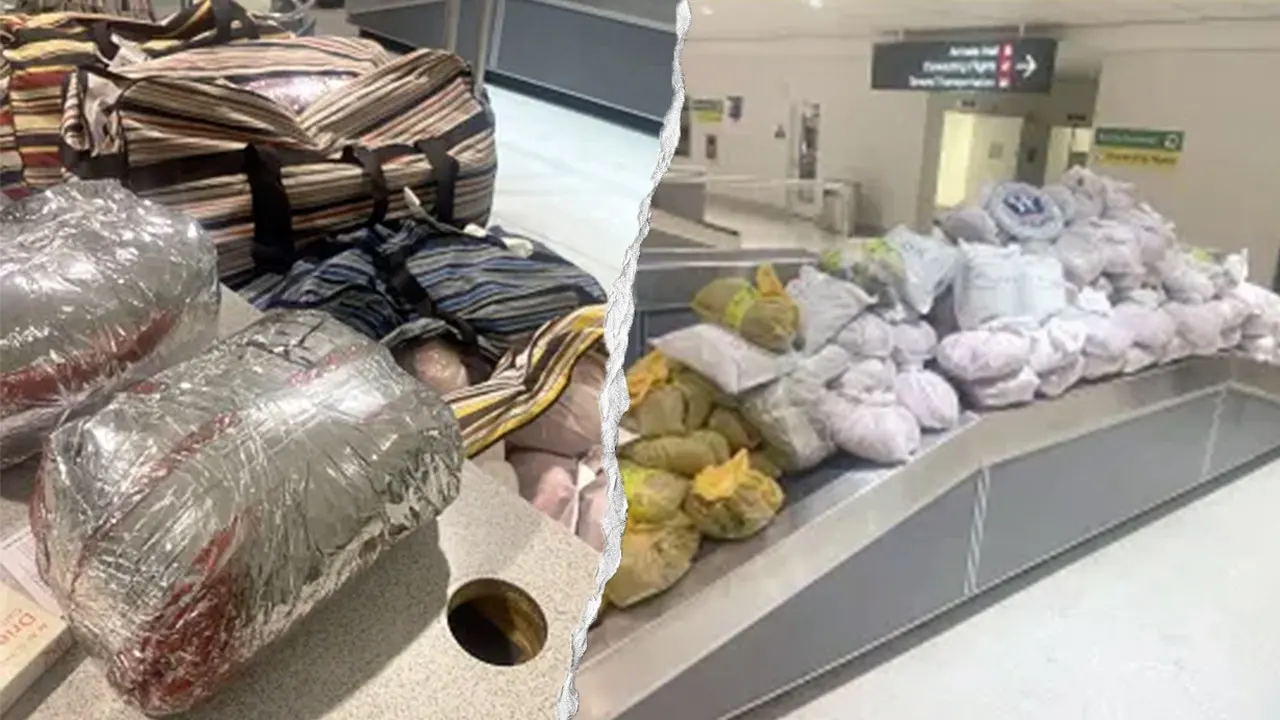
The mundane rhythm of an international airport was shattered on a seemingly ordinary Tuesday morning at Baltimore/Washington International Thurgood Marshall Airport. Passengers flowed through the sterile corridors, dragging wheeled luggage and clutching boarding passes, their minds fixed on the mundane details of travel—missed connections, hotel reservations, or the comforting prospect of home. Yet amidst this sea of routine, two U.S. citizens arriving from London stood out. Their carts were loaded not with the usual assortment of vacation souvenirs or business attire, but with twelve soft-sided suitcases that bulged at the seams, seemingly straining under a weight that betrayed their modest size. When customs officers from the U.S. Customs and Border Protection (CBP) waved them over for a routine secondary inspection, the initial scan of their baggage revealed dense, compressed masses that looked disturbingly like enormous bundles of crushed tea leaves. However, a field test quickly confirmed the officers’ worst suspicions: this was not tea, but a massive shipment of khat, a powerful stimulant plant. The total weight of the leafy contraband was a staggering 847 pounds, roughly equivalent to the mass of a small grand piano, with an estimated street value of approximately $100,000. In the sterile, brightly lit inspection room, the sheer volume of illegal vegetation spilling out of those twelve bags created a vivid tableau of audacious criminality, marking one of the most significant busts of its kind at the airport in recent memory.
To truly grasp the magnitude of this interception, one must step outside the realm of American law enforcement and into the cultural heartlands of East Africa and the Arabian Peninsula, where khat holds a centuries-old social legacy. Known by the deceptively charming monikers of “Abyssinian tea” or “African salad,” the fresh leaves of the Catha edulis plant have been chewed for generations as a central element of community gatherings and afternoon social rituals. In countries like Yemen, Somalia, and Ethiopia, men and women often sit together for hours, methodically plucking leaves from stems and packing them into their cheeks, producing a mild euphoria and a heightened state of alertness that many describe as being similar to a powerful espresso crossed with an amphetamine. The practice is woven into the fabric of daily life, a social lubricant that facilitates conversation and business dealings. However, this cultural acceptance sharply contrasts with the harsh legal reality in the United States. The chemical compounds within khat—specifically cathinone, a Schedule I controlled substance, and cathine, a Schedule IV controlled substance—are recognized by the Drug Enforcement Administration (DEA) as potent central nervous system stimulants. When the leaves are dried, they lose their fresh potency, but they can be crushed and brewed into a stimulant tea that delivers a powerful, albeit dangerous, hit. This 847-pound haul was not a nostalgic cargo of cultural tradition; it was purely an industrial-scale smuggling operation designed to inject a dangerous synthetic-like high into vulnerable American communities.
The physiological dangers of khat consumption are severe and escalate rapidly, transforming a seemingly innocuous plant into a vector for profound physical and mental degradation. According to the DEA, the immediate effects of cathinone mirror those of synthetic amphetamines, flooding the body with adrenaline and dopamine. The short-term symptoms are alarming: users often experience paranoid delusions that spiral into psychosis, a complete and dangerous loss of appetite that can lead to severe malnutrition, and labored breathing that puts strain on the respiratory system. More critically, the cardiovascular system is overwhelmed as blood pressure spikes to dangerous levels and the heart rate accelerates to a pounding, arrhythmic tempo, increasing the risk of heart attacks and strokes. The World Health Organization, recognizing the global threat of this substance, formally classified khat as a drug of abuse back in 1980, a designation that carries immense weight in international policy. Beyond the immediate physical hazards, chronic use leads to a deep psychological dependence, creating a destructive cycle of cravings that devastates families and communities. The interception of this massive load in Maryland means that 847 pounds of this neurotoxic botanical material never reached the streets, potentially sparing countless individuals from emergency room visits, psychiatric breakdowns, or worse. It is a stark reminder that the drug trade isn’t just about illicit money; it is an existential threat to the health and stability of ordinary people, and the officers who pulled those suitcases from the conveyor belt became unwitting guardians of public safety.
The customs officers who made this discovery were not shocked by the existence of khat—they have seen it all before—but they were certainly taken aback by the sheer audacity of the delivery method. Adam Rottman, the CBP Baltimore Area Port Director, articulated this sentiment perfectly in his official statement following the seizure. “Customs and Border Protection officers have observed substantial quantities of khat being smuggled in commercial shipments, but smuggling loads of this volume inside traveler baggage is a bit unusual, and not any more successful,” Rottman observed, highlighting the brazen nature of the attempt to pass off nearly half a ton of illegal stimulants as personal luggage. The port director was emphatic about the consequences, stating, “Khat is illegal and poses severe health risks to users. CBP will continue to seize khat and other dangerous drugs when we encounter it and we will work with our law enforcement partners to hold smugglers accountable.” His words carry the weight of an agency that operates on the front lines of a relentless battle. Just days prior to this arrest, officers at the very same airport had seized an additional 412 pounds of khat from unclaimed traveler baggage—a suspicious pile of abandoned suitcases left behind by a terrified smuggler who had been “spooked” by the sight of the inspection station and fled, leaving his illegal cargo sitting in the terminal awaiting discovery. These back-to-back incidents underscore the constant vigilance required of CBP officers, who must scrutinize everything from commercial cargo containers to the humble zipper of a soft-sided duffel bag, guessing which passengers are carrying the seeds of destruction.
One cannot help but be fascinated by the human psychology of the two men at the heart of this incident—these U.S. citizens from New York who dared to board a transatlantic flight from London with twelve suitcases groaning under nearly a hundred pounds of illegal greenery each. Their journey must have been a logistical nightmare. Checking in twelve bags requires fierce negotiation with airline staff, who charge hefty fees for excess baggage. Dragging that much weight through international terminals and customs halls demands immense physical endurance and a cool, unflappable demeanor. They likely believed that their cover story—that the bags contained harmless tea leaves—would go unchallenged, trusting in the anonymity of the ordinary traveler. Yet, in the harsh fluorescent light of the CBP inspection room, that façade crumbled. As the officers unzipped each bag and the pungent, bitter aroma of crushed khat filled the air, the reality of their situation must have dawned on them with horrifying clarity. They were released pending further investigation, a procedural move that offers little comfort; their passports are now flagged, their identities recorded in federal databases, and they now face the grim prospect of federal drug trafficking charges, which carry the potential for decades of imprisonment and crippling fines. In a moment of greed or desperation, they gambled their futures on the chance that a mountain of leaves could slip past the watchful eyes of American law enforcement—a gamble they lost in spectacular and humiliating fashion.
This single seizure, while significant, is merely a fleeting statistic in the vast, ongoing war against drug trafficking. The numbers released by CBP paint a sobering picture of the scale of the problem: in the last fiscal year, officers seized a colossal 46,000 pounds of khat, and in the current fiscal year alone, they have already intercepted nearly 20,000 pounds. These figures represent a relentless torrent of illegal substance flowing from the Horn of Africa through European hubs like London and into the United States. Every single pound of khat taken off the street is a victory, but the sheer volume suggests that the supply chains are deep and resilient, adapting quickly to new enforcement tactics. Yet, the dedication of the CBP officers remains unwavering. They stand as the final, unforgiving barrier between a dangerous narcotic and the country’s communities, working around the clock to spot the suspicious seams, the inconsistent baggage claims, and the nervous glances that betray criminal intent. Ultimately, this bust is not just about the eleven hundred pounds of khat seized in a single week in Maryland; it is a powerful testament to the relentless vigilance of the men and women in uniform, and a stark warning to those who contemplate smuggling drugs into the United States. The gateways are watched, the bags are opened, and the consequences—both legal and physical—are as heavy as the loads these smugglers foolishly attempt to carry.