



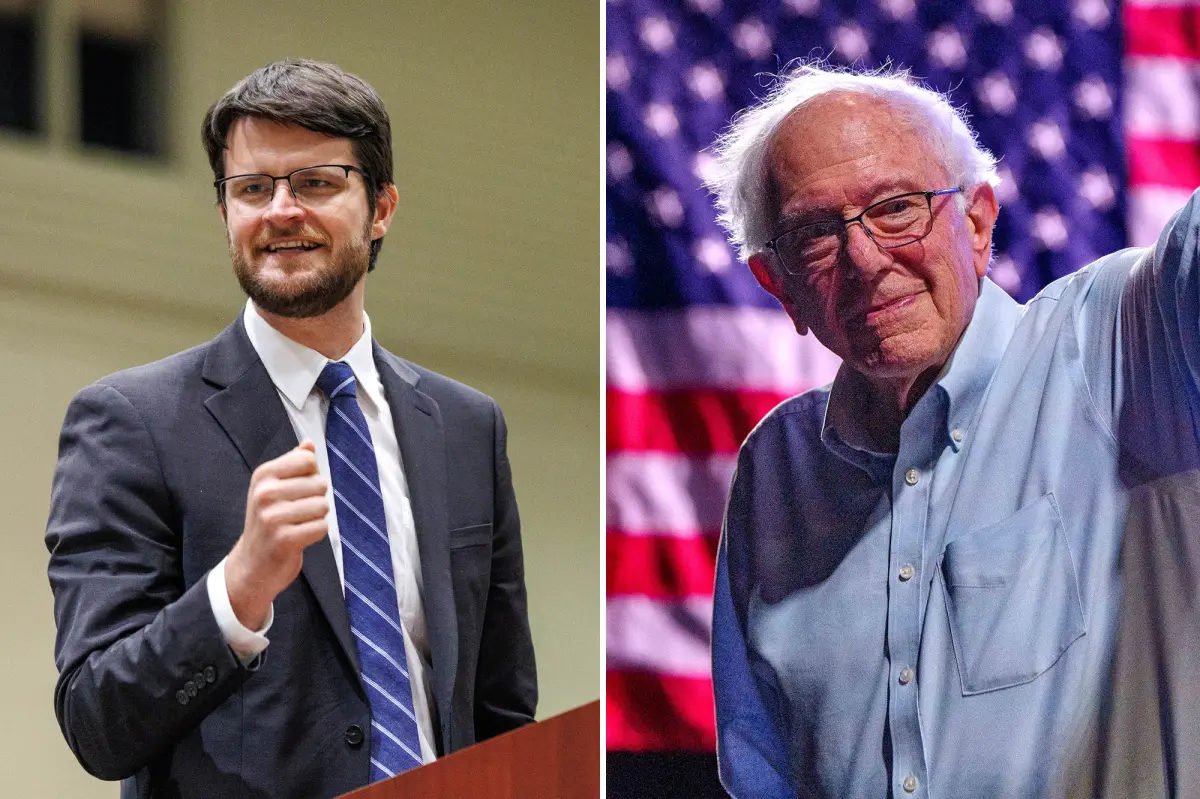
On a warm Michigan night, as the clock ticked past eleven and the tension inside the campaign headquarters reached a fever pitch, the political landscape of Michigan’s 7th Congressional District underwent a seismic shift. At exactly 11:23 p.m. EDT, the Associated Press officially called the Democratic primary, declaring William Lawrence, a grassroots progressive activist and self-described socialist, the victor. It was a stunning upset that reverberated far beyond the borders of the Great Lakes State. Lawrence, a co-founder of the youth-led climate organization the Sunrise Movement, successfully navigated a fiercely contested three-way primary, capturing 43 percent of the vote. In doing so, he defeated two formidable rivals who represented the traditional, moderate wing of the Democratic establishment: Bridget Brink, a highly respected former U.S. Ambassador to Ukraine, who finished with 29 percent, and Matt Maasdam, a decorated former Navy SEAL, who secured 28 percent. The victory was a classic David-and-Goliath story, proving that grassroots enthusiasm and a message focused on the struggles of working-class people could overcome the institutional advantages and polished resumes of mainstream candidates. For Lawrence’s supporters, who had spent months knocking on doors and talking to neighbors, the late-night announcement was not just a political win, but a validation of their belief that politics can be done differently when driven by community-first principles.
What makes Lawrence such a compelling and unconventional figure in modern American politics is his refusal to be neatly categorized by traditional political consultants. He is a candidate who embraces intellectual honesty over focus-grouped talking points, a trait that was on full display during a crowded campaign town hall in Lansing. Addressing a room full of curious voters, Lawrence spoke candidly about his political identity, acknowledging that while people often label him a socialist—and that he sometimes adopts the term himself—he also views his philosophy through multiple lenses. He explained that he considers himself a progressive, a defender of working-class interests, and even a “law-and-order” candidate in the truest sense of protecting communities from exploitation. His core message is grounded in a deep empathy for the everyday anxieties of average citizens, pointing out that unchecked capitalism has left families feeling relentlessly squeezed by soaring utility bills, stagnant wages, and the rising cost of putting food on the table. By framing his ideology around the shared human experience of financial struggle, Lawrence managed to demystify the “socialist” label, translating it into a practical commitment to economic justice and human dignity that resonates with voters who feel forgotten by Washington insiders.
This populist philosophy translates into a bold, uncompromising policy platform designed to directly improve the quality of life for Michigan residents while addressing global moral imperatives. On the home front, Lawrence’s campaign focused on protecting Michigan’s iconic natural resources, advocating for aggressive measures to safeguard the state’s freshwater and preserve its historic farmland from corporate encroachment. He has championed Medicare for All, arguing that healthcare is a fundamental human right that should never be tied to employment or financial status. On the international stage, Lawrence has taken courageous and controversial stances, calling for an end to endless foreign wars and advocating for a complete cutoff of U.S. arms sales to Israel, reflecting his deep commitment to international law and human rights. Furthermore, showing an acute awareness of emerging modern challenges, he has called for a federal moratorium on the construction of new artificial intelligence data centers, highlighting the immense strain these facilities place on local power grids and water supplies. By prioritizing human needs and environmental sustainability over corporate profit margins, Lawrence’s platform offers a vision of a society where technology and economy serve the people, rather than the other way around.
Lawrence’s victory was propelled by a diverse and powerful coalition of progressive leaders, cultural icons, and grassroots organizations who rallied behind his vision of systemic change. Foremost among his endorsers was Senator Bernie Sanders, whose populist presidential campaigns originally inspired a generation of activists like Lawrence to run for office. He also received high-profile support from Hollywood actor and environmental activist Mark Ruffalo, who recognized Lawrence’s long-standing dedication to climate justice. Within the halls of Congress, Lawrence found strong allies in progressive champions like Representative Rashida Tlaib of Michigan, a prominent member of the “Squad,” as well as influential Democratic socialist candidates and leaders from across the country, including Melat Kiros of Colorado, Chris Rabb of Pennsylvania, and Brad Lander of New York. This network of support provided the campaign with vital national momentum, turning a local congressional primary into a symbolic battleground for the soul of the Democratic Party. By uniting national progressive figures with local activists, Lawrence created a formidable political movement that successfully challenged the party’s long-held assumption that only moderate, centrist candidates can compete in swing districts.
The true test of Lawrence’s progressive vision will unfold in Michigan’s 7th Congressional District, a region that serves as a perfect political bellwether for the entire nation. Characterized by a vibrant mix of urban university towns, suburban neighborhoods, and vast rural farming communities, the district has historically favored centrist politicians and is known for its highly independent electorate. The political volatility of the area is illustrated by recent presidential election results: in 2024, Donald Trump carried the district by a razor-thin margin of just one percentage point over Kamala Harris, reversing the exact same one-point margin by which Joe Biden defeated Trump in 2020. This even split makes the district one of the most competitive and watched swing districts in the country, where voters are known to split their tickets and judge candidates on their personal character rather than party affiliation. Lawrence’s primary victory marks a significant ideological departure for local Democrats, who must now unite behind a candidate who openly challenges the economic status quo in a region where traditional politics have long reigned supreme.
As the focus shifts to the general election on November 3rd, Lawrence is set to face off against the Republican incumbent, Tom Barrett, in a high-stakes showdown that will help determine which party controls the House of Representatives. Barrett, a conservative veteran who secured his seat in 2024 with a 3.7 percentage point victory, represents a starkly different philosophy of governance, setting up a classic ideological battle between progressive populism and conservative traditionalism. Early indications suggest the race will be an absolute nail-biter; a Data for Progress poll conducted in late June showed Lawrence holding a slim, two-point lead over Barrett, well within the margin of error. Nonpartisan analysts, including the Cook Political Report, have officially rated the race as a “toss-up,” guaranteeing that millions of dollars in national campaign funds and intense media scrutiny will flood the district in the coming months. Ultimately, the election will serve as a crucial national experiment: a test of whether a passionate, authentic progressive who speaks openly about the failures of modern capitalism can build a winning coalition of working-class voters, young activists, and moderates in the heart of industrial America.