


A Campaign Finance Scandal Erupts in California’s Governor’s Race
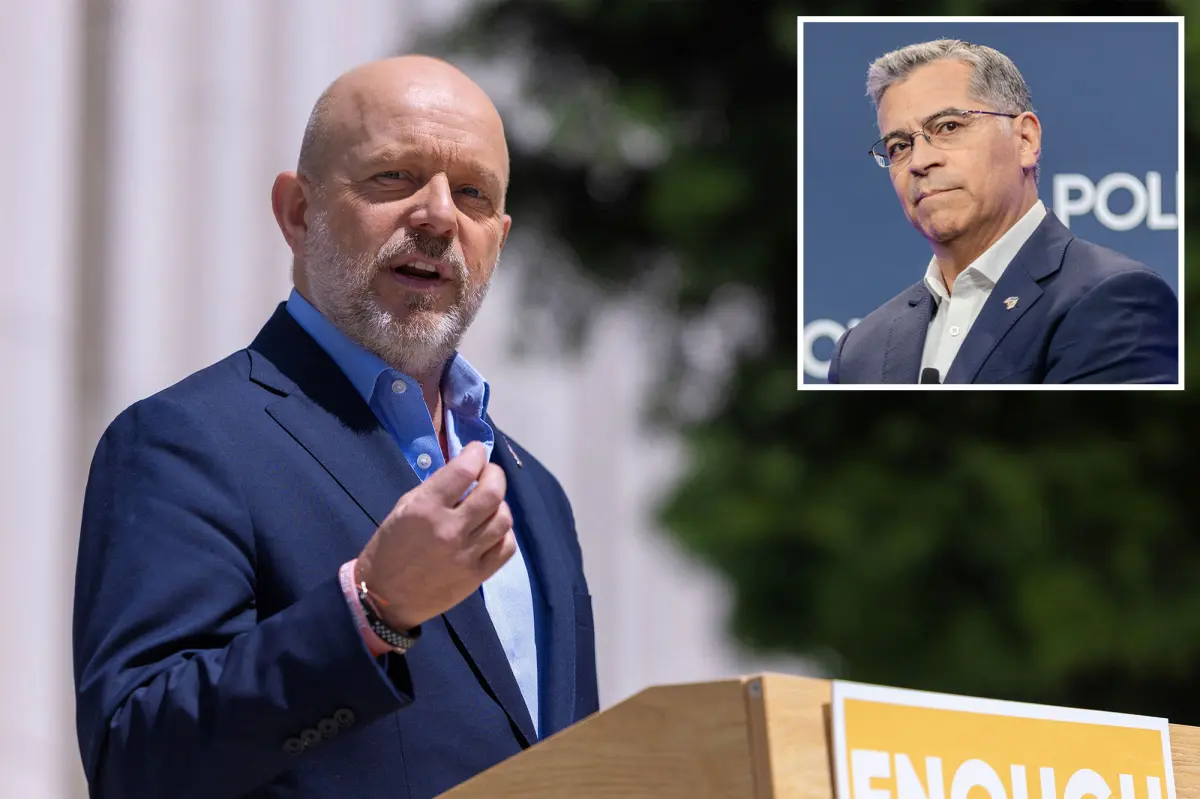
The race for California’s governorship has been abruptly overshadowed by a sprawling campaign finance scandal, igniting a fiery political battle and raising serious questions about the integrity of one of the frontrunners. At the center of the storm is Xavier Becerra, a candidate whose decades of public service are now being tested by allegations of financial impropriety linked to his dormant campaign accounts. The controversy has taken a sharp turn with his primary political rival, Steve Hilton, demanding that federal investigators re-interview Becerra, arguing that new evidence surfaced after a series of guilty pleas from Becerra’s former inner circle. Hilton’s call for a renewed inquiry has thrust the murky details of the case into the political spotlight, transforming a legal matter into a defining issue of the 2026 election cycle.
The roots of the investigation trace back to a complex web of financial transactions allegedly orchestrated by Becerra’s close associates. Federal prosecutors have built a case around money that was apparently funneled from Becerra’s inactive campaign account through a consulting firm operated by Dana Williamson, a former chief of staff to Governor Gavin Newsom. From there, the funds are alleged to have ultimately found their way to the wife of Sean McCluskie, one of Becerra’s most trusted former aides who also served as his chief of staff. The scheme, as described in court documents, paints a picture of off-the-books payments designed to enrich Becerra’s allies. The legal fallout has been swift and severe, with McCluskie, Williamson, and a Sacramento lobbyist named Greg Campbell all pleading guilty to federal charges, a clear indication that the case is built on a foundation of substantial evidence and cooperating witnesses.
Armed with these guilty pleas, Steve Hilton has escalated his attacks on Becerra, moving beyond mere political jabs to a formal request for federal action. In a letter dated August 30th, addressed to Attorney General Merrick Garland, FBI Director Kash Patel, and the U.S. Attorney for the Eastern District of California, Phillip Talbert, Hilton formally petitioned for Becerra to be questioned again. His central argument is that Becerra’s initial interview with investigators occurred before the full scope of the conspiracy was revealed and before the cooperating witnesses had provided their accounts. Hilton, joined by fellow candidate Michael Gates, contends that new testimony has emerged, potentially contradicting Becerra’s previous statements and necessitating a more direct line of questioning. “He needs to be put under oath and asked very direct questions about every aspect of this,” Hilton asserted, emphasizing that Becerra should not be given the opportunity to “get away with vague answers.”
The core of the dispute hinges on the question of what Becerra knew, and when he knew it. Hilton has seized on a series of public statements by Becerra that appear to conflict, suggesting a wavering narrative. He points to two separate television interviews in which Becerra gave differing accounts. In one, Becerra acknowledged knowing about the money transfers but claimed ignorance of their intended purpose. In another, he seemingly denied having any knowledge of the transactions whatsoever. This inconsistency, Hilton argues, is not the mark of an innocent man but rather a sign that Becerra is attempting to manage a political firestorm. “He’s given two separate answers in television interviews,” Hilton noted, pointing to the discrepancy as a key reason federal investigators need to re-examine Becerra under oath.
In their letter to federal officials, Hilton and Gates laid out what they believe to be the most incriminating pieces of evidence that have emerged since Becerra’s initial interview. The letter alleges that the indictment details specific conversations between McCluskie and Becerra, referred to as “Public Official 1” in court filings. According to the letter, McCluskie communicated with Becerra when the scheme to route the payments was first established and again when the payment method was changed. More damning, it alleges that McCluskie told Becerra that a recurring payment of $10,000 a month was a reasonable fee for the services. The letter also points to evidence suggesting that Becerra reviewed the false campaign disclosures that concealed these payments, a direct accusation that implicates him in the effort to deceive regulators and the public.
Beyond the documented communications, Hilton is focusing on the apparent motive behind the alleged scheme. He contends that the purpose of funneling this money was to allow Sean McCluskie to follow Becerra to Washington, D.C., when Becerra was appointed as the U.S. Secretary of Health and Human Services under President Biden. The supplemental income, Hilton argues, was meant to bridge the financial gap and ensure that Becerra had “his guy with him” in the nation’s capital. “The whole point of it was for Becerra to have his guy with him,” Hilton claimed, arguing that it is simply not credible for a seasoned politician like Becerra to be unaware of such a deliberate effort to financially support a key advisor. “So the idea that he didn’t know about it, to me, is hard to believe.”
In his defense, Becerra has consistently denied any knowledge of the criminal scheme, even as he admits to some awareness of the payments. He has characterized his responses as evolving, stating that while he knew payments were being made from his campaign account, he was not aware of the broader, illegal context. “I knew what was being paid,” Becerra acknowledged in an interview with FOX40, before adding, “What I didn’t know was all the underlying activity that was occurring that was against the law.” He has further explained his reliance on McCluskie, a trusted aide, to handle the minutiae of campaign finances, suggesting he was told that the payments were legitimate consulting fees. “I was told that’s the rate I would have to pay to get someone who could manage that and make sure that I don’t have to worry about [violating any federal rules],” he told the Los Angeles Times.
However, the specifics of the indictment directly challenge this “trusting boss” defense. The court documents allege that the payments were not for legitimate consulting services but were a means to pay McCluskie’s wife for a “no-work job” at Williamson’s firm. Furthermore, the indictment suggests that Becerra was not told the entire truth about where the money was ultimately going, but it also alleges he was involved in the conversations with McCluskie about the payments, including their amount and purpose. While Becerra has disputed the extent of his involvement, stating he does not recall specific conversations mentioned in the plea agreements, his camp maintains his innocence. A spokesman, Jonathan Underland, has stated that Becerra “had no idea what was going on” and that the former Secretary was a victim of a scheme designed to deceive him, a claim that federal prosecutors have also reportedly made.
The political implications of this scandal are immense, and other candidates are also weighing in. The campaign for billionaire Tom Steyer, another candidate in the race, has pointed to reporting from ABC10 that quotes Williamson’s lawyer, McGregor Scott, as saying that McCluskie told Williamson that he had “cleared the arrangement with Becerra.” This purported statement, if true, would more directly tie Becerra to the initial decision to set up the payment scheme. A Steyer campaign spokesperson, Danni Wang, used the revelation to attack Becerra, suggesting that he has been evasive on the issue. “Becerra can’t tweet his way out of tough questions,” Wang said, turning a phrase against the former Secretary. “Voters deserve to know about his role. Is he incompetent, or is he corrupt?”
When asked about the criticism that his push for a federal probe could be seen as politically motivated, Hilton framed it as an essential act of civic duty. He insisted that the voters of California deserve to have all the facts before they cast their ballots. “That’s in the interests of full information for the voters,” he told the California Post, deflecting accusations of dirty politics and positioning his request as a matter of public transparency. The demand for a re-interview comes as the November election approaches, adding another layer of complexity to a case that is already politically charged. Federal officials, bound by long-standing Department of Justice policies regarding pre-election actions—often referred to as the “60-day rule”—may be cautious about taking overt steps that could be perceived as influencing an election.
As of now, Becerra’s office and the FBI have not responded to public requests for comment on Hilton’s letter. The silence from his camp suggests they are attempting to weather the storm, hoping to keep the focus on the official finding that he has not been charged. However, the reverberations from this scandal continue to be felt across the political landscape, threatening to upend the gubernatorial race. With the evidence mounting and the timeline of events becoming clearer, the question of what Xavier Becerra knew is no longer a matter of mere speculation but a central issue that could define his candidacy. As the investigation advances, the pressure on federal authorities to act—and on Becerra to provide a more definitive and compelling explanation—will only intensify, leaving the future of his campaign hanging in a delicate and precarious balance. The coming weeks promise to be a crucible for a candidate whose political future now hinges on a story that keeps changing.