



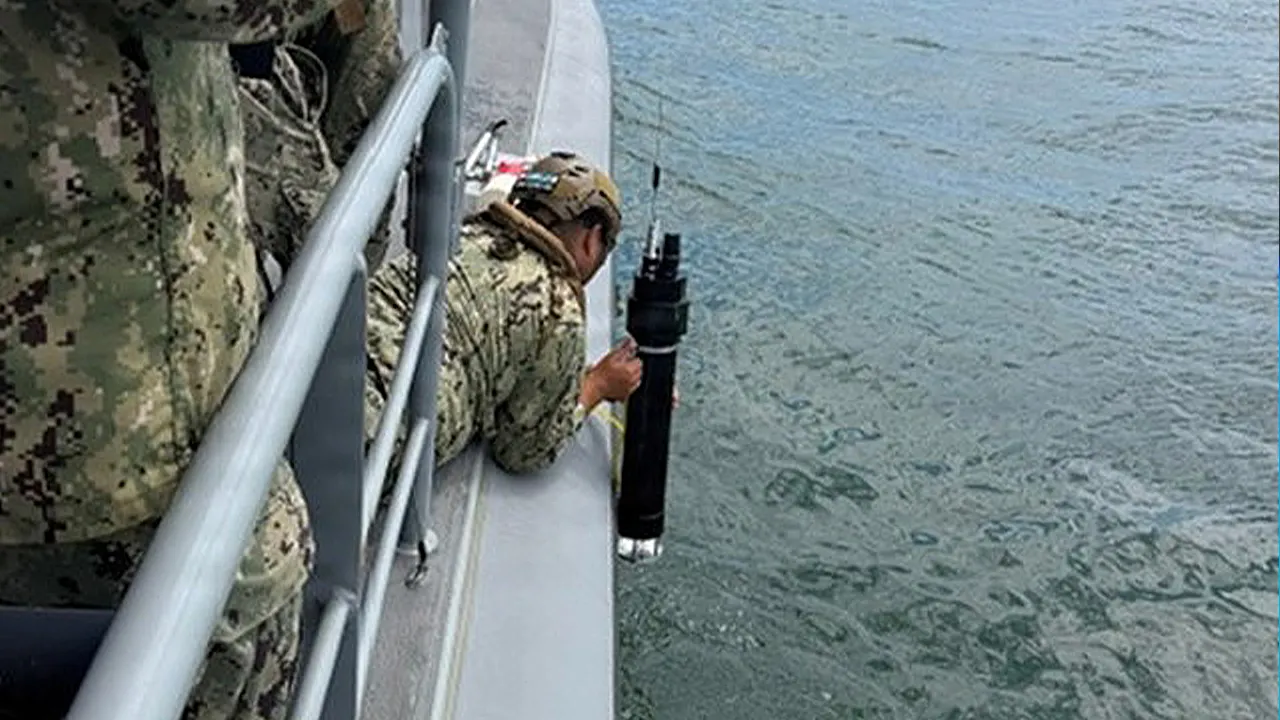
In the quiet expanse of the Pacific Ocean, where the horizon meets the sky in an endless blue blur, a silent revolution in modern warfare recently unfolded. For generations, the power of a military was measured by the sheer volume of its explosive payload, the deafening thunder of its artillery, and the visible might of its armored divisions. Today, however, the most decisive battles are being fought in a realm completely invisible to the human eye: the electromagnetic spectrum. In mid-July, off the rugged cliffs and deep waters of the U.S. West Coast, the United States Army took a massive step forward in this invisible arena by debuting the maritime variant of its revolutionary electronic warfare system, colorfully christened the “Hammer of the Gods.” This critical test, conducted during the high-stakes Project Convergence Capstone 6 (PC-C6) experiment, marks a profound shift in how nations defend their borders and their personnel. For the past two years, land-based prototypes of this system have been quietly put through their paces in arid deserts and dense forests, but taking this sophisticated technology to the open sea represents an entirely new frontier. Ocean environments present incredibly hostile conditions for sensitive electronics—salt spray, corrosive humidity, unpredictable wave motion, and the vast, unobstructed distances that can cause signals to scatter. By successfully deploying this portable signal disruptor on a maritime platform, the military has proven that it can project an invisible dome of safety over naval convoys and amphibious forces, shielding them from the deadly precision-guided munitions that have come to dominate modern battlefields. This transition from land to sea is not merely a technical achievement; it is a vital evolution in safeguarding the lives of thousands of sailors and marines who operate in highly contested waters across the globe, turning the vast and vulnerable oceans into a fortified digital sanctuary.
To truly appreciate the significance of the “Hammer of the Gods,” one must understand the absolute vulnerability of modern “smart” weaponry, which relies on an intricate, yet surprisingly fragile, web of space-based signals. Traditional artillery was a game of math, gravity, and windage, often requiring hundreds of rounds to hit a single bridge or bunker. Today’s precision-guided missiles, cruise missiles, and long-range smart munitions are entirely different beasts; they navigate using Positioning, Navigation, and Timing (PNT) data, which is beamed down from global positioning satellites orbiting thousands of miles above the Earth. Without these highly accurate data streams, a million-dollar, GPS-guided missile becomes little more than an incredibly expensive, unguided rocket, drifting off course and missing its intended target by hundreds of yards. The “Hammer of the Gods” acts as a digital blindfold, covertly scrambling and jamming these vital PNT signals before they can reach the weapon’s guidance system. Imagine the psychological terror of a ship’s crew or a ground platoon watching a barrage of incoming missiles suddenly lose their orientation, veering harmlessly into the empty ocean or detonating uselessly in deserted fields because their digital eyes were suddenly extinguished. By stripping the enemy’s weapons of their accuracy, this counter-PNT system effectively neutralizes long-range threats without launching a single counter-missile of its own. This represents a profound shift in defensive tactics; rather than scrambling to shoot down incoming threats in a frantic race against time, friendly forces can quietly disrupt the very fabric of the enemy’s guiding logic, proving that in the digital age, a well-placed radio wave can be infinitely more powerful than the thickest steel armor.
However, the genius of the “Hammer of the Gods” lies not just in its ability to blind the enemy, but in its sophisticated, dual-nature design that ensures friendly forces are not blinded by their own interference. In traditional electronic warfare, jamming an area often meant creating a massive “dead zone” where nobody—friend or foe—could communicate or navigate, a chaotic scenario that frequently led to confusion and friendly fire. Under this old paradigm, a soldier trying to call for medical evacuation or a commander attempting to coordinate a troop movement would find their radios hiss with static, isolated in the very electronic fog they created to deter the enemy. The “Hammer of the Gods” elegantly solves this paradox by creating a resilient, localized, and highly secure communications network that coexists with its jamming signal. This self-healing network links military devices together, allowing friendly forces to seamlessly “shoot, move, and communicate” even while the surrounding electromagnetic environment is completely degraded and filled with intense hostile jamming. For the soldier on the muddy ground or the sailor on a rolling deck, this capability is nothing short of a lifesaver. It provides a profound psychological reassurance, knowing that even as the sky above is thick with jammed signals and invisible static, their lifeline to home, their chain of command, and their coordinates remain crystal clear. This technology humanizes the battlefield by preserving the vital connections that keep soldiers coordinated, informed, and above all, alive, ensuring that organization and clear communication survive even in the chaotic heart of a high-tech conflict.
This technological leap does not exist in a vacuum; it is a direct response to the brutal, real-world lessons currently being learned on the battlefields of Eastern Europe and the contested waters of the Pacific. The ongoing conflict in Ukraine has rapidly transformed into a crucible for modern electronic warfare, proving that traditional military doctrines are hopelessly outdated in the face of widespread drone usage and GPS-guided artillery. Reports have increasingly warned of sophisticated adversaries, including Russia’s notorious “shadow fleet” and electronic warfare units, probing NATO’s drone defenses and actively jamming civilian GPS networks over the Baltic Sea, disrupting commercial flights and maritime shipping. In this new era of grey-zone warfare, where adversaries continuously seek to undermine stability just below the threshold of open conflict, having a deployable, covert system like the “Hammer of the Gods” is a paramount strategic deterrent. It signals to potential aggressors that their massive investments in precision-guided arsenals could be rendered obsolete overnight. Beyond the grand strategy of geopolitical chess, there is a deeply human story here about the changing face of heroism and military duty. Today’s battlefield defenders are just as likely to be young specialist technicians huddled over glowing computer monitors, fine-tuning frequencies to block incoming drone swarms, as they are to be infantrymen holding a physical trench. Because of this, the development of counter-PNT systems is a humanitarian endeavor in its own right, aimed at neutralizing threats before they can inflict mass casualties and ensuring that the terrifying precision of modern warfare can be successfully blunted by human ingenuity and technological foresight.
Successfully pulling off the maritime debut of the “Hammer of the Gods” required an extraordinary level of synergy and collaboration across some of the most historically separated branches of the American military, illustrating how modern defense demands the tearing down of traditional institutional silos. The mid-July exercise was not just an Army triumph, but a masterfully orchestrated symphony of joint forces, bringing together the U.S. Army, the U.S. Navy, and the newly established U.S. Space Force, alongside regional commands like U.S. Space Forces Pacific, Naval Base San Diego, and the U.S. Army Space and Missile Defense Command. Historically, these branches often operated within their own isolated spheres, sometimes struggling to share data in real-time. Yet, the complexity of modern warfare requires space assets (satellites), cyber defense capabilities, naval vessels, and ground forces to operate as a single, unified organism. During the PC-C6 experiment, human operators from these diverse backgrounds sat side-by-side, translating complex orbital mechanics, maritime radar data, and electromagnetic jamming algorithms into actionable tactical decisions on the water. This human collaboration is the true cornerstone of the system’s success; without the dedication of the scientists, engineers, sailors, and space guardians who spent countless sleepless nights integrating these systems, the “Hammer of the Gods” would remain nothing more than theoretical equations on a whiteboard. By bridging the gap between outer space and the deep ocean, these service members demonstrated that the future of military supremacy rests not on isolationist strength, but on the seamless, empathetic, and highly integrated cooperation of human beings working toward a common goal of defense.
Ultimately, looking to the horizon, the successful testing of the “Hammer of the Gods” represents a profound philosophical shift in how we conceptualize national security and the moral weight of armed conflict. Historically, military innovations focused heavily on increasing lethality—making bombs bigger, faster, and more destructive. The development of advanced electronic warfare systems flips this paradigm entirely, focusing instead on de-escalation, neutralization, and the preservation of life. By rendering the enemy’s most sophisticated, multi-million-dollar precision weapons completely blind and useless, we drastically reduce the likelihood of devastating collateral damage and civilian casualties that so often characterize modern urban warfare. Furthermore, by providing an invisible digital shield, this technology protects our own service members from long-distance precision strikes, allowing them to perform their duties with a significantly reduced risk of sudden, unavoidable harm. As we steer into an uncertain future dominated by artificial intelligence, autonomous drone swarms, and hypersonic missiles, the “Hammer of the Gods” reminds us that human intellect and strategic adaptability remain our greatest assets. It is a powerful testament to the idea that the ultimate goal of military technology should not be the amplification of violence, but the creation of a world where aggression is rendered so futile, so technologically impotent, that peace becomes the only logical alternative. By cloaking our forces in an invisible armor of disrupted signals and unbroken communication, this system stands as an enduring tribute to the human desire to protect, defend, and survive against the invisible tides of a dangerous world.