


In the heart of Washington, D.C., where the nation’s history unfolds daily under the watchful eyes of towering monuments, a tense standoff unfolded on a seemingly ordinary afternoon. Picture the U.S. Capitol, that iconic symbol of democracy, surrounded by tourists and everyday Americans going about their business. Amidst this buzz of activity, a young man named Carter Camacho, just 18 years old from Smyrna, Georgia, decided to make a bold and alarming entrance. He parked his Mercedes SUV nearby and bolted toward the building, his heart pounding with what he later claimed was a simple desire to connect with someone in Congress. In our fast-paced world, where social media and news updates can make anyone feel disconnected from those in power, incidents like this remind us of the raw human impulses that drive people to seek direct answers. Camacho wasn’t some shadowy figure from afar; he was a local guy, part of the suburban fabric of America, who felt compelled to act on his frustrations or dreams. As he sprinted across the Capitol grounds, carrying not just his intentions but a loaded shotgun slung over his shoulder, it was as if the weight of his journey mirrored the burdens many young people carry—questions about jobs, politics, or just a personal crisis crying out for attention. In humanizing this moment, one can’t help but wonder about the quiet desperation that might have led him there: maybe a troubled past, unfulfilled aspirations, or the kind of alienation that pushes individuals into extraordinary actions. Imagine the scene—from the gleaming dome reflecting the sunlight to the sudden disruption it caused, turning a public space into a potential powder keg. Security was on high alert, as always, following past events that had scarred the nation’s capital. Carter’s run wasn’t just a physical dash; it symbolized a deeper sprint against obscurity, a young man’s bid to be heard in an age where voices often get lost in the digital noise. Authorities, scrambling to assess the threat, saw not just a lawbreaker but a potential tragedy averted. His appearance in court that day painted a picture of a life interrupted, where an impulsive decision could derail everything. And as the news rippled out, it sparked conversations across communities: what drives someone to risk it all for a conversation? This part of the story humanizes the Capitol incident, transforming cold facts into a narrative of human ambition, fear, and the fragile line between protest and peril. In recounting Camacho’s approach, it’s easy to empathize with the thrill and dread that coursed through him, fuel for his race toward the steps. The adrenaline of youth mixed with the gravity of his intent created a cocktail that defined this snapshot of modern America. People in Smyrna and beyond might recall Carter as the kid next door—perhaps someone who played video games, attended local schools, or harbored big dreams that felt unattainable. By delving into this personal angle, the incident becomes more than headlines; it’s a reminder of how ordinary lives can intersect with monumental places. The loaded shotgun he carried wasn’t just a weapon; in his story, it represented a tool for amplification, albeit a dangerous one, echoing how many feel the need to shout louder to be noticed. As he climbed those iconic stairs, each step might have echoed his heartbeat, blending determination with naivety. Security officers, trained for such unpredictability, spotted him immediately, their instincts honed by recent history pinning down threats before they escalate. This narrative of pursuit and encounter invites readers to ponder the human cost of such bravery or recklessness, making the event relatable rather than distant. The emotional undercurrents—Camacho’s stated wish to speak with a congressperson—hint at a quest for dialogue in divisive times, where political divides often leave individuals feeling voiceless. By humanizing Camacho’s dash, we see a reflection of broader societal struggles, urging empathy even as we condemn the means. It’s a tale of youthful fervor meeting institutional walls, a microcosm of America’s enduring tensions between individual expression and collective safety. In the end, this beginning of the story sets a stage for reflection, moving us beyond mere reporting to a shared understanding of what it means to chase one’s convictions.
Carter Camacho stepped out of his car that day clad in body armor and camouflage-style clothing, a choice that spoke volumes about his mindset, perhaps inspired by adventure stories, survival games, or even military lore he admired. At 18, he embodied the transitional phase of young adulthood, where idealism clashes with reality, and actions can stem from online influences or community frustrations. His outfit wasn’t just practical; it humanized him as someone preparing for a mission, maybe visualizing himself as a protagonist in a high-stakes drama. The shotgun slung over his shoulder, a Mossberg Model 88 12-gauge, weighed heavily, both literally and metaphorically, as he sprinted toward destiny. In expanding this portrait, one can imagine the thoughts racing through his mind: anticipation of confronting power, fear of rejection, or simply the exhilaration of stepping into the spotlight. Georgia roots ran deep—he grew up in a place where Southern hospitality meets suburban dreams, attending high school amidst banquets and ballgames, the kind of environment that molds ambitious spirits. Yet, beneath that exterior, there might have been unspoken struggles: family pressures, job market woes, or the isolating effects of social media algorithms that amplify anxieties. This human side emerges when we consider how he chose to dress and arm himself, aiming to appear imposing yet purposeful, like a self-styled envoy rather than an aggressor. The camouflage blended into the urban landscape, but his movements drew eyes, creating a scene reminiscent of action movies where the underdog defies odds. Camacho’s choice of vehicle—a Mercedes SUV—added another layer, symbolizing aspiration and mobility, perhaps financed by part-time work or parental support. In humanizing this, we see echoes of countless young men who dream big but feel constrained, turning to bold gestures as outlets. His attire wasn’t arbitrary; it reflected a cultural melting pot of influences—from gaming avatars to protest gear—making him relatable to peers navigating identity crises. As he approached the Capitol, the blend of civilian and combat-ready elements invited sympathy for the confusion of youth, where boundaries between fantasy and reality blur. This preparation phase reveals Camacho as a person shaped by his environment, responses to world events, and personal narratives, fostering a narrative of vulnerability beneath the bravado. Readers might see parallels in their own lives, where dressing for a role precedes uncertain outcomes, emphasizing the universal pull of making one’s mark. The incident, through this lens, transcends a mere arrest, delving into the emotional fabric of a young adult’s psyche, urging us to question what drives such sartorial and tactical choices in pursuit of voice. Ultimately, this depiction softens the facts, inviting connection rather than judgment, as we recognize the human blueprint behind his actions.
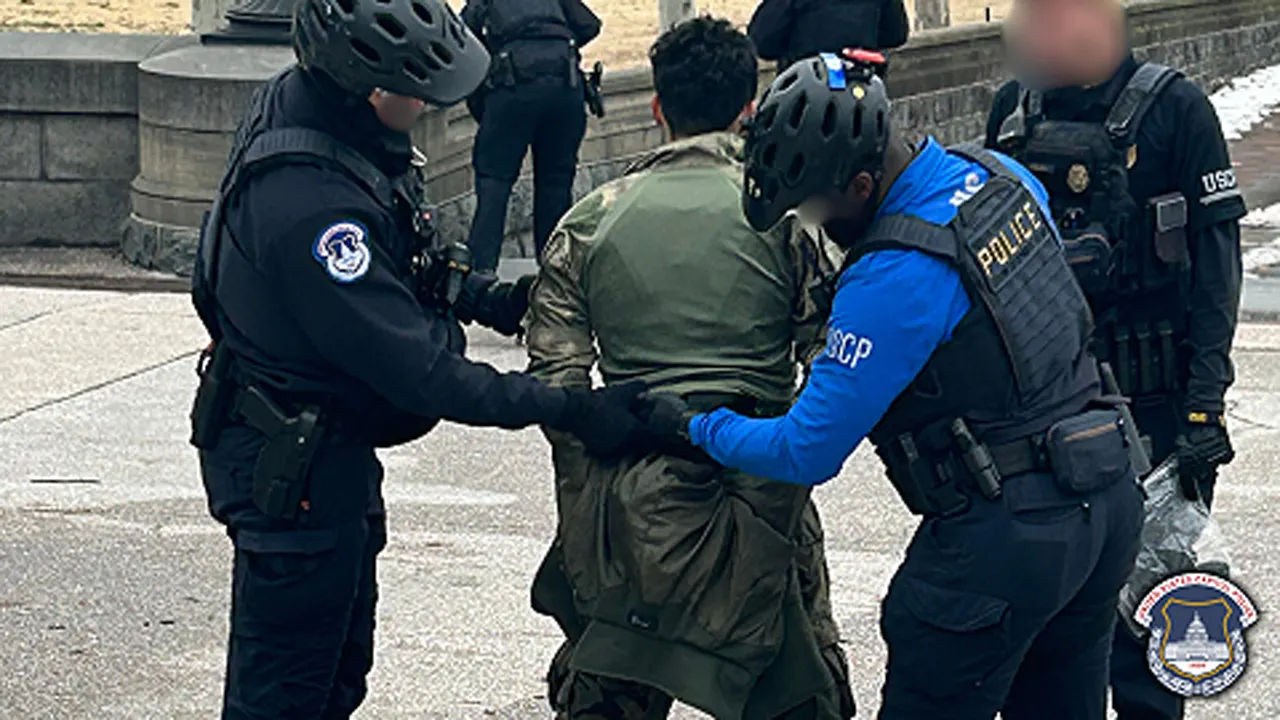
As Carter ascended the grand stone stairs of the U.S. Capitol, his path intersected with the vigilant gaze of a uniformed officer, injecting a pulse of human tension into the unfolding drama. The officer’s voice cut through the air, a calm amidst the chaos, inquiring about what Camacho was carrying—a standard protocol that has protected countless since. Their interaction painted a vivid picture of courage on both sides: the officer, a dedicated professional who has sworn to safeguard the seat of government, and Camacho, a youthful intruder whose intentions were shrouded in mystery. In this climactic meeting, emotions likely surged—anticipation for Camacho, alertness for the guard—as words bridged the gap between stranger and sentinel. Camacho raised his right arm, clutching the shotgun, a gesture that could have escalated instantly but instead led to compliance. The records describe him halting and getting to the ground, a moment of surrender that humanizes the encounter, revealing not just obedience but perhaps the weight of realization hitting him as crowds and cameras lingered nearby. Imagine the officer’s professionalism, honed by years of training for such scenarios, balancing empathy with duty to ensure safety. Camacho’s response to the query was telling: he expressed a desire to speak with a congressmember, framing his intrusion as a quest for dialogue rather than harm. This exchange transforms the incident from a headline-grabbing commotion to a conversation about unmet needs, where a young man’s voice sought recognition in a system that often feels opaque. The officer’s cautionary steps—securing the scene while probing motives—highlight the human element of law enforcement, where quick decisions protect lives. In recounting this, one feels the palpable stress: heart rates spiking, breaths held, as de-escalation prevailed. Camacho’s willingness to talk underscored his humanity, pointing to insecurities or convictions that propelled him across state lines. This paragraph of the narrative invites readers to empathize with the officials too, who embody the frontline guardians of democracy, responding with poise to unpredictable challenges. By humanizing the standoff, we see it as a testament to communication’s power, where words defused potential violence, fostering understanding in an era rife with division.
The details of the weapon and its ammunition underscored the gravity of Carter Camacho’s actions, revealing a meticulously prepared setup that spoke to premeditation and peril. The shotgun, fully loaded with seven rounds and its safety disengaged, carried an additional 17 rounds attached to the stock—a portable arsenal that escalated the threat level instantly. Nearby his vehicle, a knife further compounded the impression of readiness, painting Camacho as someone who anticipated confrontations. In humanizing this, one can envision the deliberation behind it: late nights researching gear, acquiring items from stores or online, driven by a mix of practicality and drama. At 18, such preparations might stem from thrill-seeking, protective instincts, or misguided idealism, reflecting how juveniles often romanticize conflict without grasping repercussions. The loaded state wasn’t accidental; it indicated intent to be heard, albeit dangerously, evoking comparisons to historical figures who armed themselves for attention. Authorities seized these elements, cataloging them as evidence, which strips the narrative down to cold facts but humanizes the story by considering Camacho’s possible rationale—self-defense in a perceived hostile world, or a theatrical prop for his advocacy. Readers might relate to his choices, recalling times they’ve armed themselves figuratively or literally for life’s battles, whether through arguments or precautions. This armament added layers to his persona: not a random actor, but a calculated one, whose actions mirrored societal debates on gun rights and responsibilities. The knife’s discovery hinted at layers of preparedness, suggesting Camacho envisioned scenarios beyond talking, perhaps protecting against perceived threats on those hallowed grounds. By exploring this weapons narrative, empathy emerges for the young man’s mindset, shaped by influences like media portrayals of heroes and villains. It’s a reminder of how objects, even tools of potential harm, tie into personal stories, urging reflection on access and mindset. This portion of Camacho’s tale bridges facts with feelings, illustrating the human propensity to overprepare when feeling vulnerable, transforming an arrest into a cautionary yet understanding anecdote.
Delving into Carter Camacho’s motives, the court records offer sparse but intriguing clues, centering on his stated intent to speak with a congressmember without specifying anyone. This ambiguity humanizes the young Georgian as a seeker of answers in a polarized political landscape, where everyday issues like economics, justice, or representation drive individuals to extraordinary measures. Imagine the journey from Smyrna: hours in the car, phone silenced, fueled by podcasts, news bites, or personal grievances that culminated in this impulsive pilgrimage. At 18, Camacho likely inherited influences from family discussions, school debates, or online echo chambers, crafting a worldview that demanded direct engagement. His body armor and camo gear further suggest preparation for resistance, perhaps anticipating dismissal or danger in approaching power structures. In humanizing this pursuit, one sees a relatable figure—echoing frustrations of youth worldwide—who felt compelled to bypass bureaucracy for a raw conversation. Unlike formal channels like letters or town halls, Camacho’s bold advance was spurred by urgency, a human impulse when virtual interactions fall short. The lack of a named lawmaker broadens the motive to encompass broader discontent, possibly linked to current events like policy debates or social unrest. Authorities probed for deeper reasons, and while specifics remain obscure, humanizing Camacho involves considering psychosocial factors: from mental health challenges to ideological fervor, shaping a narrative of someone lost and searching. This quest for dialogue, armed as it was, invites sympathy for the underlying needs—belonging, representation, validation—that propel young adults. Readers may draw parallels to their own civic engagements or disillusions, fostering a compassionate view. Ultimately, this motive exploration softens the incident, portraying Camacho not as a villain, but a product of his times, whose actions begged for understanding amidst the chaos.
In the aftermath, as Carter Camacho faced his court appearance and bond denial, reordered to remain in custody until March 2 for unlawful possession of a gun on Capitol grounds, the incident reverberated with implications for security and society. The area cleared and reopened swiftly, but the psychological echoes lingered, prompting reflections on vulnerability in emblematic places. Humanizing this closure involves picturing Camacho’s family and community in Smyrna, grappling with shock and support, as news spread via apps and alerts. His charge highlighted the stringent measures post-January 6, where loaded firearms near power centers trigger alarms, safeguarding against escalation. For Camacho, the no-bond order underscored perceived risk, isolating a young man in a system designed for accountability. This narrative invites empathy for the human toll: loneliness in detention, future uncertainties, and lessons learned about boundaries. Broader takeaways emerge for Americans, emphasizing open communication over rash gestures, yet acknowledging the desperation that breeds them. The event, listeners to Fox News articles might note, evolves into a story of prevention and growth, with Camacho’s path symbolizing cautionary arcs. In reconnecting with humanity, we see not just a defendant, but a warning against unchanneled passions, urging dialogues that avert such confrontations. This summation ties the threads, humanizing the ripple effects on all involved—officers, public, and the young protagonist—into a testament to resilience and reform. As investigations continue, the tale prompts introspection, blending facts with feelings to illustrate how individual actions ripple through collective consciousness, fostering understanding in an uncertain world.