





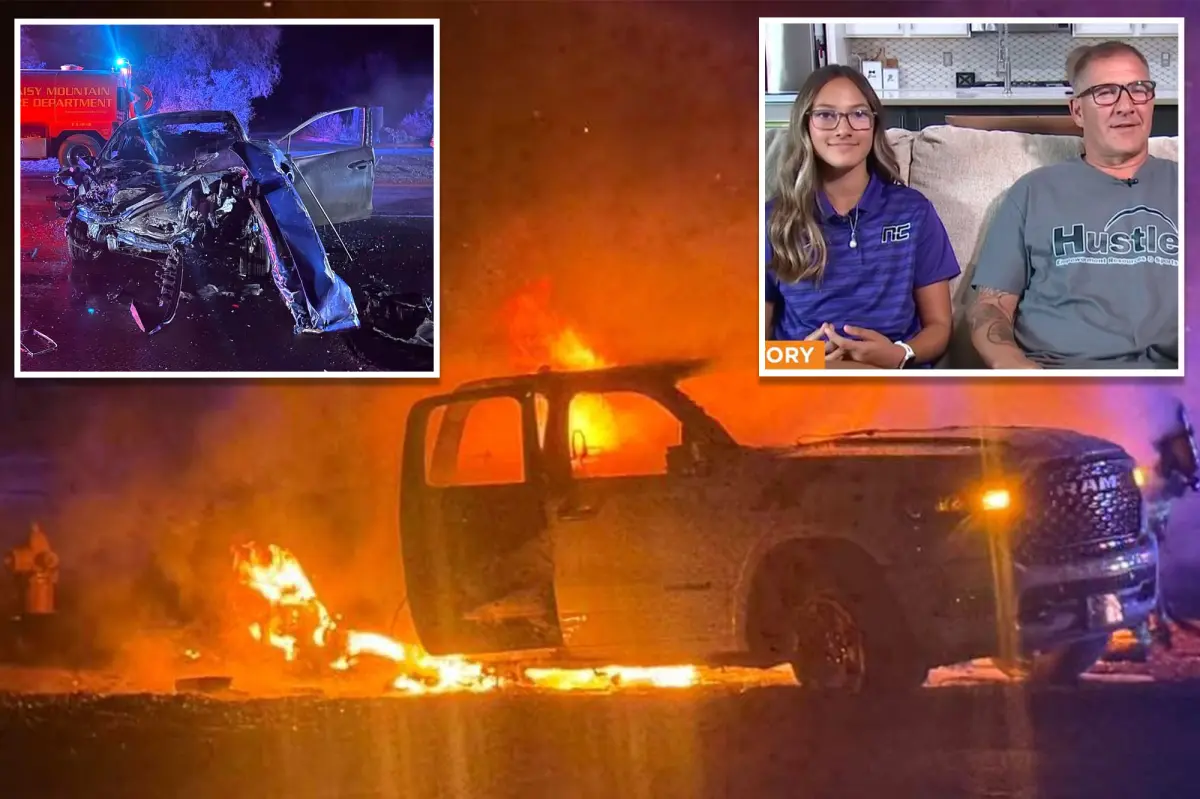
The vast, open stretches of Arizona’s Carefree Highway are usually a sanctuary of quiet beauty, where the desert sky meets the sprawling horizon in a tranquil stillness. On a recent Saturday night, this peaceful landscape was shattered in an instant, transforming into a chaotic theater of fire, twisted metal, and desperate screams. Casey Reinke, a local luxury real estate agent who once proudly served his country as a United States Marine, was driving down the highway with his fourteen-year-old daughter, Elliana. It was supposed to be a routine, quiet evening of father-daughter bonding, wrapped in the comfortable silence of a weekend drive. However, their peaceful journey was violently interrupted when a speeding sedan, traveling at a terrifying velocity of over 100 miles per hour, lost control and slammed directly into a pickup truck. The impact was catastrophic; the high-speed collision instantly ruptured the pickup truck’s fuel tank, igniting a highly volatile mixture of gasoline and heat that caused both vehicles to immediately erupt into a ferocious wall of bright orange flames and thick, suffocating black smoke.
For Casey, the luxury real estate agent who spent his days negotiating high-end property deals, the transition from civilian father to combat-trained life saver occurred in the span of a single heartbeat. The moment the fiery explosion bloomed in his windshield, his deeply ingrained Marine training—forged through years of rigorous discipline and high-stress scenarios—suppressed any natural instinct to seek personal safety. He did not hesitate, pull back, or wait for emergency sirens to echo in the distance. Instructing his daughter Elliana with calm but absolute authority to immediately dial 911, Casey vaulted out of his vehicle and ran directly toward the blinding furnace of the wreckage. Meanwhile, Elliana, displaying a maturity and composure far beyond her fourteen years, did not panic. As she communicated vital information to the emergency dispatchers, she stood on the roadside flagging down passing motorists, quickly transforming shocked and hesitant bystanders into a cohesive, impromptu team of civilian rescuers who were ready to risk their lives for complete strangers.
With the rescue squad assembled by Elliana’s quick actions, Casey confronted a scene of absolute devastation, describing the sudden cooperation of the gathered bystanders as a beautiful moment of unspoken orchestration amid absolute chaos. The driver of the sedan was pulled to safety by Casey’s hands alone, but a far more terrifying challenge awaited them at the overturned pickup truck, where five terrified occupants were trapped inside the cabin as aggressive flames began to lick the bumper and threaten the cab. Working in perfect harmony without a single rehearsal, the group of Good Samaritans combined their physical strength to heave against the weight of the overturned truck, successfully righting the vehicle. Under Casey’s direction, they began pulling the five remaining victims through the jagged, shattered glass of the vehicle’s windows, fighting against the suffocating heat of the growing blaze that threatened to engulf them all at any second.
The physical toll of the crash was devastating, leaving two women in critical condition with severe, life-altering burns that have since required multiple intense surgical procedures and an incredibly long, agonizing road to recovery. Yet, despite the gravity of their injuries, they survived—a miraculous outcome that would have been statistically impossible without the immediate, selfless intervention of the passersby. One of the survivors, Jeffrey Johnson, who was traveling in the pickup truck with his family, expressed his deep, tearful gratitude to the heavens, stating that he and his loved ones “thank the Lord” for the existence of people like Casey and the brave collective of impromptu rescuers who stopped to help. Johnson later recalled the sheer terror of the event, noting that the vehicle that caused the accident was traveling at such an extreme speed that they never stood a chance of avoiding the impact on their own, emphasizing that the quick-thinking strangers who emerged from the darkness saved their lives.
Looking back on those breathless, adrenaline-fueled minutes where his own life hung in the balance, Casey admitted that he completely disregarded his own physical safety as he ran into the heat of the fire. His mind was entirely occupied by a single, terrifying thought: the unbearable tragedy of what would happen to those families if he and the other bystanders failed to act quickly enough. This unyielding resolve to prioritize the lives of others over his own safety is a defining characteristic of his character, one that he traces back to his foundational years in the military. It was a stark reminder that once a person becomes a Marine, they carry that internal compass of duty, courage, and rapid problem-solving for the rest of their lives, rising to meet the most harrowing challenges when the clock is ticking down and every second counts.
When database numbers and official reports are filed, the true victory remains the human lives that were preserved through an extraordinary display of civilian bravery and familial love. Responding firefighters who arrived at the scene to extinguish the smoldering ruins of the vehicles made it a point to tell young Elliana that her father’s instant, decisive leadership singlehanded saved all six occupants from burning to death. For Elliana, however, the revelation that her father was a hero was nothing new; she had known of his character her entire life, taking to social media to proudly share her admiration by stating, “My dad is that guy. Proud of him.” In an era often defined by division, the story of Casey and Elliana Reinke serves as a powerful reminder of the profound impact of everyday heroism, showing how a father’s enduring values and a daughter’s quiet strength can unite a group of strangers to perform a miracle on a dark Arizona highway.