


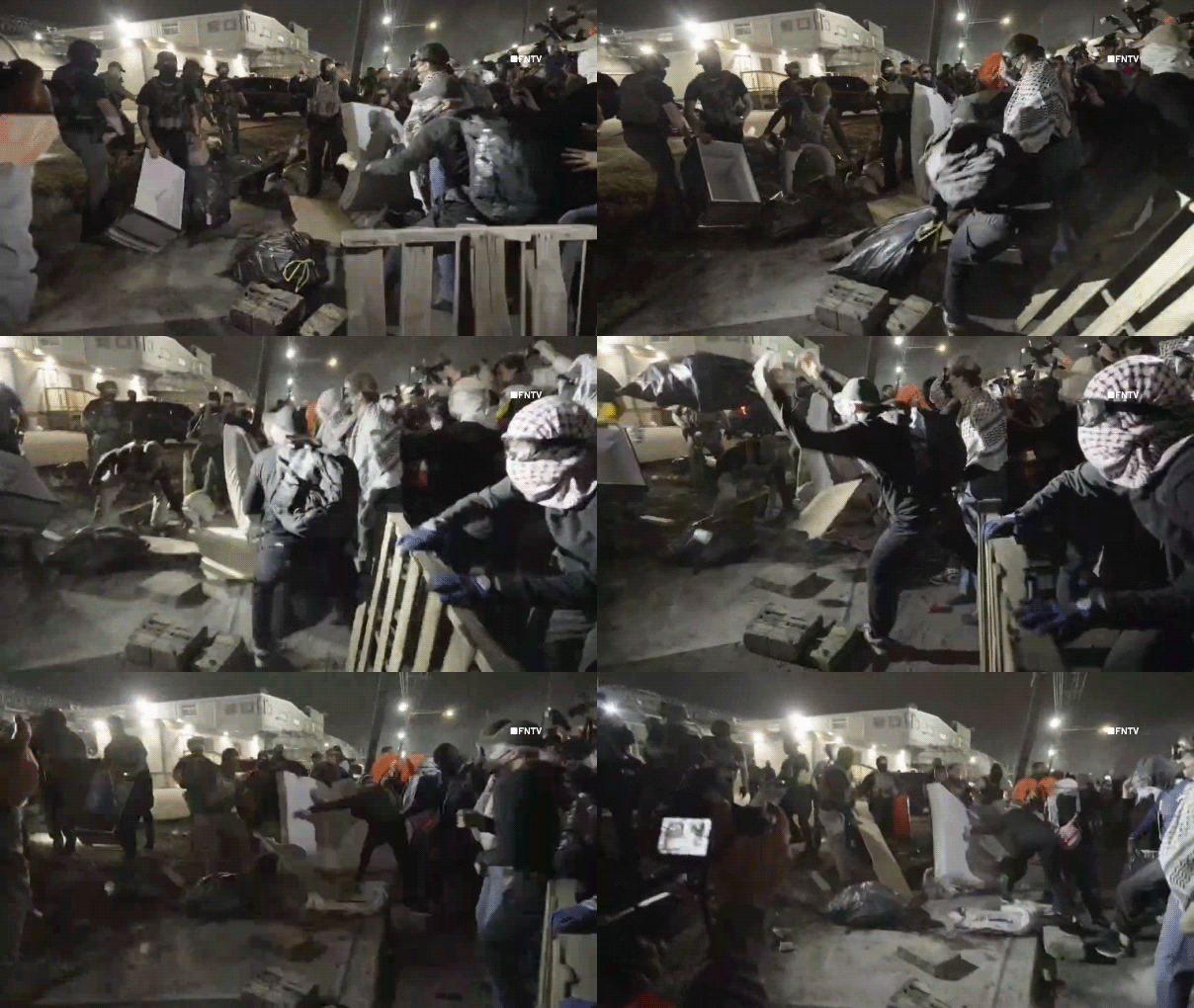
The gritty, heavily industrial landscape of Newark, New Jersey, has transformed into a literal and figurative crucible this week as the simmering frustrations of a deeply divided nation erupted into sustained, violent physical conflict. Under the unforgiving glare of security floodlights and the flashing red and blue strobes of emergency vehicles, the bleak, concrete exterior of the Delaney Hall detention center became the stage for a dramatic and chaotic confrontation. For five consecutive nights, a crowd of passionate, keffiyeh-clad demonstrators has gathered along the chain-link barriers, their voices hoarse from chanting slogans against the federal government’s immigration policies and the allegedly inhumane treatment of individuals inside the facility. What began as a series of vigils to protest the conditions of undocumented immigrants quickly devolved into a chaotic, close-quarters street battle between civilian activists and federal Immigration and Customs Enforcement (ICE) agents. In the damp darkness of Wednesday night, the air grew thick with the acrid stench of chemical irritants and the rising heat of human rage. Protesters, determined to breach the perimeter or hold their ground, began utilizing whatever items they could scavenge from the surrounding industrial zone, hoisting stained mattresses and heavy, bright orange traffic cones to serve as improvised defensive riot shields. The verbal assault was just as sharp as the physical debris, with agitators screaming deeply personal invectives like “kill yourself, bro!” and “how do you live with yourself?” through the barrication, directly targeting the consciences of the federal agents standing watch. These face-to-face clashes have laid bare the profound emotional chasm dividing those who view the private detention facility as an engine of institutional cruelty and those charged with maintaining order and upholding federal law in an increasingly hostile environment.
At the ultimate center of this escalating public crisis lies a deeply human drama: the agonizing plight of the detainees locked inside the gray walls of Delaney Hall, whose desperate plea for physical survival served as the catalyst for the protests. The emotional match was lit when a handwritten open letter, authored collectively by the detainees, managed to make its way past the facility’s extensive security apparatus and into the hands of local immigration advocacy groups. In raw, heartbreaking detail, the authors described their daily reality as a form of “physical and psychological torture,” detailing systemic neglect that left them starving, deprived of basic medical attention, and completely isolated from their anxious families and legal representatives. To those on the outside, this letter was not just a list of grievances; it was a cry of desperation from human beings who felt entirely discarded by the state, living in a state of suspended animation while trapped in a for-profit detention machine. However, the official response from the Department of Homeland Security (DHS) presented a thoroughly sanitized, starkly contrasting version of reality. In a formal statement designed to quell public outrage, federal officials adamantly denied all allegations of abuse, asserting that the facility fully adheres to humane standards. DHS maintained that every detainee at Delaney Hall is guaranteed three balanced meals a day, continuous access to clean drinking water, fresh clothing, comfortable bedding, hot showers, soap, and essential hygiene products, alongside the right to use telephones to consult with legal counsel and check on their families. This immense, irreconcilable gap between the raw pain expressed by the detainees and the sterile, clinical assurances of federal administrators has only deepened the mutual distrust, convincing the protesters that they are fighting against a system designed to silence the vulnerable.
As the sun set on Wednesday night, the standoff outside Delaney Hall escalated into a tactical, low-intensity urban conflict that severely disrupted the surrounding Newark community and forced both sides to their absolute physical limits. In their bid to resist federal containment, the demonstrators built formidable blockades across the busy industrial corridor, utilizing heavy concrete blocks and filled sandbags to fortify their position and block vital transportation arteries. This physical disruption quickly impacted local workers, as illustrated by a tense moment when an ordinary truck driver, his livelihood stalled by the gridlock, climbed out of his cab to confront the crowd directly, pleading, “Come on! What’s wrong with y’all?” in a voice crackling with exhaustion and disbelief. Meanwhile, the clash at the barrier line reached a fever pitch, with ICE agents responding to the barrage of flying debris with aggressive crowd-control measures, including the deployment of heavy wooden batons, burning pepper spray, and chemical-filled pepper balls fired into the crowd. The desperation on both sides was captured in dramatic video footage, showcasing moments of raw fury, such as when ICE agents yanked a wooden pallet away from the protesters and hurled it straight back into the crowd to drive them back. This followed a previous night of violence where two individuals were arrested for allegedly spraying law enforcement officers with an unknown chemical substance, demonstrating how quickly the defensive actions of both sides have spiraled into a dangerous cycle of reciprocal aggression. The scene was a chaotic tapestry of flashing lights, the sharp pop of crowd-control launchers, and the agonizing wails of demonstrators blinded by chemical agents, painting a visceral picture of a society where peaceful dialogue has completely broken down, leaving only the blunt instruments of force and physical resistance.
The highly publicized violence and humanitarian allegations rapidly elevated the local dispute into a major political event, drawing high-profile political figures to the gates of the Newark facility on Memorial Day. United States Senator Andy Kim and Democratic Representative Mikie Sherrill arrived at Delaney Hall with the intention of exercising their constitutional oversight duties to inspect the controversial living conditions inside. However, the visit immediately highlighted the deep institutional tensions at play, as Senator Kim was permitted to enter the facility for an inspection while Representative Sherrill was locked out, barred at the entrance by facility staff. Following his walk-through, Senator Kim took to social media to share his findings, publishing a series of detailed updates that described the conditions within Delaney Hall as “unacceptable,” pointing to symbolic failures—such as a carton of milk on a storage shelf with an expiration date set for the very next day—as evidence of systemic neglect. For many, his observations validated the concerns of the protesters and gave a powerful legislative voice to the silent struggle of the detainees inside. Yet, to supporters of the enforcement agency and conservative commentators, the lawmakers’ presence was viewed as a calculated piece of political theater designed to exploit a volatile security situation for partisan gain rather than a genuine, bipartisan effort to improve administrative standards. This political tug-of-war transformed Delaney Hall from an obscure local detention center into a highly symbolic national stage, where the grand ideological debates surrounding American sovereignty, human rights, and the ethics of civil disobedience were fought out in real-time.
The federal backlash to these political interventions was swift, aggressive, and highly defensive, led by conservative lawmakers and officials who sought to firmly reestablish the narrative of national sovereignty and the rule of law. Expressing profound anger over the escalating unrest, Republican political figure Markwayne Mullin publicly condemned Senator Andy Kim’s social media campaign, accusing him of spreading “false narratives” and irresponsibly “adding fuel to the fire” during an ongoing security crisis. Mullin pointedly reminded the public that Delaney Hall is a high-security detention facility built to house individuals who have entered the country illegally, asserting that “this isn’t a Holiday Inn” and that those detained are there because they broke the nation’s laws. Mullin’s sharp rhetoric shifted the national conversation away from the comfort of the detainees and directly onto the safety and authority of the federal officers, who had been subjected to physical assaults and targeted with unidentified chemical sprays by anti-ICE rioters. He went on to lay the blame for the chaos directly at the feet of New Jersey’s progressive leadership, claiming that state authorities were actively preventing local and state police departments from responding to federal requests for emergency assistance. According to Mullin, this politically motivated lack of cooperation left a handful of federal ICE agents isolated and vulnerable against a hostile crowd, a dangerous situation he attributed to local sanctuary policies that deliberately restrict state-level law enforcement from coordinating with federal immigration authorities.
The ongoing conflict at Delaney Hall now threatens to spill over into the broader regional economy, highlighting how local immigration standoffs can trigger wider systemic disruptions. In a stern warning issued during a national television appearance, Mullin cautioned that if New Jersey’s local and state police continue to withhold their support, the federal government will be forced to take drastic retaliatory measures to protect its personnel. He warned that Customs and Border Protection (CBP) officers may have to be reassigned from their normal duties processing international arrivals at Newark Liberty International Airport to provide security reinforcement for the besieged ICE agents at Delaney Hall. Such a re-allocation of federal resources would undoubtedly result in massive delays for international travelers, disrupting one of the busiest travel corridors in the world and demonstrating the far-reaching, tangible consequences of the state’s political standoff with federal immigration enforcement. Ultimately, the crisis at Delaney Hall serves as a haunting, complex microcosm of the contemporary American immigration crisis—a stark system where the raw human suffering of migrants, the physical vulnerability of law enforcement officers, the legal obligations of federal agencies, and the bitter divisions of partisan politics collide without hope of easy compromise. As both sides dig in for a protracted struggle, the fundamental questions of human dignity and sovereign law enforcement remain completely unresolved, leaving the community of Newark, the detainees inside, and the nation at large trapped in a painful, seemingly endless cycle of hostility.