


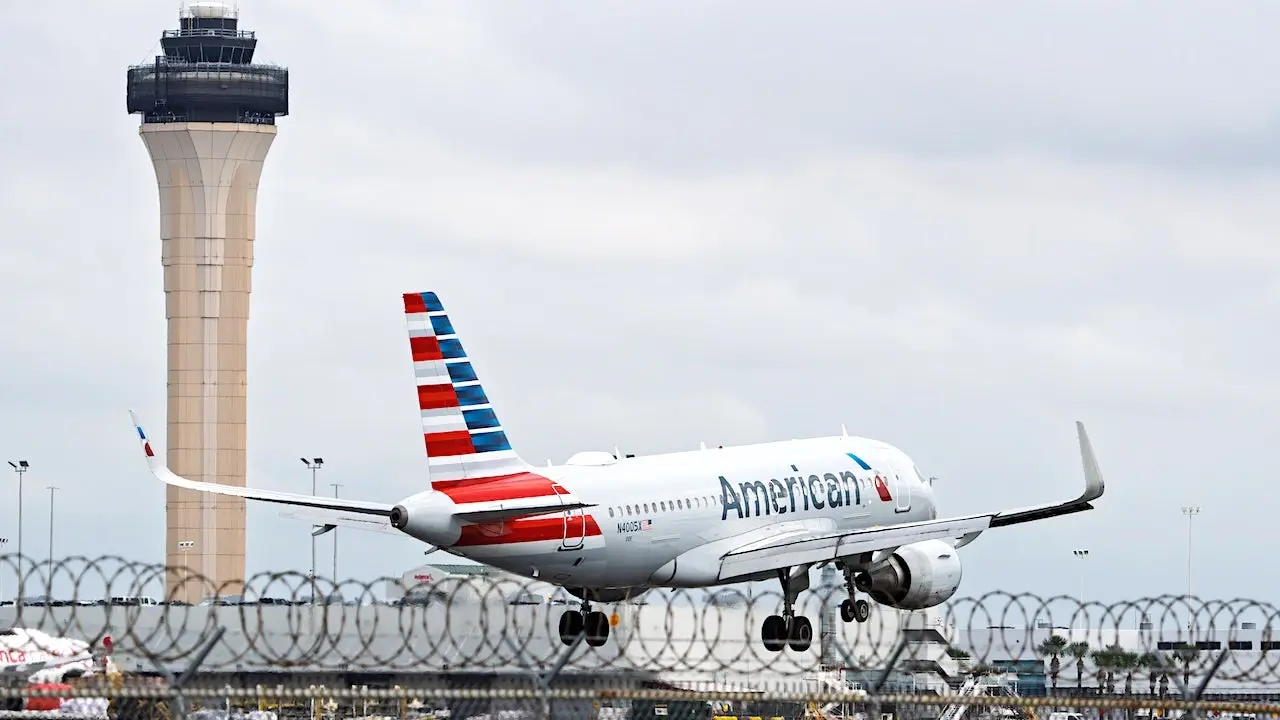
On a warm, bustling Friday evening at Miami International Airport, the routine predictability of modern air travel was suddenly shattered by a split-second decision that averted an unimaginable tragedy. American Airlines Flight 308, fully loaded with passengers eager to escape to the pink-sand beaches of Bermuda, was hurtling down Runway 8 Right, its engines roaring with the intense thrust required for takeoff. Inside the cabin, travelers were settling into their seats, perhaps reading, listening to music, or looking out at the glittering Florida coastline, completely unaware of the danger rapidly materializing ahead. Just as the aircraft gained speed, a sleek business jet mistakenly taxied onto the active runway directly in the commercial liner’s path, bringing the two fast-moving aircraft within a terrifying third of a mile of each other. At that critical moment, technology took a back seat to raw human instinct; rather than relying solely on their flight instruments or the green lights from air traffic control, the alert American Airlines pilots relied on old-fashioned visual vigilance. Spotting the hazard on the tarmac with their own eyes, they slammed on the brakes, aborting the takeoff and executing a high-stakes stop that saved hundreds of lives from what could have been a catastrophic collision.
The terrifying sequence of events was mirrored by a tense, confusing exchange over the air traffic control radio frequencies, highlighting how easily human miscommunication can threaten aviation safety. Recorded audio from the tower revealed a frantic scramble to piece together how a business jet, NetJets Flight EJA434, ended up in the path of a departing airliner. A controller had instructed a cargo plane, Amerijet Flight 461, to cross one runway and hold short of another, but the pilot of the NetJets aircraft—which was being moved by a third-party maintenance vendor rather than its normal crew—mistook the directive as their own. “You just crossed an active runway,” an agitated controller told the business jet after the close call, to which the pilot quickly defended, “You just told me to cross the runway, sir.” The controller immediately corrected the misunderstanding, identifying the specific cargo callsign, but the damage of the misinterpretation had already been done. It was a chilling reminder that in a world governed by complex data, the ultimate point of failure remains the spoken word delivered over a crackling radio, where a single misheard name can dictate the difference between life and death.
In the immediate aftermath of the near-miss, a collective sigh of relief echoed through the aviation community, though the incident left behind a trail of investigations and lingering questions. American Airlines later released a statement expressing deep gratitude for the quick, decisive actions of their cockpit crew and thanking their passengers for their patience during the unexpected ordeal. The federal government quickly intervened, with the Federal Aviation Administration announcing a formal investigation into how the business jet crossed the active runway without authorization. NetJets was also quick to clarify the situation, confirming that although the aircraft belonged to their fleet, it was not under their operational control at the time of the incident but was instead being handled by an external maintenance operator. Meanwhile, the shaken passengers of Flight 308 eventually made their way to Bermuda, landing safely but roughly two hours behind schedule—a small price to pay for a delay that ultimately preserved their lives.
This terrifying close call in Miami did not happen in a vacuum; it occurred on the eve of the hectic July 4th holiday travel season, serving as a stark warning about the immense pressures currently facing the global aviation infrastructure. As millions of passengers pack into airports, air traffic controllers and flight crews are working under unprecedented stress, battling severe staffing shortages, scheduling fatigue, and an increasingly crowded airspace. The modern aviation system is a marvel of efficiency, but it is operating at its absolute limit, leaving very little margin for error when things go wrong. When airports are pushed to their maximum capacity, the likelihood of a misheard instruction or a mental lapse increases exponentially. Situations like the one in Miami demonstrate that the thin line protecting passengers from disaster is increasingly resting on the shoulders of frontline workers—the pilots and controllers who must remain flawlessly vigilant even when the system around them is strained to its breaking point.
To make matters worse, this incident is part of a deeply concerning trend of runway incursions and near-misses that have plagued the aviation industry in recent months, shaking public confidence in air travel. Just earlier this year, a tragic runway collision involved an Air Canada flight that struck an emergency truck that had mistakenly wandered onto an active runway, resulting in a fiery crash that claimed the lives of two pilots and left dozens injured. More recently, a United Airlines flight narrowly avoided a collision with an unauthorized drone during its approach to Newark Liberty International Airport, coming within 100 feet of the unmanned device. Even more harrowing was a near-miss at Boston Logan International Airport, where an American Airlines plane and a Delta Air Lines jet came within an estimated 300 feet of one another during a runway conflict. Each of these events serves as a stark reminder that despite decades of technological advancement, the runway remains one of the most hazardous environments in the entire transport network.
Ultimately, the miracle in Miami highlights the irreplaceable value of human oversight in an increasingly automated world. While aviation safety agencies continually push for advanced ground-radar systems and automated cockpit warnings, the visual confirmation made by the American Airlines pilots proves that human eyes and quick reflexes are still the ultimate failsafe. Technology can map out the skies and track coordinates with incredible precision, but it cannot replace the gut instinct of an experienced pilot who senses that something is wrong and decides to act. As the FAA continues its investigation into the Miami near-miss and works to address the systemic vulnerabilities of the nation’s runways, passengers can take comfort in knowing that dedicated aviation professionals are still watching out for them. In the end, it was not a computer program or an automated system that saved Flight 308 from disaster, but the simple, timeless act of a pilot looking out the window and choosing safety over assumption.