


A Challenging Touchdown: LATAM Flight’s Remarkable Landing Incident in Atlanta
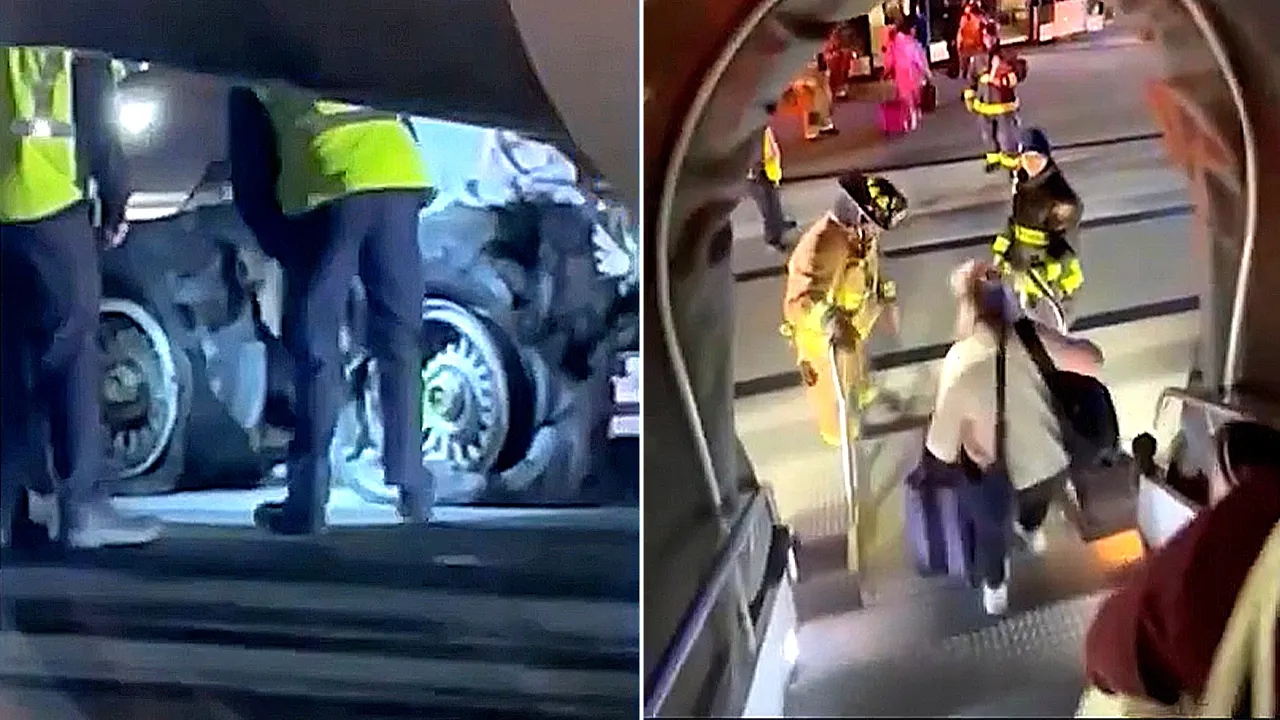
In a startling incident at Hartsfield-Jackson International Airport in Atlanta on Tuesday evening, LATAM Flight 2482’s arrival turned dramatic when all eight of its landing tires burst upon touchdown. The Boeing 767, which had completed a seven-hour journey from Lima, Peru, experienced what aviation experts are calling a highly unusual mechanical failure. While no injuries were reported among the 221 passengers and crew, the incident left travelers stranded on the tarmac for two hours before airport buses could transport them to the terminal. Airport witnesses described hearing multiple loud popping sounds followed by visible smoke as the aircraft made contact with the runway, creating a tense scene that quickly drew emergency responders.
The technical details of the incident point to something more complex than a simple hard landing. According to retired Captain Paul Carr, who spoke with Fox 5 Atlanta and has extensive experience flying Boeing 767 aircraft, the simultaneous failure of all eight tires is extraordinarily rare. “That’s very odd for all eight tires to blow on a landing,” Carr explained to local media. His professional assessment suggests the likely culprit was a malfunction in the aircraft’s automatic braking system, which may have inadvertently locked all wheels simultaneously. This malfunction would have created tremendous friction as the massive aircraft continued moving along the tarmac, ultimately causing every tire to fail under the extreme stress. Such a scenario represents a significant but thankfully non-catastrophic failure of critical landing systems.
The physical impact inside the cabin revealed the severity of the landing forces, even as the aircraft maintained its structural integrity. According to reports, the sudden deceleration and vibration caused interior damage including dislodged cabin panels and a bathroom door that was completely torn from its hinges. One passenger described the unsettling sensation of wheels “rattling on the tarmac” for an unusually long time as the aircraft struggled to come to a complete stop. Social media posts from airport employees corroborated the dramatic scene, with one worker writing, “I was at work and my coworkers and I heard a couple of loud bangs and saw a lot of smoke. One of the airport ops guys told us that the plane landed so hard that all the tires blew out.”
This incident highlights the critical importance of redundancy and emergency protocols in commercial aviation. Despite the dramatic tire failures, the pilots maintained control of the aircraft throughout the landing sequence, bringing it to a safe stop without injuries to passengers or crew. The Boeing 767’s robust design includes multiple safety systems specifically engineered to handle partial landing gear failures, though simultaneous failure of all tires represents an edge case that pilots rarely encounter in their careers. The successful management of this emergency speaks to both the aircraft’s engineering resilience and the crew’s professional handling of an unexpected crisis. While certainly frightening for those aboard, the incident demonstrates how modern aviation’s layered safety approaches prevent mechanical failures from becoming tragedies.
For the passengers, what should have been a routine end to their international journey turned into hours of uncertainty and delay. After the aircraft came to a stop on the runway, emergency protocols required that everyone remain aboard while airport operations assessed the situation and arranged for alternative transportation. The two-hour wait on the tarmac added to the stress of the experience, though airport buses eventually arrived to transport all 221 people safely to the terminal. Throughout aviation history, landing gear problems have represented some of the most visually dramatic but statistically manageable emergency situations that commercial flights encounter. While the incident temporarily shut down one runway, airport officials noted that overall operations at the busy international hub continued with minimal disruption to other flights and schedules.
The Federal Aviation Administration will likely conduct a thorough investigation into this unusual mechanical failure, working with both the airline and Boeing to determine the exact sequence of events that led to all eight tires failing simultaneously. Such investigations typically examine maintenance records, the aircraft’s service history, and the specific conditions present during the landing approach. For LATAM, a major South American carrier, this incident represents a serious mechanical anomaly that will require careful analysis to prevent recurrence across their fleet. Boeing, still navigating broader scrutiny of their manufacturing and quality control processes, will also have interest in understanding whether this represents an isolated incident or points to potential systemic concerns with the 767’s braking systems. As with most aviation incidents, the detailed investigation findings will eventually contribute to improved safety protocols and potentially modified maintenance requirements for similar aircraft worldwide.