


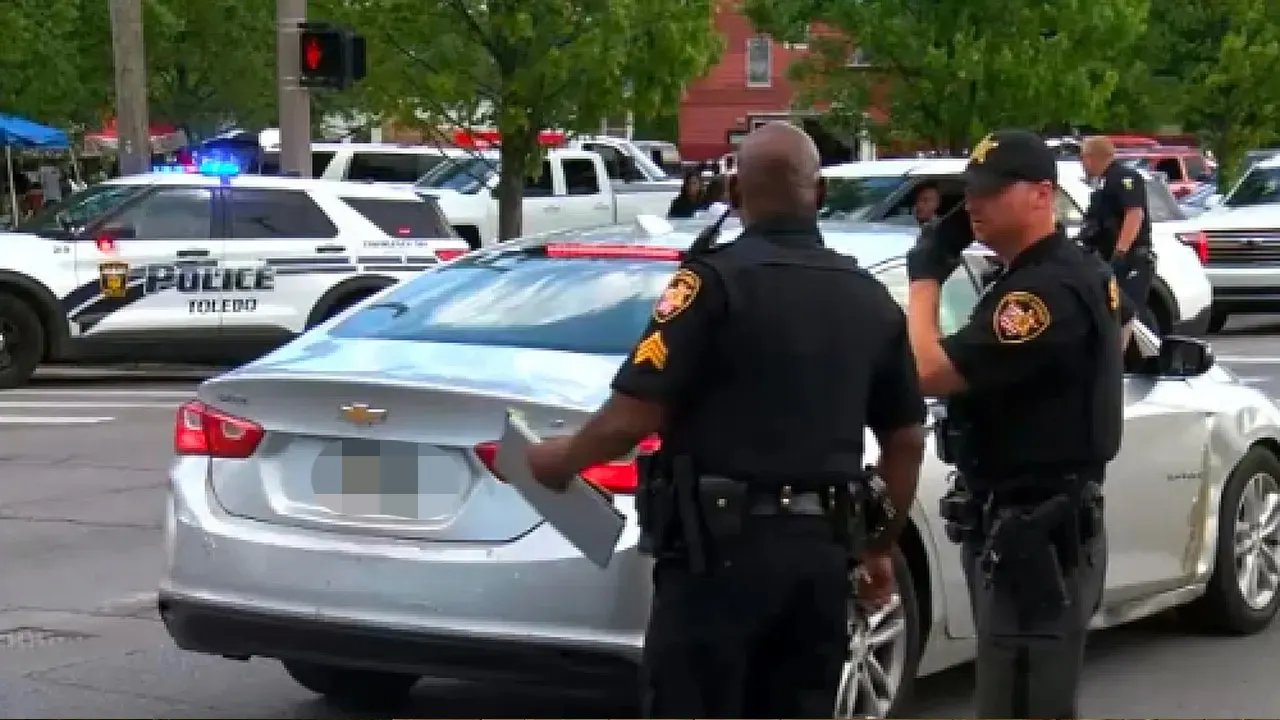
For decades, the historic neighborhood of Toledo’s Old West End has stood as a crown jewel of architectural beauty and community solidarity, renowned for its stunning Victorian homes, leafy streets, and an enduring sense of neighborly warmth that peaks each year during its celebrated annual festival. This beloved weekend gathering is far more than a simple street fair; it is a vital community ritual where local artists exhibit their crafts, street musicians fill the air with melody, children play in safety, and families of all backgrounds come together to celebrate their shared home. Under the bright late-spring sky, this year’s event began with the same vibrant energy, promising a peaceful sanctuary where the stresses of daily life could be briefly forgotten in favor of collective joy and neighborhood pride. However, on a warm Saturday afternoon around 5:37 p.m., this idyllic scene was suddenly and violently torn apart near the intersection of Delaware Avenue and Glenwood Avenue. In an instant, the gentle hum of laughter and chatter was replaced by the terrifying, unmistakable crackle of rapid gunfire echoing off the historic brick facades. Panic swept through the crowd as hundreds of unsuspecting festival-goers, including young children and elderly residents, were forced to flee for their lives, diving behind parked vehicles, ducking into local gardens, and scrambling for any available cover. The terrifying transition from an atmosphere of peaceful celebration to one of raw, life-or-death survival left the entire community in a state of profound shock, serving as a devastating reminder of how quickly the sacred spaces of American civic life can be penetrated by modern violence.
Amidst the empty streets and scattered festival banners left in the wake of the gunfire, the true human cost of this tragedy quickly became apparent, centering on twelve distinct lives that were suddenly and violently altered. The victims of this senseless act of violence span a heartbreakingly wide demographic range, from a vulnerable fourteen-year-old child whose youth has now been tragically marked by the horror of gun violence, to a sixty-one-year-old elder who had merely set out to enjoy a peaceful weekend afternoon in his community. This broad age range underscores the indiscriminate nature of the threat, leaving families to grapple with the painful reality that no one, regardless of age or innocence, was safe in that moment. First responders and brave bystanders rushed toward the danger, administering crucial first aid and stabilizing multiple victims who were suffering from traumatic and potentially life-threatening gunshot wounds. In the anxious hours that followed, the Toledo community waited with bated breath for updates from the hospital, fearing the worst for their neighbors, friends, and loved ones. By Monday morning, a collective sigh of relief washed over the city as the Toledo Police Department released a heartening progress report, confirming that all twelve victims had been stabilized and were continuing to show steady physical improvement. However, while modern medicine can repair the physical damage caused by stray bullets, the deeper, invisible psychological trauma of surviving a mass shooting will require a far longer and more complex healing process for the survivors and their families, who must now rebuild their sense of safety in a world that can feel suddenly hostile.
As the chaos of the immediate emergency response subsided, the focus of the Toledo Police Department shifted to the meticulous and urgent task of identifying those responsible for transforming a peaceful community festival into a war zone. Ballistics experts and forensic investigators spent hours scouring the crime scene near Delaware and Glenwood Avenues, documenting evidence, recovering shell casings, and trying to reconstruct the exact sequence of events that led to the violence. According to preliminary findings shared by investigators, the mass shooting did not appear to be a targeted attack aimed at the festival itself, but rather the catastrophic byproduct of a reckless gun battle between at least two heavily armed individuals who chose to settle a dispute by firing wildly at each other in the middle of a dense crowd. This extreme disregard for human life effectively turned innocent bystanders into shielding targets, highlighting a terrifying trend of interpersonal conflicts spilling over into public spaces with deadly consequences. Currently, the suspects remain at large, and police are engaged in an active, round-the-clock manhunt to bring them to justice. Detectives are following multiple leads but recognize that community cooperation is vital to solving this crime, prompting the Toledo Police Department to urge anyone with cellular video footage, photographs, or eyewitness accounts to come forward immediately. To facilitate this, authorities have heavily promoted the Crime Stoppers hotline at 419-255-1111, offering a secure, anonymous channel for citizens to share crucial details without fear of retaliation, reinforcing the idea that public safety is a shared responsibility that requires absolute solidarity between law enforcement and the neighborhoods they serve.
Inside police headquarters, the prevailing sentiment among leadership was one of deep frustration, sorrow, and administrative exhaustion. The department had invested significant time, energy, and resources into drafting and executing a comprehensive security plan for the Old West End Festival, strategically positioning officers and resources to ensure that the event could proceed safely and peacefully as it had for decades. Reflecting on this disheartening reality, Deputy Chief Joseph Heffernan publicly lamented that despite the best-laid plans of law enforcement, a few individuals with complete disregard for the community chose to disrupt a beloved, long-standing metropolitan tradition. His words captured a growing frustration among urban police forces nationwide, who find themselves consistently planning for worst-case scenarios only to see their efforts bypassed by spontaneous, high-powered violence. Investigative Lieutenant Dan Gerken echoed this sentiment, describing the scale of the violence as “over the top” and completely unprecedented in the festival’s history. This characterization highlights a troubling shift in the nature of public conflicts, where traditional boundary lines of safety are increasingly ignored, and disputes are settled with rapid-fire weaponry in crowded public squares. This leaves law enforcement agencies struggling with a difficult double-bind: how to maintain the open, welcoming, and vibrant atmosphere of historic community celebrations while at the same time implementing the increasingly militarized, high-visibility security measures necessary to deter modern gun violence and assure a frightened public of their safety.
The moral gravity of the Toledo shooting quickly caught the attention of local and state leaders, who used the national spotlight to voice their outrage and challenge the growing societal acceptance of mass violence. Ohio Governor Mike DeWine, joined by First Lady Fran DeWine, expressed deep concern over the incident, stating emphatically that summer festivals must remain safe spaces where families can bond, play, and connect without the shadow of violence hanging over them. At the local level, Toledo Mayor Wade Kapszukiewicz took his response a step further, addressing the psychological and cultural toll that these recurring tragedies take on the American collective consciousness. In a series of moving public statements, the mayor issued a stark, philosophical warning, insisting that citizens must never shrug their shoulders in defeat or accept this level of public violence as the inevitable transaction cost of living in a free society. He argued that to normalize such events is to surrender the very essence of public freedom and safety, urging his constituents to remain outraged, engaged, and united in their refusal to let gun violence dictate the terms of their daily lives. By explicitly calling out the dangers of desensitization, Mayor Kapszukiewicz framed the tragedy not merely as a localized criminal justice issue, but as a critical fight for the soul, safety, and cultural integrity of both the city of Toledo and the nation as a whole.
In the final analysis, the true measure of Toledo’s character will not be defined by the violence that occurred on Saturday, but by the overwhelming wave of unity, resilience, and compassion that has emerged in its aftermath. Mayor Kapszukiewicz highlighted this defining trait of his city, proudly noting that Toledo has faced more than its fair share of socioeconomic division, hardship, and adversity over the generations, yet its citizens have always allied together to emerge stronger on the other side. This enduring spirit was modeled in real-time by the swift, life-saving actions of the Toledo Police Department and Toledo Fire and Rescue, whose bravery and professionalism under pressure prevented further loss of life and restored order to a chaotic scene. As the physical and emotional dust begins to settle, the residents of the Old West End and the broader Toledo metro area are already reclaiming their streets, pledging to support the victims through their recovery, and refusing to let fear dictate the future of their cherished neighborhood traditions. By standing shoulder to shoulder, neighbor checking on neighbor, local church groups organizing vigils, and community organizers planning next steps, the people of Toledo are demonstrating that the bonds of civic love and mutual support are infinitely stronger than the destructive forces of violence. The path forward will undoubtedly be long and require difficult conversations about security, runaways, and gun reform, but the citizens of Toledo are walking it together, determined to protect their sacred public spaces and ensure that the Old West End Festival remains a beacon of light, art, and community for generations to come.