


For everyday voters and local leaders across the American South, the political ground is shifting with a sudden, disorienting speed that feels more like a seismic tremor than a standard legislative cycle. In the month following a pivotal Supreme Court ruling that significantly weakened the protective canopy of the Voting Rights Act, Republican state lawmakers have redrawn congressional maps at a dizzying pace, turning the region’s electoral process into a chaotic scramble. This rapid-fire redistricting has forced veteran members of Congress to abandon their re-election campaigns, postponed scheduled primary elections, and prompted raw recruits to mount last-minute campaigns for seats that did not even exist a few weeks prior. At the center of this storm are ordinary people, like Mayor Chaz Molder of Columbia, Tennessee, a Democrat who spent months campaigning only to find his own home suddenly, surgically sliced out of the congressional district he hoped to represent. Across the South, from the small towns of Alabama to the sprawling suburbs of Georgia, voters are finding themselves cast as collateral damage in a high-stakes, hyper-partisan game of chess, transforming what should be a straightforward exercise in democratic participation into an agonizing map-reading exercise where the boundaries of their political voices keep disappearing overnight.
This current redistricting frenzy is not an isolated event, but rather the culmination of a larger national struggle over a razor-thin partisan divide in Washington, accelerated by a conservative Supreme Court supermajority. Recognizing the immense challenge of holding onto their narrow margin in the House of Representatives, Republicans had already been looking to redraft maps long before this summer, a strategy heavily championed by former President Donald Trump. Texas ignited the initial spark by rewriting its lines to target several Democratic seats, and while California Democrats attempted to push back with their own mapping maneuvers, it was the Supreme Court’s striking down of Louisiana’s congressional map that truly shattered the fragile status quo in the South. The High Court ruled that Louisiana’s second majority-Black district—won by Democrat Cleo Fields—constituted an unconstitutional use of race in redistricting, a decision that radically elevated the legal threshold required to prove discrimination under the Voting Rights Act. Almost instantly, state legislatures in Alabama, Louisiana, and Tennessee moved to dismantle districts with high concentrations of minority voters, while Florida quickly dissolved four Democratic-held seats to dilute the voting strength of Black and Hispanic communities. For a region where nearly 60 percent of Black Americans reside—marking a historic return of families who once fled the South during the Great Migration—the immediate result is a severe contraction of political power, turning a booming demographic presence into a marginalized political voice.
For many Black Southerners, this aggressive redrawing of boundaries feels less like modern political strategy and more like a deliberate, painful attempt to resurrect the dark eras of disenfranchisement. The legal rollback has reignited a deeply personal debate over how far the South has actually traveled from the segregationist legacies of poll taxes, literacy exams, and violent voter suppression. While Supreme Court Justice Samuel Alito Jr. wrote confidently in his majority opinion that “vast social change has occurred throughout the country and particularly in the South,” the view from the ground is markedly different, filled with a palpable sense of anxiety and heartbreak. Outside a noisy, tense hearing room in the Louisiana State Capitol, seventy-year-old resident Janet Tobias captured this historical dread, expressing a profound fear that the quiet efforts to roll back Black history curricula and diversity initiatives are now matching a structural effort to lock minoritized voices out of the halls of power. This anxiety is shared by veteran statesmen like Representative James Clyburn of South Carolina, a legendary political powerhouse who has spent over three decades fighting to ensure that the unique, often ignored hardships of impoverished, majority-Black Southern communities are brought directly to the floor of Congress. Without these protected districts, many fear that the crucial representation of lived Black experiences in the South—and the critical federal resources that such representation secures—will simply vanish, leaving historically neglected communities without a champion.
In stark contrast, proponents of the new maps view the judicial shift as a clean, colorblind victory that rightfully removes race from the democratic formula altogether. Local Republican officials, such as Ben Lilley, a party chairman in Louisiana, argue that the system should operate as a straightforward meritocracy where anyone, regardless of background, can run and win if they have the right message. Republican mapmakers have consistently dismissed allegations of racism, asserting that their goals are purely partisan—a practice of political gerrymandering that the Supreme Court has repeatedly deemed perfectly legal under federal law. Yet, this ideological debate offers little comfort to the local election administrators and bewildered voters currently caught in the administrative gears of this sudden overhaul. In several states, new maps were forced through just as absentee ballots were being mailed out and early voting booths were preparing to open, prompting a flood of frantic phone calls to congressional offices from citizens asking if the elections had been completely canceled. In Alabama, voters find themselves in a bizarre democratic limbo, waiting for a final judicial decree to determine which of two entirely different congressional maps will be used for a fast-approaching special election, proving that the scramble to consolidate power has created a system so unstable that even basic electoral schedules are collapsing under the weight of partisan ambition.
Remarkably, the frustration surrounding this chaotic redistricting has crossed traditional party lines, uniting a diverse array of Southern voters who are deeply fatigued by the erosion of competitive, fair elections. For conservative voters like Edward Callaway of Columbus, Georgia, the issue transcends party loyalty; while he agrees that race should not be the defining factor in drawing political lines, he deeply laments modern gerrymandering as a fundamental threat to the American democratic experiment, pointing out that lawmakers are no longer representing natural communities of shared history and interest. Similarly, Jeff Holcomb, a sixty-six-year-old military veteran and Republican voter in South Carolina, expressed intense frustration with politicians trying to force through entirely new voting boundaries after citizens had already begun casting their ballots, viewing the late-stage changes as a profound disrespect to the sanctity of the vote itself. This growing sentiment suggests that while lawmakers in state capitals are eager to carve up counties and neighborhoods to secure safe seats, the average citizen—regardless of their political affiliation—is increasingly alienated by a system that prioritizes backroom party survival over actual, responsive public service, leaving voters feeling more like pawns than participants.
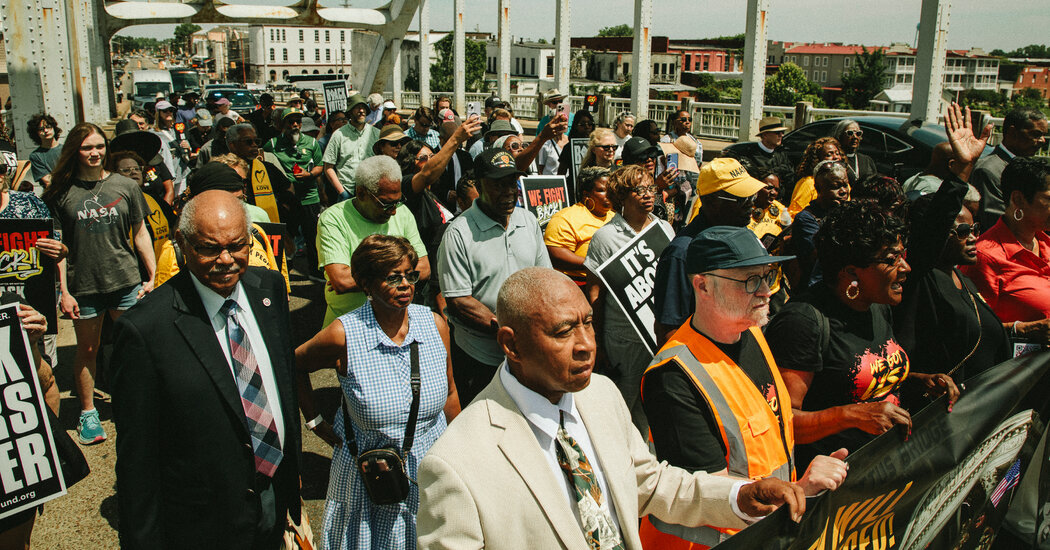
Faced with a rapidly shrinking footprint in the halls of Congress and a lack of legislative leverage in state capitals dominated by Republican supermajorities, Black leaders, organizers, and everyday voters are refusing to quietly surrender their hard-won rights, turning instead to the time-honored tradition of grassroots organizing. In a symbolic rekindling of the civil rights movement, a coalition of activists and faith leaders recently organized a pilgrimage to the historic streets of Selma and Montgomery, Alabama, to draw strength from the past and lay the groundwork for a long-term electoral counter-offensive. There is a quiet, resilient energy building across the region, manifested in standing-room-only town halls in New Orleans and historic surges in voter turnout, such as in South Carolina, where the first day of early voting shattered previous participation records. Fifty-eight-year-old Nettie Ramsey, casting her primary ballot during a quick lunch break in Montgomery, voiced the stubborn determination of a generation that refuses to let progress slip away, noting that while the journey toward true equality remains painfully long, stopping the fight is simply not an option. For the modern South, this turbulent moment is proving that political representation cannot be entirely erased by the stroke of a pen or the shifting of a border; instead, the attempt to silence these voices has only served to fuel a deeper, more fierce resolve to keep marching forward.