


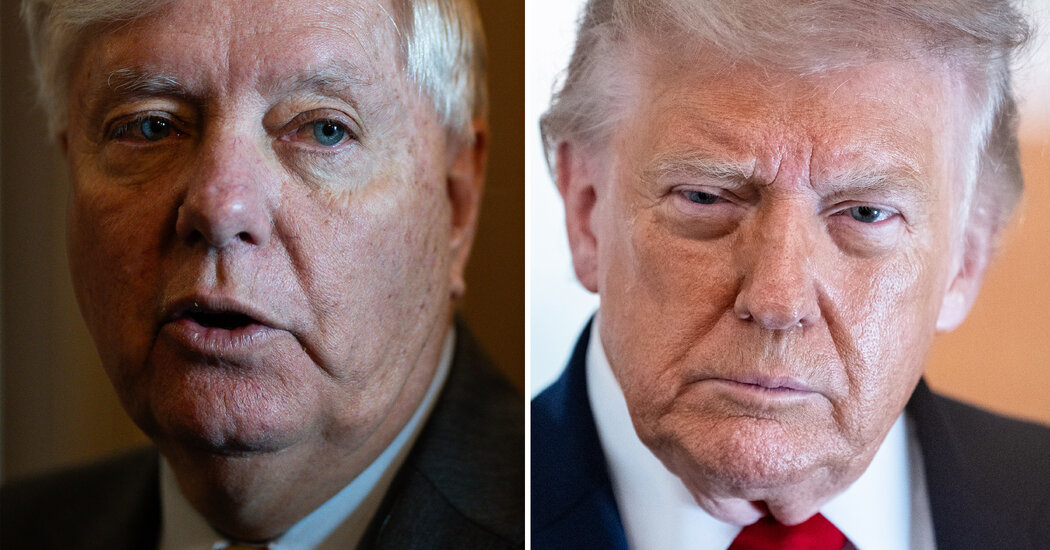
On the eve of a high-stakes Republican primary in South Carolina, Senator Lindsey Graham finds himself standing on a familiar political tightrope, his political survival once again tethered to the mercurial whims of Donald J. Trump. For Graham, this election is not merely a defense of his Senate seat; it is a critical test of a years-long, highly calculated strategy of alignment with a leader who has systematically reshaped the Republican Party. In an era where traditional GOP heavyweights like John Cornyn and Bill Cassidy have been unceremoniously ousted or sidelined after being deemed insufficiently loyal to the Trump movement, Graham’s survival mechanism has been total immersion in the MAGA universe. Trump’s enthusiastic endorsement of Graham as doing a “fantastic job” serves as a vital shield against a fierce primary challenge from the right. Yet, this current display of mutual admiration is a striking departure from where their relationship began. To understand the gravity of Graham’s current campaign is to appreciate the extraordinary, fraught, and deeply transactional journey these two men have taken—evolving from vitriolic personal enemies to intimate golfing companions, surviving multiple public breakups, and ultimately forging one of the most resilient, if head-scratching, alliances in modern American political history.
The foundation of their relationship was not built on policy agreement, but on a foundation of mutual, raw, and highly public hostility during the chaotic 2015-2016 Republican presidential primaries. At the time, Graham was a staunch defender of the old-guard conservative establishment and the best friend of the late Senator John McCain, a political giant whose legacy Trump directly attacked by claiming McCain was only a war hero because he had been captured in Vietnam. For Graham, this was not just a political disagreement; it was a deeply personal insult to his closest confidant, prompting him to publicly trash Trump on national television as a “demagogue,” “the world’s biggest jackass,” and a “race-baiting xenophobic religious bigot.” Trump retaliated with his trademark brand of public humiliation, standing before a crowd in Graham’s home state of South Carolina, mocking him as an “idiot” and a “lightweight,” and reading Graham’s personal cell phone number aloud to the audience, encouraging supporters to call it. As Trump’s momentum grew, a visibly disgusted Graham issued a final, desperate plea on CNN, warning that Trump’s proposed ban on Muslims would condemn Middle Eastern allies to death and that his hardline immigration policies would tear the party apart, famously declaring that the only way to make America great again was to tell Donald Trump to “go to hell.”
Yet, when the dust settled on the 2016 election and Trump emerged victorious, Graham faced a brutal existential choice: slide into political irrelevance as a vocal, powerless critic, or adapt to the new reality of his party. Opting for influence over ideological purity, Graham participated in a mutual friend-brokered “make-up lunch” with the president in March 2017, a meeting that marked the beginning of an unlikely personal rapprochement. Over the next three years, the two became frequent golfing partners, sharing hours on the green where Graham learned to navigate Trump’s ego, shifting from a fierce critic to one of his most trusted Senate whispers. When pressed by journalists about his sudden face-turn, Graham offered a candid assessment of political pragmatism, admitting he had run out of adjectives to describe Trump but noted that the American electorate had ultimately rejected his analysis. Trump, too, seemed amused by the transformation, marveling at how a former “great enemy” had become a “great friend.” The bond was cemented during the contentious 2018 Supreme Court confirmation hearings for Brett Kavanaugh, where Graham’s fiery, emotional defense of the nominee endeared him once and for all to the populist base, proving he was willing to fight in the trenches for the Trump agenda.
The true test of this transactional brotherhood came in the turbulent aftermath of the 2020 presidential election, exposing the fragile boundaries of Graham’s loyalty. While Graham initially supported Trump’s legal challenges and defended his skepticism on television, the violent events of January 6, 2021, pushed the South Carolina senator to his breaking point. Standing on the Senate floor in the literal and figurative wreckage of the Capitol riot, an exhausted Graham delivered a dramatic address, stating that he and Trump had been on “a hell of a journey” but declaring, “Count me out. Enough is enough.” This moment of apparent fracture, however, was brief; the gravity of Republican primary politics quickly pulled Graham back into the orbit. Just weeks later, he refused to join Cassidy and other colleagues in voting to convict Trump during his second impeachment trial, calculating that a complete break from Trump would mean political suicide in South Carolina. Over the ensuing years, Graham worked quietly to rebuild the bridge, backing Trump’s 2024 comeback bid, even as he was forced to endure humiliating boos from grassroots MAGA crowds in New Hampshire and his home state, who still viewed him with deep suspicion as a wolf in populist clothing.
This underlying ideological tension is not just a relic of the past; it remains a volatile element in Graham’s current re-election campaign, where he must constantly defend his flank against accusations of insincerity. The populist base’s distrust of Graham flared up again as recently as 2024, when a public disagreement over a proposed federal abortion ban prompted an irritated Trump to publicly state that he regretted ever endorsing Graham in 2020. Furthermore, Graham’s deeply rooted hawkish foreign policy views—vocalized through his support for international military aid—clash violently with the isolationist, “America First” doctrine championed by modern populists. This ideological chasm has been aggressively weaponized by his primary opponent, businessman Mark Lynch, who has spent millions of dollars to paint Graham as a warmongering establishment relic who is fundamentally disloyal to the populist movement. Backed by high-profile firebrands like Representative Marjorie Taylor Greene, who labeled Graham an “America Last warmonger,” Lynch’s campaign has saturated the airwaves with ads featuring old footage of Trump declaring that Graham couldn’t even run for “dogcatcher” in South Carolina and win.
Faced with this ferocious assault from the right, Graham and his allies have deployed a staggering $15 million campaign treasury to plaster the state with ads highlighting Trump’s current, glowing endorsement, turning the race into a referendum on who Trump actually trusts. In a frantic final push to avoid a costly and unpredictable runoff election, Graham has repeatedly reminded voters that when it comes to legislative battles in Washington, he remains Trump’s most effective ally. Trump himself bolstered this narrative on the eve of the primary, holding a tele-rally where he showered Graham with praise, a gesture that political strategists note is the ultimate currency in modern Republican primaries. As South Carolina voters head to the polls, Graham’s journey stands as a vivid, complex human portrait of political survival in a deeply polarized age. It depicts a man who chose to swallow his pride, forgive personal insults, and abandon his old bipartisan instincts in order to remain at the table of power, proving that in the modern political landscape, the art of survival often requires rewriting your own history to match the desires of the kingmaker.