





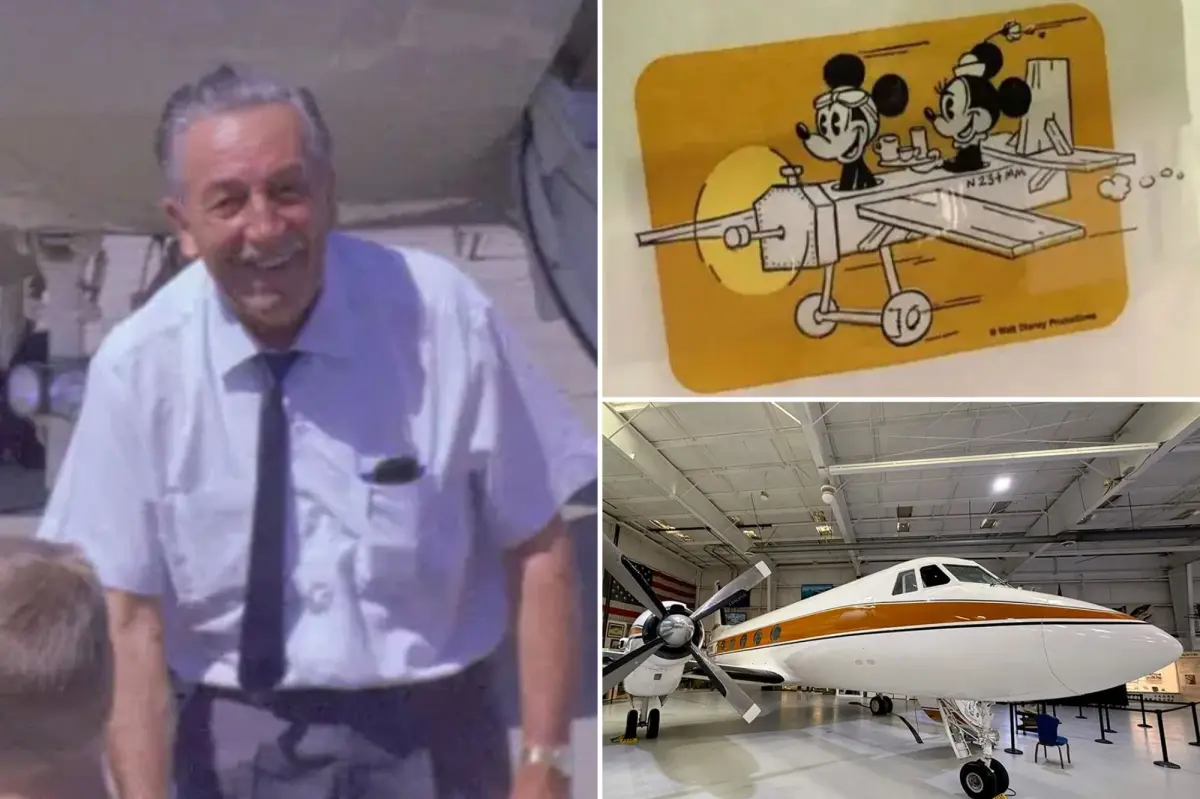
In the grand tapestry of American imagination, Walt Disney is often remembered as a visionary who built empires on paper, celluloid, and sprawling acreage. Yet, one of the most intimate spaces where he dreamed up the future lay high above the clouds, inside a twin-engine corporate aircraft affectionately christened “Mickey Mouse One.” For decades, this historic Grumman Gulfstream I was a lost relic of mid-century optimism, left to slowly surrender to the brutal humidity and relentless sun of an open-air graveyard behind Disney’s Animal Kingdom in Florida. Stripped of its Rolls-Royce engines, its cockpit equipment hollowed out, and its fuselage wrapped in protective plastic like a forgotten toy, the plane seemed destined for a quiet, tragic end. However, in a beautiful real-world manifestation of the happy endings Walt so famously championed, a monumental three-year restoration effort led by the Palm Springs Air and Space Museum, Walt Disney Imagineering, the Disney Archives, and the Phoenix Air Group has successfully resurrected this flying time capsule, meticulously restoring both its sleek exterior and its vibrant, retro-futuristic interior to their original 1960s glory.
The story of “Mickey Mouse One” began in 1960, born from Walt Disney’s growing frustration with the rigid schedules, lack of privacy, and mounting delays of commercial air travel. As his creative empire expanded exponentially, Walt realized he needed a reliable “magic carpet” to shrink the vast distances between his studio in Burbank and his creative ventures across the United States. After briefly experimenting with a smaller Beechcraft Queen Air, Walt acquired the Gulfstream I in late 1963, personally overseeing its customization alongside his wife, Lillian. Together, they transformed the fifteen-passenger cabin into a warm, inviting extension of their own living room, capturing the absolute pinnacle of 1960s design with a rich color palette of rust, orange, brown, and gold. To carve out a quiet sanctuary for Walt within the high-flying boardroom, Lillian designed a unique, elegant partition made of clear acrylic, which encased delicate leaves and tall grasses hand-gathered directly from the backyard of the Disney family home, seamlessly blending the natural world with the sleek marvels of the jet age.
For Walt, who possessed a lifelong, childlike fascination with the mechanics of transportation, the plane was far more than a luxury convenience; it was an inspiring, interactive workspace. He was an aviation enthusiast at heart, and rather than sitting passively in the back, he had a custom instrument panel mounted directly on the cabin wall next to his favorite passenger seat, allowing him to monitor the aircraft’s altitude, air speed, and flight trajectory in real time. A private telephone handset hung beside his armrest, giving him an instant connection to the flight crew in the cockpit, while the attentive stewards made sure to keep a custom-branded Mickey Mouse matchbook beside his personal ashtray to accommodate his frequent smoking. The aviation world warmly embraced this whimsical executive transport, especially when pilots requested clearances using the aircraft’s legendary tail number, N234MM; air traffic controllers across the nation often bypassed standard radio jargon, choosing instead to cheerily announce the arrival of “Mickey Mouse” on their radar screens.
Beyond the charming interior design and cozy domestic details, the aircraft served as the actual womb for some of the Disney company’s most monumental historical achievements. From the wide, oval windows of the cabin, Walt peered down at the endless green stretches of Central Florida swampland, mapping out the precise geography of what was secretly codenamed “Project X”—the massive undertaking that would eventually become Walt Disney World. The plane also functioned as a high-speed corporate shuttle during the frantic preparations for the landmark 1964-1965 New York World’s Fair, carrying elite squads of Disney Imagineers back and forth across the country as they prepared to introduce revolutionary attractions like “It’s a Small World” and “Great Moments with Mr. Lincoln” to the global stage. It was within this very pressurized cabin, suspended miles above the earth, that Walt and his inner circle conceptualized how to turn wildest fantasies into physical, permanent realities.
Following Walt’s untimely passing in 1966, the trusty Gulfstream continued to serve as a hardworking ambassador for the company, accumulating an extraordinary legacy over twenty-eight years of active service. It logged approximately 20,000 flight hours and transported an estimated 83,000 passengers, playing host to cultural icons and world leaders alike, including Julie Andrews during her Mary Poppins prime, as well as future presidents Jimmy Carter and Ronald Reagan. The aircraft even transcended its corporate duties to become a silver-screen actor, making memorable appearances alongside a young Kurt Russell in the classic Disney comedies “The Computer Wore Tennis Shoes” and “Now You See Him, Now You Don’t.” But when the aircraft was finally retired in 1992 and parked as a static prop on the Studio Backlot Tour in Orlando, the elements began their slow, destructive work, turning a proud symbol of mid-century progress into a water-damaged shell that appeared virtually unsalvageable to passersby.
The remarkable resurrection of “Mickey Mouse One” represents a triumph of historical preservation and public affection over the ravages of time. The rescue began in earnest in 2019, when dedicated Disney conservation teams carefully pressure-cleaned the exterior, replaced the clouding, deteriorated windows, repaired the structural damage to the wing edges, and repainted the fuselage in its iconic, crisp orange-and-white 1960s livery. In a massive logistical feat, the aircraft was carefully disassembled and transported on specialized flatbed trucks across the American highway system to Anaheim, California, for the 2022 D23 Expo, where emotional fans wept at the sight of Walt’s wings finally restored to the light of day. Today, reconstructed and sitting proudly at its new home at the Palm Springs Air and Space Museum, the completed interior restoration stands as an arresting, beautifully preserved monument to an era when the sky was not a limit, but a laboratory for dreams, inviting visitors to step directly into the private, airborne sanctuary of the man who taught the world how to wish upon a star.