



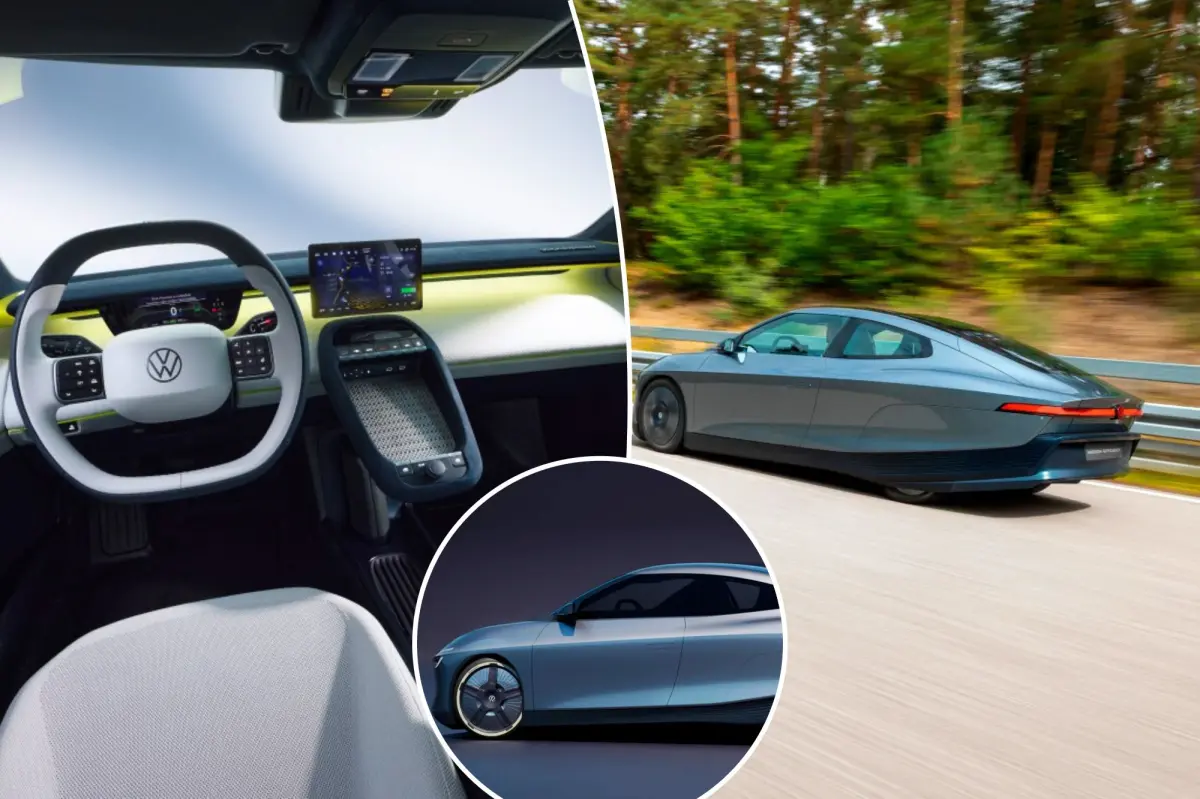
Volkswagen has its foot on the gas, and it’s not letting up. In a world where electric vehicles are often judged by their range and charging speed, the German automaker has just thrown down a gauntlet of a different kind: efficiency. The company recently unveiled “Mission Efficiency,” a prototype EV that isn’t just a concept car for show—it’s a rolling laboratory that has already shattered three world records for production-adjacent vehicles. These records cover aerodynamics, energy consumption, and overall efficiency in its class, and they signal a serious shift in how VW is approaching the electric future. The prototype is based on the existing ID.Polo, but it’s been stretched and lowered, taking design cues from the quirky and ultra-sleek Volkswagen XL1 from 2013. Think of it as a marriage between the practicality of a modern electric hatchback and the obsessive, almost fanatical aerodynamic focus of a science experiment. The result is a car that slips through the air with almost supernatural ease, and it raises an important question: What if we stopped worrying so much about bigger batteries and started focusing on making every single electron count?
The heart of this story is aerodynamics, and the numbers are nothing short of astonishing. The Mission Efficiency prototype achieves a drag coefficient, or Cd value, of just 0.158. To put that in perspective, most modern passenger cars—even very sleek ones—typically fall somewhere between 0.25 and 0.30. The lower the number, the less resistance the car faces as it pushes through the air, which means less energy is wasted fighting the wind. This isn’t just about top speed; it’s about efficiency at every speed. When a car doesn’t have to work as hard to move forward, the motor draws less power, the battery lasts longer, and the range stretches further. VW achieved this remarkable figure through a teardrop-shaped body that seems to have been sculpted by the wind itself. There are active cooling air flaps that open only when needed, frameless doors that reduce turbulence, and even patented aerodynamic wheel deflectors that smooth the airflow around the tires. The car’s design boss, Andreas Mindt, put it simply: the body shape is “committed fully to functionality and thus the laws of aerodynamics.” It’s a beautiful reminder that efficiency can be its own kind of beauty, and that every curve, crease, and panel gap has a job to do.
But aerodynamics alone doesn’t win the efficiency race; it has to be paired with incredible energy consumption. During standardized testing, Mission Efficiency achieved a record-breaking figure of just 6.48 kWh per 100 kilometers. For anyone who’s used to thinking in miles per gallon, this is the electric equivalent of hypermiling on a whole new level. To understand how impressive that is, consider that the average EV on the market today uses somewhere between 16 and 18 kWh per 100 kilometers. Even the Tesla Model 3, widely praised for its efficiency, uses around 13 to 15 kWh per 100 kilometers. Mission Efficiency uses less than half of that. Under controlled test conditions, at a steady speed of 68 km/h and with the climate control switched off, VW estimates the car could travel up to 500 miles on a single charge. That’s a figure that would make even the most range-anxious driver breathe a sigh of relief. And this isn’t just a lab experiment. To prove the concept works in the real world, VW drove the prototype 794 miles from Wolfsburg, Germany, to Vienna, Austria, passing through Poland and the Czech Republic along the way. The car operated at speeds up to 86 mph, with an overall average of 42 mph, and it needed only a single charging stop for the entire journey. That kind of real-world performance is the difference between a clever press release and a genuine engineering breakthrough.
Lightweight construction played an equally vital role in this achievement, and the engineers didn’t leave any stone unturned. The Mission Efficiency prototype uses an aluminum structure, high-strength carbon fiber-reinforced polymer, and aramid composite components to shave off every possible kilogram. Mass reduction is critical because a lighter car requires less energy to accelerate and maintain speed, and it also puts less stress on the tires, brakes, and suspension. But the clever touches go beyond just exotic materials. The car is fitted with solar panels integrated into both the roof and the boot lid, providing a combined output of 370 watts. In optimal summer conditions, that solar power can feed enough energy into the battery to add up to 18 miles of extra driving range. It’s not a huge amount, but it’s a meaningful contribution, especially for a car that’s already incredibly efficient. Interestingly, all this technology comes with a small trade-off: the larger dimensions and the addition of roof panels make Mission Efficiency about 110 pounds heavier than the ID.Polo on which it’s based. Yet despite that extra weight, the car still manages to outperform virtually everything else on the road in terms of efficiency. Underneath the sleek skin, power comes from the same 114 hp electric motor found in the entry-level ID.Polo, paired with the largest 52 kWh battery pack available. It’s proof that you don’t need a massive, expensive battery to achieve extraordinary range—you just need to be smart about how you use the energy you have.
Now, here’s the reality check: you can’t buy this car. Mission Efficiency is not destined for dealerships, and it’s not going to be parked in anyone’s driveway anytime soon. It is, in VW’s own words, a technological demonstrator—a showcase of what’s possible, not what’s immediately available. The company plans to take the design innovations and engineering lessons learned from this prototype and apply them to future production models, meaning we’ll likely see trickle-down benefits in the next generation of ID-branded EVs. The goal is to make efficiency a core pillar of Volkswagen’s electric strategy, not just a one-off engineering exercise. Thomas Schäfer, CEO of the Volkswagen brand, framed it as a mission with a deeper purpose: “Mission Efficiency is the ideal way to demonstrate what distinguishes Volkswagen in the electric age: technology for the masses—not just for the few.” That’s a noble sentiment, especially coming from a company that has built its reputation on making cars for everyday people. But it’s also a message that arrives during a difficult transition for VW. The automaker recently agreed to cut 100,000 jobs by 2030, including 50,000 previously announced layoffs, as it struggles to navigate the costly shift to electric mobility. In that context, Mission Efficiency isn’t just an engineering triumph; it’s a strategic statement that VW still intends to lead, even as it tightens its belt and reimagines its future.
What does all of this mean for the average driver? For one, it suggests that the future of electric vehicles isn’t just about bigger batteries and longer range for the sake of it. It’s about smarter design, cleaner aerodynamics, and a more holistic approach to energy use. If VW can bring even a fraction of Mission Efficiency’s improvements to a mainstream EV, it could mean more affordable cars with less need for massive battery packs, which would lower costs and reduce the demand for rare earth materials. That’s good news for the environment, and it’s good news for consumers who want an EV that doesn’t break the bank. The solar roof, the lightweight materials, the obsessive focus on drag coefficient—all of these technologies point toward a future where electric cars are more efficient, more sustainable, and more accessible. Of course, there are still challenges ahead. The job cuts at VW are a stark reminder that the transition to electric vehicles isn’t easy, and that even the biggest automakers are feeling the financial pressure. But Mission Efficiency offers a glimpse of a brighter, more efficient path forward. It’s a reminder that innovation doesn’t always mean cramming more power under the hood; sometimes, it means making better use of the power you already have. And in a world where every kilowatt-hour counts, that’s a mission worth pursuing.