

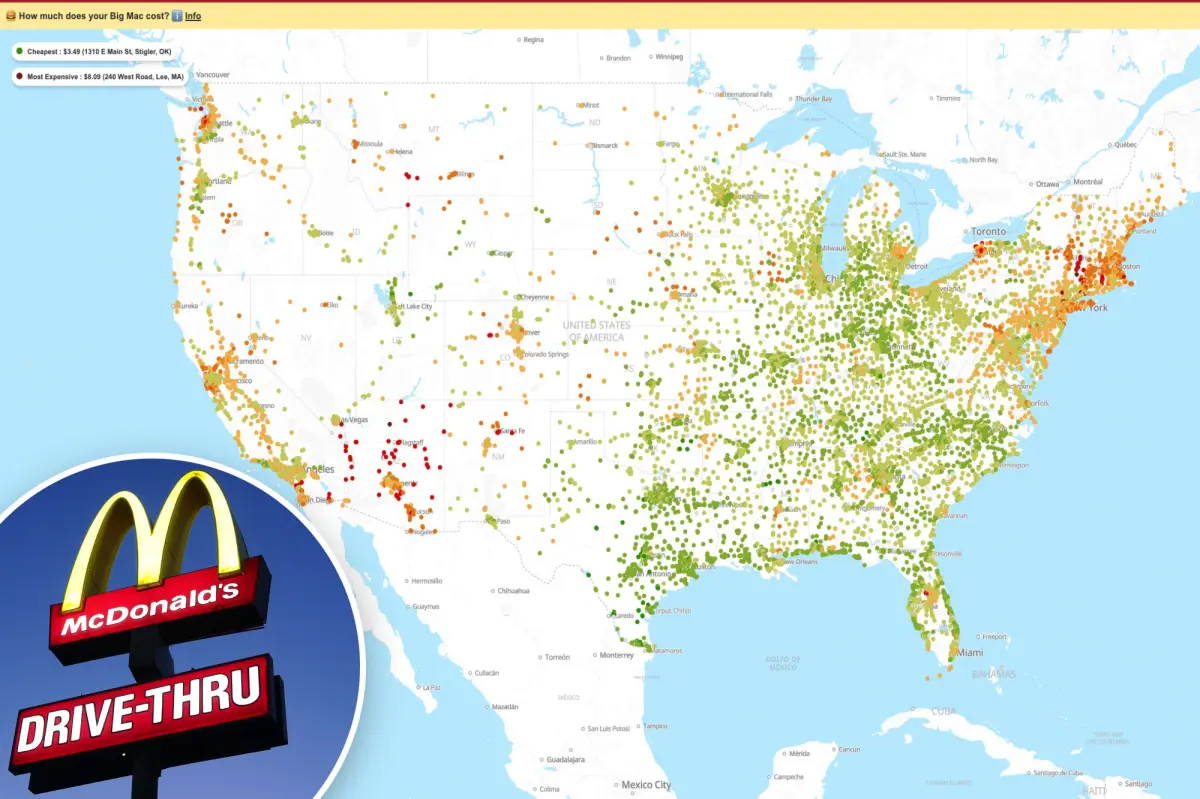
For generations, the glowing yellow arches of McDonald’s served as a universal symbol of affordable indulgence, a reliable sanctuary where a few spare coins could buy a warm meal. Today, however, that nostalgic slice of Americana is facing a harsh economic reality, leaving loyal customers in a state of sticker shock as inflation fundamentally reshapes the landscape of everyday dining. In direct response to this widespread financial frustration, the creative minds at the food research organization Pantry & Larder developed an innovative virtual tool designed to help household budgets go further without forcing people to travel miles out of their way. Known as the “McCheapest” map, this interactive online resource tracks and visualizes the price of McDonald’s most iconic menu item across the United States. Recognizing that fast food is no longer the effortless bargain it once was, everyday consumers are actively turning to this digital cartography to hunt down the best local offers rather than traveling blindly. It is a fascinating testament to modern consumer resilience, proving that in an air of tightening wallets, the quest for a reasonably priced burger has become both a strategic game and a financial necessity. Map developers meticulously mapped out over 10,000 individual franchise locations across the nation, creating a comprehensive database that transforms the simple act of ordering lunch into a highly calculated, tech-driven treasure hunt. By using the legendary Big Mac as the ultimate baseline of economic measurement, this project has managed to capture the diverse, chaotic state of regional pricing, offering a stark and sobering look at how inflation manifests differently in communities just hours apart.
To navigate this modern financial minefield, the McCheapest map provides users with an intuitive, color-coded interface that instantly reveals where their nearest budget-friendly meal resides. When users open the map, they are greeted by a dense sea of vibrant dots spread across the American landscape, with deep green representing the most welcoming, low-cost options and dark crimson-red signaling the most expensive, wallet-straining locations. Clicking on any individual dot instantly brings up the exact address of that restaurant, transforming abstract macroeconomic data into local, actionable intelligence. The sheer scale of the geographic disparity highlighted by the tool is nothing short of breathtaking. At the absolute bottom of the pricing spectrum, budget-conscious diners can head to the quiet town of Stigler, Oklahoma, where a classic Big Mac can still be purchased for a modest $3.49. On the flip side of the coin, traveling northeast to the town of Lee, Massachusetts, reveals a staggering price tag of $8.09 for the exact same sandwich—a price difference of more than double for the same ingredients and preparation. To make the interface even more valuable for thrifty shoppers, the map includes a historical transaction index that tracks whether prices at a specific location have recently trended upward or downward. This dynamic index allows savvy customers to see past the immediate marketing and truly understand the trajectory of their local dining costs, stripping away the mystery of the legendary “dollar menu” of yesteryear to analyze individual unit prices without the confusing distraction of limited-time bundle promotions or digital application exclusives.
This massive chasm between a three-dollar burger and an eight-dollar burger highlights the complex, often hidden mechanics of the franchise business model. McDonald’s corporate headquarters does not actually dictate a uniform nationwide price list; instead, the vast majority of locations are owned and operated by independent local franchisees who have the absolute authority to establish their own menu pricing. These operators must carefully balance their books against local economic realities, factoring in skyrocketing commercial rent, localized labor shortages that demand higher hourly wages, and the varying transportation costs of getting fresh ingredients to remote or high-density areas. Furthermore, franchise owners frequently tailor their prices to match the estimated disposable income of the demographic surrounding their storefronts. This strategic localization exploded into the public consciousness when a shocking image of an individual McCrispy chicken combo meal priced at an astronomical $18.99 in Darien, Connecticut, went viral on the social media platform X. The viral post served as a sudden, collective wake-up call for the American public, shattering the long-held cultural illusion that fast food remains a democratic equalizer where everyone, regardless of tax bracket, can dine cheaply. This sudden exposure of high prices forced a difficult realization: McDonald’s is increasingly operating as a premium luxury for working-class families, rather than the casual, pocket-change fallback it historically built its global empire upon.
The growing chasm between affordability and reality has sparked passionate, highly active debates across social media, particularly on forums like Reddit, where users have begun sharing and dissecting their fast-food receipts with the intense scrutiny of corporate accountants. On these digital platforms, a fascinating divide has emerged between those who believe the system can still be negotiated and those who feel entirely priced out. One optimistic user confidently claimed that critics of the chain were simply “doing it wrong,” posting a photo of a receipt showing two double cheeseburgers, large golden fries, and a large Dr. Pepper for an impressive total of just $6.68—a feat achieved through aggressive app-exclusive deals and digital reward mechanics. However, this triumphant claim was quickly met with wave after wave of frustration from users living in higher-cost regions. A resident of Spokane, Washington, quickly pointed out that ordering that exact same meal in their local market would instantly run up a total of $11.65, demonstrating the severe geographic inequality of the pricing. Other disgruntled diners chimed in to express their annoyance at local franchise policies that prohibit the stacking of multiple digital promotions, pointing out that a single soft drink can cost over two dollars while a regular box of fries often exceeds four dollars. These lively online exchanges humanize the data, showing that beneath the dry charts of inflationary pressure lies a deep, palpable frustration among everyday people who feel they are being priced out of life’s simplest, most basic conveniences.
To truly appreciate why these price shifts feel so incredibly jarring to average consumers, it is essential to look back at the historical trajectory of fast-food menu pricing over the last decade. Data compiled by specialized organizations like Top Nutrition Coaching reveals that since 2015, major fast-food chains across the country have raised their prices by anywhere from 39% to an astonishing 100%. When looking at McDonald’s specifically, the statistics paint an incredibly bleak picture of eroding purchasing power: a basic Quarter Pounder with Cheese meal now averages around $11.99, representing a mind-boggling 122% price increase compared to under a decade ago. Similarly, a standard ten-piece Chicken McNuggets meal has climbed to roughly $10.99, marking a steep 83% hike. Perhaps most frustratingly for working parents, the beloved Happy Meal—a fundamental staple of American childhood for generations—can no longer be reliably purchased for under five dollars. What once cost a modest, accessible range of $2.99 to $3.59 back in 2015 has now climbed to between $5.09 and $6.93 depending on the location, making a simple family night out an increasingly stressful financial calculation. For a family of four, an impromptu dinner under the golden arches can easily surpass forty or fifty dollars, a price point that was once reserved for sit-down family diners with table service and higher-quality ingredients, fundamentally shifting how families view their weekly dining budgets.
As the lines between budget-friendly fast food and casual sit-down dining continue to blur, a profound shift in consumer psychology and spending behavior is beginning to take root. Faced with paying nearly restaurant-level prices for mass-produced, wrapped-in-paper meals, many long-time patrons are starting to take their hard-earned dollars elsewhere in search of true value. Online communities are increasingly echoing the sentiment that if an individual burger is going to cost nearly ten dollars, it makes far more practical sense to support local diners, craft burger joints, or independent eateries where the raw quality, taste, and overall experience actually justify the premium price tag. Consumers are starting to recognize that the fundamental social contract of fast food—an implicit promise of sub-par quality in exchange for unbeatable speed and extreme affordability—has been completely broken by corporate pricing structures and macroeconomic instability. McDonald’s and its legacy competitors are now finding themselves at a dangerous, highly precarious crossroads where they must either actively work to earn back the trust of the budget-conscious working class or risk losing them forever to high-quality local competitors. Ultimately, the viral popularity of tools like the McCheapest map is not just about finding a cheap lunch; it is a quiet, consumer-led protest against a changing financial climate, proving that while corporations can raise their prices, the modern, tech-savvy consumer will always find a smarter way to fight back.