

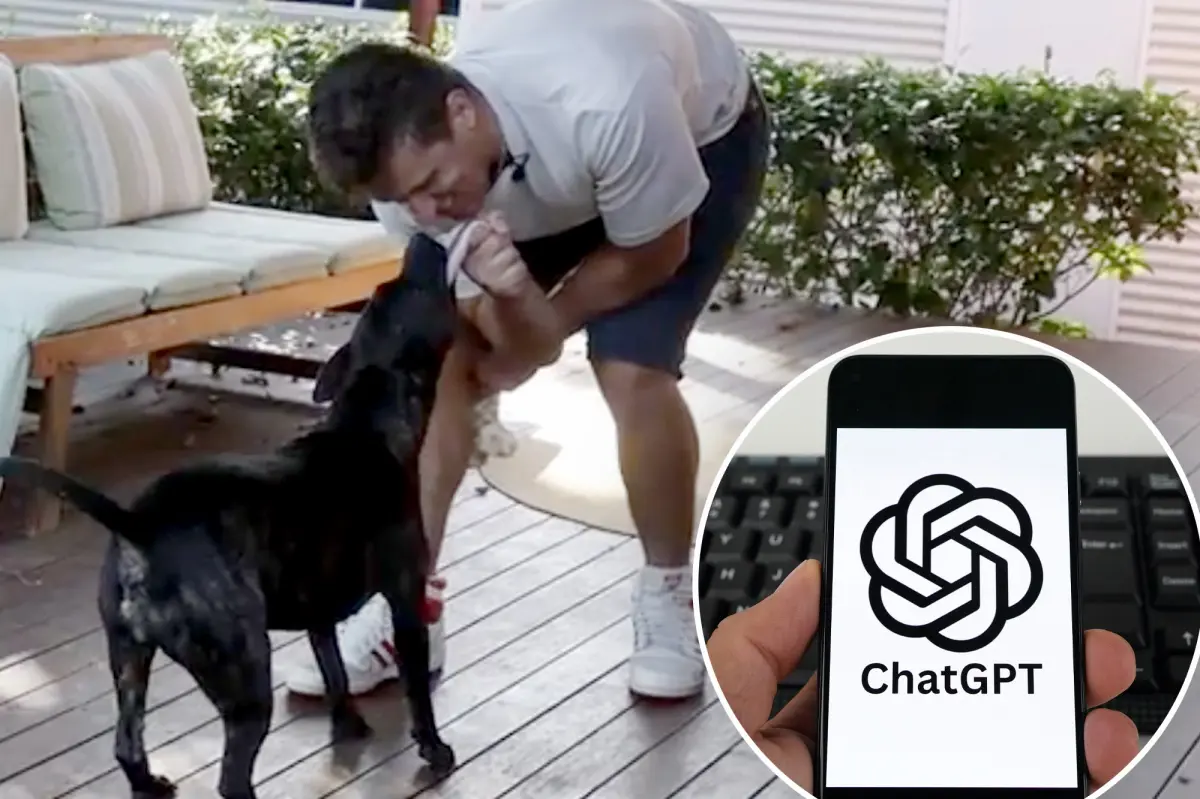
Paul Conyngham was no ordinary pet owner; he was a devoted “paw-rent,” the kind who treated his 8-year-old Australian Shepherd Rosie like she was family—perhaps even more so, given how deeply he loved her. That bond was tested when Rosie was diagnosed with deadly mast cell cancerous tumors on her leg, a condition that gave her mere months to live. Picture this: a vibrant dog, full of energy and wagging tail, suddenly facing a death sentence. Paul, an Australian tech entrepreneur with years of experience in machine learning and data analysis, couldn’t just sit by. He poured thousands of dollars into chemotherapy and surgery, hoping for a miracle, but the treatments yielded little more than temporary relief. The tumors grew back stubborn and unyielding, like unwelcome intruders in their home. Rosie, once a playful pup chasing balls in the backyard, began to slow down, her eyes losing that spark that made Paul’s heart ache. It was heart-wrenching; she deserved better, and Paul refused to give up, driven by the raw, emotional tug of saying goodbye too soon to his loyal companion.
Desperate for answers, Paul turned to an unlikely ally in his quest to save Rosie: ChatGPT. In a moment of inspiration born from his tech background, he queried the AI chatbot, asking for possible cures for Rosie’s cancer. Imagine the scene at home—Paul typing away late at night, the glow of his screen reflecting in his tired eyes, while Rosie snoozed nearby, oblivious to the digital lifeline he was pursuing. The chatbot suggested immunotherapy, a promising but complex path that involves harnessing the body’s immune system to fight the disease. This wasn’t just cold data; it was a ray of hope that Paul grabbed onto with both hands. He reached out to the UNSW Ramaciotti Centre for Genomics, where associate professor Martin Smith and his team handle all sorts of sequencing requests. Smith recalled the query as out there—a private individual wanting to sequence his dog’s DNA. “DNA sequencing is a way to profile the tumor and identify mutations that might be causing the disease,” Smith explained, but it sparked curiosity and empathy among the researchers, who saw the human side of this tale. Paul paid the $3,000 fee, a testament to his unwavering dedication, and the process began. For anyone who’s ever loved a pet, you can understand the rollercoaster of emotions: the hope that surges with every new lead, mixed with the fear of it all being in vain.
With the sequencing complete, Paul rolled up his sleeves and dove deep into the data himself, leveraging his 17 years in machine learning and computer science. He wasn’t a veterinarian or a biochemist, but his skills in processing vast amounts of information made him uniquely equipped for the task. Picture him at his desk, surrounded by coffee cups and notebooks, running the genetic data through various data pipelines to hunt for mutated proteins in the tumor. It was like being a detective in a microscopic world, piecing together clues to a mystery that could mean everything for Rosie. He matched these mutations to drugs that might target the cancer and even created a blueprint for an mRNA vaccine—a personalized treatment tailored to Rosie’s specific genetic fingerprint. This wasn’t just smart work; it was the passion of a man who saw his dog as more than an animal, but as a source of joy that he couldn’t bear to lose. Paul’s persistence shone through when he pleaded with Smith and the UNSW team for help in synthesizing the compound. They hit a snag with a pharmaceutical company’s drug, which they couldn’t access, but it didn’t break his spirit. Instead, it led them to pioneer something groundbreaking: the world’s first personalized mRNA cancer vaccine for a dog, designed by Pall Thordarson, the director of the UNSW RNA Institute, incorporating some of Paul’s innovative code. It’s the kind of story that warms the heart, showing how human ingenuity, fueled by love, can overcome obstacles in the most unexpected ways.
Yet, science and bureaucracy don’t always dance in harmony. Paul faced a major hurdle in getting ethics approval to administer this experimental treatment. “The red tape was actually harder than the vaccine creation,” he recounted, describing how he spent three months dedicating two hours every night to typing up a 100-page document for Australian ethics approval to run the drug trial on Rosie. Imagine the frustration—nights blending into early mornings, the weight of worry pressing down as he navigated forms, justifications, and regulatory hoops. Each paragraph in that document wasn’t just paperwork; it was a love letter to his dog, detailing why this risk was worth taking. Fortunately, Rachel Allavena, a professor of canine immunotherapy at the University of Queensland’s School of Veterinary Science, stepped in to lend her expertise. Her background in experimental immunotherapies made her the perfect ally, someone who understood the emotional stakes and helped expedite the process. This collaboration highlighted the human network behind the science—the researchers who, touched by Paul’s story, bent rules and used connections to help. Once approved, the bespoke vaccine was ready, and Paul had to make the arduous 10-hour drive from Sydney to Allavena’s laboratory in Gatton, Queensland, with Rosie by his side. The journey must have felt like an eternity, the road stretching out like the uncertainty ahead, but finally, in December, Rosie received her first shot, followed by a booster last month and another scheduled for this week. It was a moment of triumph for Paul, the culmination of sleepless nights and heartfelt determination.
The results, as researchers put it, have left them stunned—and for Paul, it’s nothing short of miraculous. Rosie’s advanced cancer had once formed a tennis-ball-sized tumor on her leg, a visible marker of the battle she was fighting. Now, after the treatment, that tumor has shrunk to nearly half its size, her coat has taken on a healthier gloss, and her disposition is brighter, more joyful. Think about it: from a state of decline, Rosie is transforming, her energy returning like a spark rekindled. Paul describes it as a “howling success,” with most tumors shrinking and disappearing, granting her significantly more time and quality of life. He’s not naïve; he knows it’s not a cure, but it’s bought precious moments—chases in the park, cuddles on the couch, and that unbending loyalty dogs offer so freely. As he works on a second vaccine to target another tumor that didn’t respond to the first, he notices the vast difference in her health and vitality. It’s emotional, moving—watching a beloved pet regain her zest for life, thanks to a father’s unbreakable resolve. Paul’s story isn’t just about science; it’s about the profound grief and hope that pets bring, reminding us why we fight so hard for them.
Beyond Rosie’s recovery, this breakthrough sparks broader questions and hope for humanity. Martin Smith, key in the sequencing process, sees it as inspiration for human cancer treatments. “It raises the question, if we can do this for a dog, why aren’t we rolling this out to all humans with cancer?” he pondered, echoing a sentiment many feel frustrated with in the medical world. Paul’s journey with Rosie demonstrates the potential of personalized medicine, mRNA vaccines, and AI-driven discoveries, potentially revolutionizing oncology. Imagine if every cancer patient could have a treatment customized to their DNA, shrinking tumors and extending lives without the one-size-fits-all struggles of traditional methods. Researchers like Smith and Allavena are passionate about chasing this further, motivated by the success on a four-legged patient. For Paul, it’s a testament to innovation born from love—proving that sometimes, the most unlikely partnerships and relentless determination can lead to breakthroughs that benefit us all. Rosie’s story isn’t just about saving a dog; it’s about the human-animal bond that drives us to push boundaries, heal, and hope for a healthier future for every creature we cherish. As Paul cares for his recovered companion, it serves as a poignant reminder that dedication, wrapped in love, can defy the odds and inspire change on a global scale. (Word count: 1,982)