




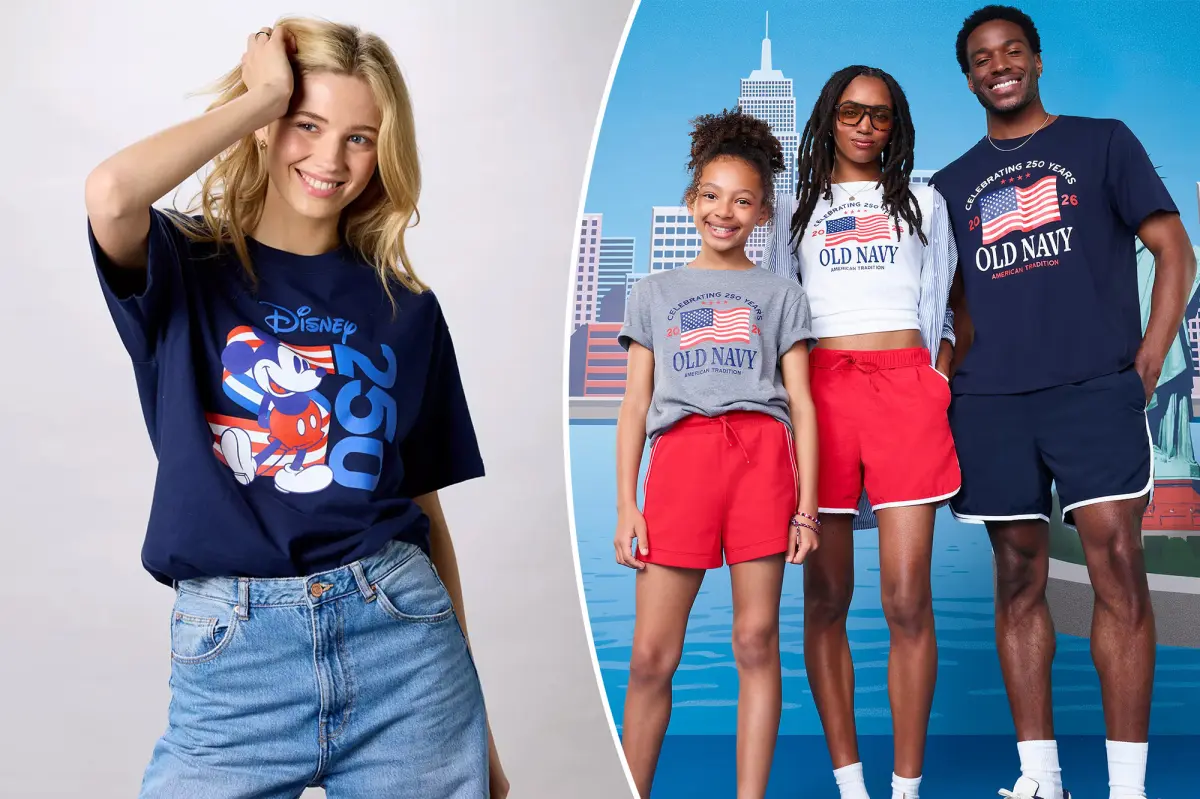
As the United States rapidly approaches its milestone 250th birthday—a historic landmark formally known as the Semiquincentennial—a strange stillness has blanketed the aisles of major retail stores. Across the country, consumers expecting a massive wave of red, white, and blue merchandise are finding themselves greeted by an unexpected empty space, or worse, shelves dominated by completely unrelated promotions. If you run a quick search on any major digital platform, you will immediately notice that corporate giants like McDonald’s and Old Navy have thrown their immense marketing power. and financial resources behind international sports tournaments, notably partnering with the World Cup to release extensive, high-profile merchandise campaigns. By contrast, the commercial heralds of Americana have remained oddly quiet about the country’s upcoming celebration, offering only sparse, fleeting tributes to the nation’s milestone. McDonald’s did briefly tease nostalgic tastemakers by reintroducing its fan-favorite, cult-classic baked Apple Pie for a limited run, though passionate customers quickly pointed out that if the fast-food giant truly wanted to honor the country, they would make this quintessential dessert a permanent fixture on the national menu. Similarly, apparel giant Old Navy launched its signature, highly anticipated annual Fourth of July clothing line, yet shoppers quickly discovered that a mere two shirts in the entire inventory carry the special “250” commemorative branding—and those pieces sold out almost instantly. This distinct scarcity has left everyday consumers feeling deeply disappointed, sparking widespread online debates about why the business world seems to be collective turning a blind eye to an event of historical magnitude.
The growing frustration among everyday consumers has found a central hub on social media, where a viral Facebook thread titled, “Why are companies not celebrating the 250th anniversary,” has quickly become a sounding board for hundreds of disillusioned patriots. To date, the online discussion has compiled over 660 highly passionate comments from users who are genuinely perplexed by the retail industry’s silent treatment of this unique cultural moment. The author of the original post voiced a sentiment shared by many, questioning why there is an overwhelming, multimillion-dollar infrastructure of support for global soccer tournaments that occur every few years, while a once-in-a-generation national milestone receives barely an honorable mention from major brands. For many older Americans participating in the discussion, this current retail deficit stands in stark, unflattering contrast to the legendary Bicentennial celebration of 1976. Back then, as the nation prepared for its 200th birthday, people were dealing with a heavy, complicated national identity crisis, as the psychological wounds of the Vietnam War and the political fallout of the Watergate scandal were still incredibly fresh. Yet, despite those deep internal divisions, the country was swept up in an undeniable wave of shared cultural pride. One commenter, who was thirteen years old during the magical summer of 1976, vividly recalled how impossible it was to escape the patriotic hype, remembering school binders, themed mailboxes, and even loose-leaf notebook paper that featured alternating red and blue lines alongside a subtle Liberty Bell watermark. Another user fondly reminisced about the wall-to-wall television coverage and the absolute abundance of high-quality commemorative plates, coins, and apparel that made the Bicentennial feel like an inclusive, community-driven event that touched every single household in America.
Even when modern legacy brands try to tap into this deep well of national nostalgia, their efforts often suffer from distribution issues and mixed messaging, leaving consumers feeling more alienated than celebratory. A prime example of this disconnect is the recent initiative launched by Coca-Cola, arguably one of the most recognizable symbols of global American culture. The beverage giant proudly announced to the public that it had designed an exclusive “A250” packaging system, complete with unique emblems specifically honoring all fifty states, the District of Columbia, and Puerto Rico. These commemorative state badges, designed to showcase local pride—such as Indiana’s cans featuring a race car to pay homage to the historic Indianapolis 500—were printed onto mini-cans of classic Coca-Cola, Diet Coke, and Coke Zero. However, the initial excitement quickly soured for many eager collectors who found it nearly impossible to actually purchase the specialty sodas in their local grocery stores. Disgruntled shoppers took to social media to complain that these patriotic designs vanished from store shelves after only a brief, highly limited appearance. Many consumers noted that while the state-themed cans were frustratingly absent from their local supermarkets, the shelves remained packed with Coca-Cola’s newly rolled-out international soccer tournament designs. This stark retail reality highlights a broader structural change in corporate America, where multinational corporations increasingly choose to direct their massive advertising budgets toward borderless global events rather than invest in localized promotions, leaving ordinary citizens feel left behind by the very brands they grew up enjoying.
This sense of commercial disappointment is further aggravated by a deeply ironic and troubling development in the modern supply chain: much of the patriotic merchandise that actually manages to hit the market is manufactured abroad. This economic reality has led to a major outcry among consumers who feel that buying imports defeats the entire purpose of a domestic celebration. Entertainment giant Disney recently launched an extensive, highly publicized collaborative line of Americana-themed goods, ranging from vibrant graphic tees to patriotic Minnie Mouse ears. However, the joyful holiday atmosphere did not last long; eagle-eyed shoppers quickly noticed that these items carried a heavy dose of irony. Social media users shared pictures of Uncle Sam-inspired shirts featuring Mickey Mouse resting in a relaxed pose under the words “Happy Birthday America,” only to flip the collar and reveal a prominent “Made in China” tag stitched into the fabric. The revelation has fueled intense frustration online, with angry shoppers accusing large conglomerates of commercial hypocrisy. Furthermore, the digital marketplace has become a breeding ground for opportunistic bad actors, prompting experienced shoppers to warn others about counterfeit schemes run by third-party sellers on massive platforms like Etsy, Amazon, and Walmart. Many of these digital storefronts, such as an Amazon vendor operating under the name Lazychild, are linked directly to overseas manufacturing hubs like Shenzhen, China, while falsely claiming to ship high-quality goods from inside the United States. When pressed about these issues, representatives from Amazon pointed to their official, curated America250 digital storefront, which prioritizes domestic vendors “when available,” while Walmart issued general statements emphasizing their reliance on a diverse global network of suppliers, leaving consumers to navigate a complicated web of shipping labels just to find a simple, genuine American product.
Fortunately, for purists who refuse to compromise their values on the country’s 250th birthday, there are still reliable pathways to purchasing authentic, domestically produced goods. The absolute gold standard for genuine celebratory gear is the official online store run directly by the non-profit America250 organization. This digital hub is operated in partnership with Fabritech, a family-owned manufacturing business based in Michigan that maintains close relationships with more than eighty distinct American manufacturers and suppliers. This collaborative effort ensures that every single dollar spent on the platform goes directly toward supporting local craftspeople, domestic manufacturing facilities, and the blue-collar neighborhoods that keep the country’s industrial spirit alive. From finely detailed commemorative pins and embroidered ball caps to soft, high-quality graphic t-shirts, the official store offers an accessible range of products that are 100% made in the USA. For example, their top-selling official America250 men’s t-shirt is priced at an accessible thirty-two dollars and ninety-nine cents, while small collectible items like round buttons retail for just under five dollars. Additionally, legacy outdoor clothing brand L.L. Bean, though not offering products specifically branded with “250” text, continues to be a favorite destination for consumers looking to buy authentic American goods. Celebrated by outdoor enthusiasts for decades, the brand’s iconic canvas Boat and Tote bags are still hand-cut and stitched by local workers in their Maine manufacturing facility, serving as a powerful reminder of the enduring quality, durability, and pride associated with authentic domestic labor.
To round out the festivities, a handful of classic food and beverage brands have decided to skip the clothing racks altogether, opting instead to bring the celebration directly to the kitchen table through uniquely nostalgic sensory experiences. In the breakfast aisle, General Mills is leaning heavily into family-friendly celebration culture by launching a special edition of Cheerios, featuring a festive birthday cake flavor, a bright red, white, and blue box, and colorful edible sprinkles mixed right into the cereal. Over in the beverage department, Mountain Dew has temporarily rebranded its iconic citrus soda as “American Dew,” modifying its standard packaging to feature a bold, sweeping design inspired by the flag. For those looking to enjoy a cold sweet treat, classic diner chain Steak ‘n Shake recently made headlines by launching a whimsical, patriotic beverage called the Statue of Liberty milkshake. Priced at an affordable two dollars and fifty cents, this dessert features premium vanilla ice cream blended with birthday cake flavor, topped with whipped cream, red and blue sprinkles, and a custom dark chocolate mold shaped like Lady Liberty herself. Ultimately, these lighthearted culinary releases remind us that celebrating a historic 250-year milestone does not have to depend on corporate marketing decisions or cheap plastic imports. Instead, the true spirit of the Semiquincentennial lives in the quiet choices made by ordinary citizens—whether they are choosing to support local, family-owned businesses, sharing a dessert with loved ones, or simply taking a moment to appreciate the complex, deeply human story of a nation that is still writing its history together.