


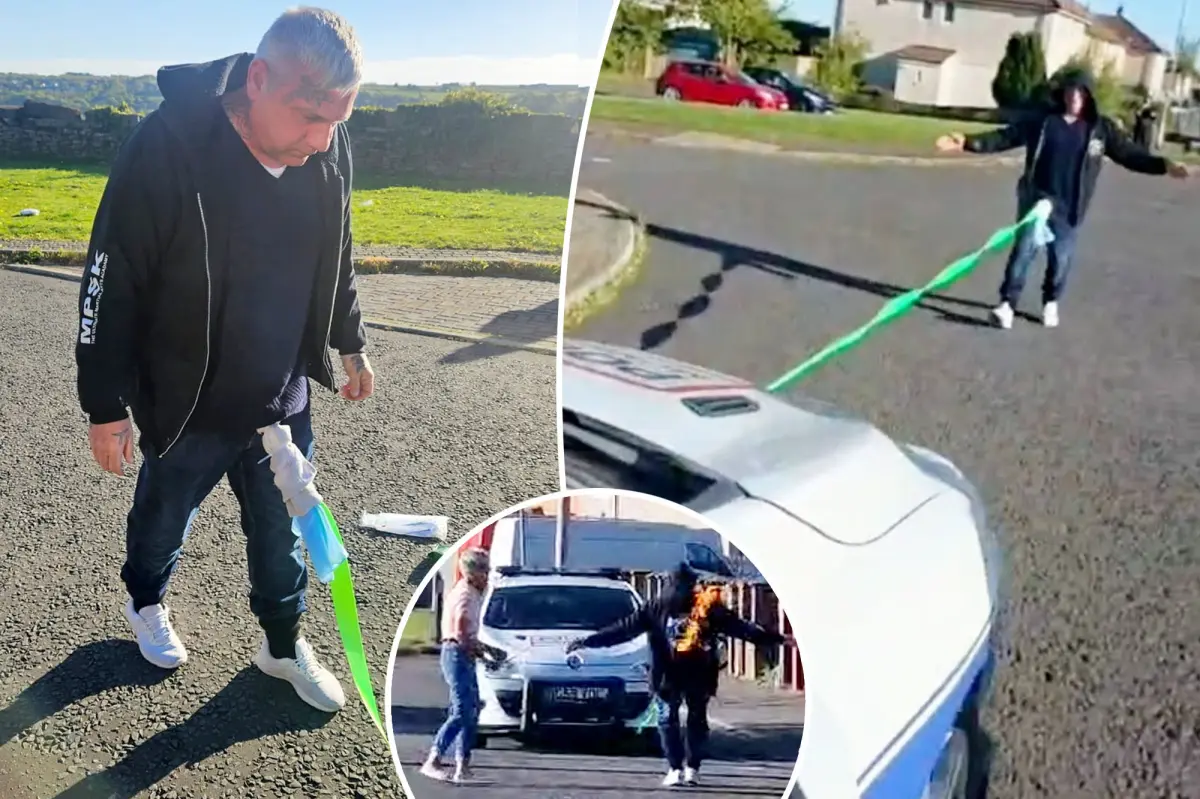
John Stephenson, a 50-year-old father of three from Halifax, West Yorkshire, isn’t your average guy. Picture this: a painter and decorator by trade, martial arts enthusiast, and self-proclaimed “wacky strongman” who turns everyday challenges into extraordinary feats that blend absurdity with heartfelt purpose. On a chilly day in late April, Stephenson stunned onlookers by hauling a 2-ton French police Renault Clio RS a whopping 131 feet down a residential street—not with his arms, legs, or any conventional means, but using his penis as a tow rope. And to make it even more mind-boggling, he did it while engulfed in flames, having doused himself in lighter fluid beforehand. The stunt drew baffled residents peeking through curtains and doors, whispering among themselves, but for John, it was all part of a bigger narrative. He’s not just in it for the shock value; this eccentric act was his way of spotlighting men’s health issues, particularly prostate cancer, which hits close to home for many families. Growing up in a working-class background, John has always been the kind of bloke who pushes boundaries—the sort who might joke about his escapades during Sunday roast dinners with his kids, turning wild stories into family lore. His wife and three children, accustomed to his antics, probably roll their eyes in a mix of admiration and exasperation, knowing that behind the madness lies a man deeply committed to causes bigger than himself. As he neared 50, John felt a personal pull to confront aging vulnerabilities, and this stunt was his creative cry for help to educate others.
Diving into the details, the challenge unfolded on Thursday, April 30, under a wind-swept Yorkshire sky that didn’t make things easier. John had meticulously planned it: attaching a tow rope to his penis in a secure yet audacious manner, ensuring it could withstand the pull. He wasn’t reckless; years of martial arts training and past feats had honed his body and mind for such extremes. As flames licked at his skin—ignited by his own hand with lighter fuel—the pain must have been searing, like a trial by fire only Hollywood dares to dramatize. Yet, with sheer willpower, he plowed forward, the car’s weight dragging behind him for about 40 meters (or 131 feet, as passersby estimated). His focus? Ignoring the burn and the odd stares from neighbors, some filming on phones, others gasping in disbelief. Imagine the internal monologue racing through his head: “Keep going, John, for the lads out there who suffer in silence.” Wind played tricks, making the flames dance unpredictably, and it took a couple of attempts before success. Exhausted but triumphant, he extinguished the fire quickly, the air thick with the scent of smoke and adrenaline. Post-stunt, black and blue marks adorned sensitive areas, but as John recounted with a chuckle, everything remained intact—no permanent damage. He’s painted vivid scenes like this for us: the quiet street erupting in nervous laughter mixed with awe, locals treating him like a local hero rather than a lunatic. This wasn’t isolated madness; it built on previous records, like pulling a vehicle with his testicles or even with his head ablaze, each one chipping away at perceptions of masculinity and vulnerability.
Of course, the physical toll was heavy—John admits the pain was “quite a bit,” a sharp, throbbing reminder that human bodies have limits, no matter how conditioned. After dousing himself and feeling the fire’s kiss, he described the sensation as an intense wave of heat clashing with cold determination. His mind, sharp from martial arts discipline, compartmentalized the agony, focusing on the road ahead rather than the discomfort below. But let’s humanize this: picture John back home, nursing mild burns with aloe vera, perhaps joking with his wife about needing “special care” from the family. His three kids, wide-eyed, might beg for stories or wisely advise him to stick to safer hobbies. Recovery was swift, thanks to self-care and rest, but it underscores the risks he takes willingly. This isn’t ABOUT the pain; it’s a testament to mental fortitude. As a former bare-knuckle fighter, John’s no stranger to bruises and breaks—each scar tells a tale of resilience. Yet, in quiet moments, he opens up about burnout from pushing limits; the loneliness of preparing for stunts in secret, fearing judgment. His evolution from street brawler to record-breaker reflects a journey toward channeling energy positively, often alone, dreaming of inspiring others. Neighbors now see him as a enigma, dropping by with well-wishes, bridging gaps between eccentricity and community spirit.
Beneath the spectacle, John’s stunt harbors a serious motivation: rallying for prostate cancer awareness among men who might otherwise chuckle it off. He sees himself as a bridge between absurdity and advocacy, using his platform to spotlight issues that affect countless families. “People think I’m mad, but I set challenges to highlight real problems,” he shared earnestly. Growing up around tough men who buried emotions, John understands the stigma—guys often delay check-ups, joking through discomfort. His act targets that, urging men to confront their health head-on, especially prostate cancer, which lurks silently. As a message, it’s raw: if a guy can pull a car aflame by his private parts, surely you can muster the courage for a simple PSA test? John’s personal drive stems from losses in his circle—friends battling cancers, whispering regrets. He humanizes this by sharing anecdotes of bluffing through pain, much like the stunt, to mask fear. It’s not just fundraising; it’s a call to break taboos, encourage open chats with loved ones, and view oneself as a survivor, not a statistic. By blending fire with focus, John transforms potential shame around men’s health into empowered action, reminding us vulnerability isn’t weakness—it’s human.
Prostate cancer, the elephant in the room for many, demands attention. It’s the most common cancer in men (excluding skin cancers) in the US, claiming lives as the second-leading cause among males. Statistics paint a grim picture: one in six men will face a diagnosis in their lifetime. Risk factors like obesity, family history, high blood pressure, lack of exercise, and even height weave into daily lives, affecting men from all walks. But early detection changes everything—the five-year survival rate exceeds 99% when caught early, per the Prostate Cancer Foundation. Tragically, initial stages offer no symptoms; the tumor grows silently, undetected. That’s where screening shines: PSA tests, starting at 50 (or 45 for higher-risk groups like African-Americans or those with family histories), can flag issues before disaster. John emphasizes this in casual talks, relating it to his stunts—proactive checks are like pre-planning a bold act to avoid catastrophe. He’s championed screenings in men’s groups, sharing survivor stories of men who’d ignored warnings, leading to late diagnoses. Humanizing the data, consider a dad delaying a check for work excuses, only to learn too late; John’s narrative urges breaking that cycle. Awareness means lives saved, families preserved—it’s a legacy beyond flames.
John’s eccentricities extend far beyond this viral stunt. He’s an Official World Record holder for wild feats: reeling off 300 punches in 30 seconds while holding 1 kg dumbbells in each hand, or mastering six martial arts kicks in under five-and-a-half seconds. Then there are the vehicular records—lifting or tugging cars in bizarre ways, cementing his status in Martial Arts Halls of Fame. Beyond the spotlight, he’s an author, penning books on discipline and perseverance, drawing from his bare-knuckle days turned redemptive. Charity fuels him too; he’s raising funds for Ruddis Retreat in Huddersfield, granting life-affirming vacations to families of kids with cancer—a tender counter to his tough image. It’s personal: John speaks of a friend’s child battling the disease, fueling his empathy. A father himself, he juggles family life with antics, teaching his three kids resilience through example. “I’m not just mad; I’m driven,” he reflects, building a community of supporters who see his heart. Other ventures include phobia-tackling workshops, blending humor with help. As he ages, John muses on legacy—not just records, but ripple effects of one man’s whimsy saving lives. Humanly, he’s flawed yet fervent, a reminder that bold actions, big or bonkers, can foster change, connecting us all.