


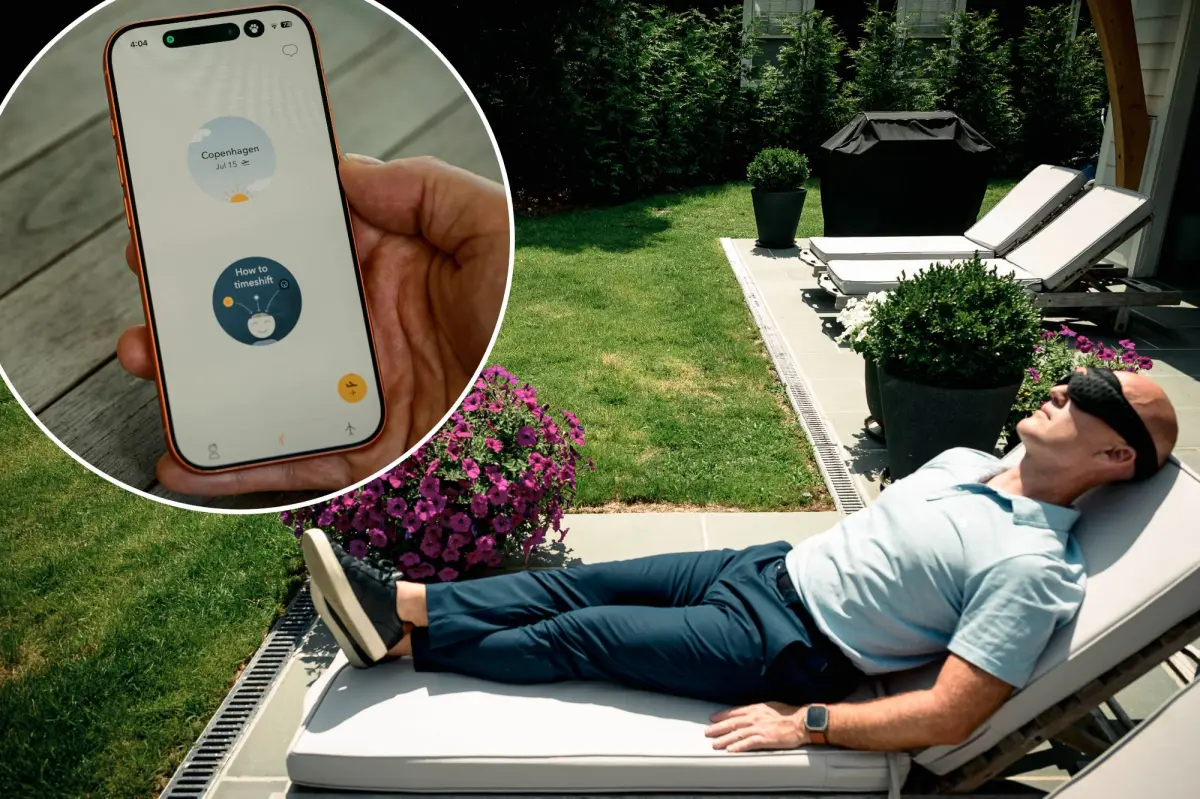
For frequent flyers, jet lag has long been accepted as an inevitable, exhausting tax on global travel. We’ve all heard the usual remedies: drink plenty of water, force yourself to stay awake until local bedtime, choose a heavy meal, or try to sleep it off. However, Mickey Beyer-Clausen, a seasoned traveler and Southampton, Long Island resident, is on a personal mission to dismantle these age-old myths. Born in a Danish fishing village and raised as the son of a flight attendant, Beyer-Clausen has spent his life in transit, experiencing firsthand how miserable time-zone shifts can be. He argues that traditional advice—like relying on special diets or hydration—is completely unsupported by scientific evidence and does virtually nothing to realign a struggling body. To solve this universal pain point, he teamed up with Dr. Steven Lockley, a renowned Harvard Medical School scientist with deep ties to NASA, to co-found Timeshifter. Launched in 2018, the groundbreaking app translates complex circadian science into personalized plans, successfully declaring war on jet lag for everyday travelers.
At the absolute core of Timeshifter’s massive success is its departure from the generic, one-size-fits-all approach to travel fatigue. The app, which has already amassed nearly two million subscribers, relies on the exact same circadian rhythm technology that NASA used to help astronauts manage their sleep schedules aboard the International Space Station. The primary mechanism for shifting the body’s internal clock isn’t food or pills, but light. Timeshifter guides users on the precise hours they need to seek out bright light or avoid it entirely. To make this practical, Beyer-Clausen champions a surprisingly simple tool: a pair of dark sunglasses, which he considers the absolute number-one essential carry-on item for any traveler. By slipping on sunglasses, even on a brightly lit airplane or inside a bustling airport terminal, travelers can easily simulate the dark environments their brains need to begin adapting to a new time zone long before they actually land.
Beyond light exposure, Timeshifter’s algorithms are deeply customized to an individual’s unique biology, specifically their “chronotype.” This term refers to a person’s natural predisposition to sleep and feel alert at certain times of the day, classifying them generally as early birds or night owls. Because these internal clocks vary wildly from person to person, a strategy that works for one traveler might completely backfire for another. For instance, early birds inherently struggle less when traveling east, whereas night owls adapt much more comfortably when heading west. Timeshifter takes these personal nuances into account, often prompting users to subtly shift their slumber patterns in the days leading up to their departure. By combining science-backed schedule adjustments with everyday habits like caffeinating and sleeping at calculated intervals, the app effortlessly nudges the body’s internal clock into alignment with its destination, making the transition seamless and natural.
This highly scientific yet user-friendly approach has quickly captured the attention of major corporations and elite athletic organizations worldwide. The aviation industry was among the first to recognize its value; Lufthansa forged an official partnership with Timeshifter after more than 150 of its own employees independently downloaded and praised the app. Soon after, sports science researchers and professional athletic trainers realized that managing circadian rhythms could unlock a massive competitive advantage. Major League Baseball, the NBA, elite tennis players, and Formula 1 racers have all integrated the technology into their travel regimens to maximize physical performance. The stakes are incredibly high in professional sports, where even a slight dip in energy can mean the difference between winning and losing. Timeshifter provides these organizations with analytical clarity, allowing them to map out upcoming travel schedules and pinpoint exactly which away games present the highest physiological risk to the team’s performance.
To further cement its status as an athletic necessity, athletic giant Nike recently rolled out a massive collaboration with Timeshifter to support its highly valued sponsored athletes. During the World Cup, powerhouse soccer teams representing England, France, Brazil, Norway, the Netherlands, and Team USA relied heavily on the app to maintain their peak physical output while traversing continents. The partnership has proven to be so incredibly effective that Nike plans to deploy Timeshifter’s specialized services once again for the upcoming 2028 Olympic Games in Los Angeles. The app’s transition from a niche consumer travel tool to an essential piece of high-performance athletic gear has completely redefined how elite competitors prepare for international tournaments. Under Beyer-Clausen’s vision, managing sleep is no longer just about comfort; it is now an essential science of human optimization.
As the sports scientific community continues to generate overwhelming data proving the link between circadian alignment and athletic success, Timeshifter’s business is booming. The financial success of their specialized elite athletic programs has caught even its founders by surprise. Beyer-Clausen recently revealed that the entire revenue he had budgeted for their concierge athlete services for the year 2026 was fully reached by January 15th of this year. As the app continues to disrupt the travel and hospitality sectors, its rapid financial growth proves that people are willing to invest heavily in reclaiming their time and energy. Whether you are an Olympic goal-scorer chasing a gold medal, a business executive preparing for a high-stakes meeting, or simply a vacationer hoping to enjoy your trip from day one, Timeshifter is proving that jet lag is no longer an inevitable consequence of exploring our planet.