


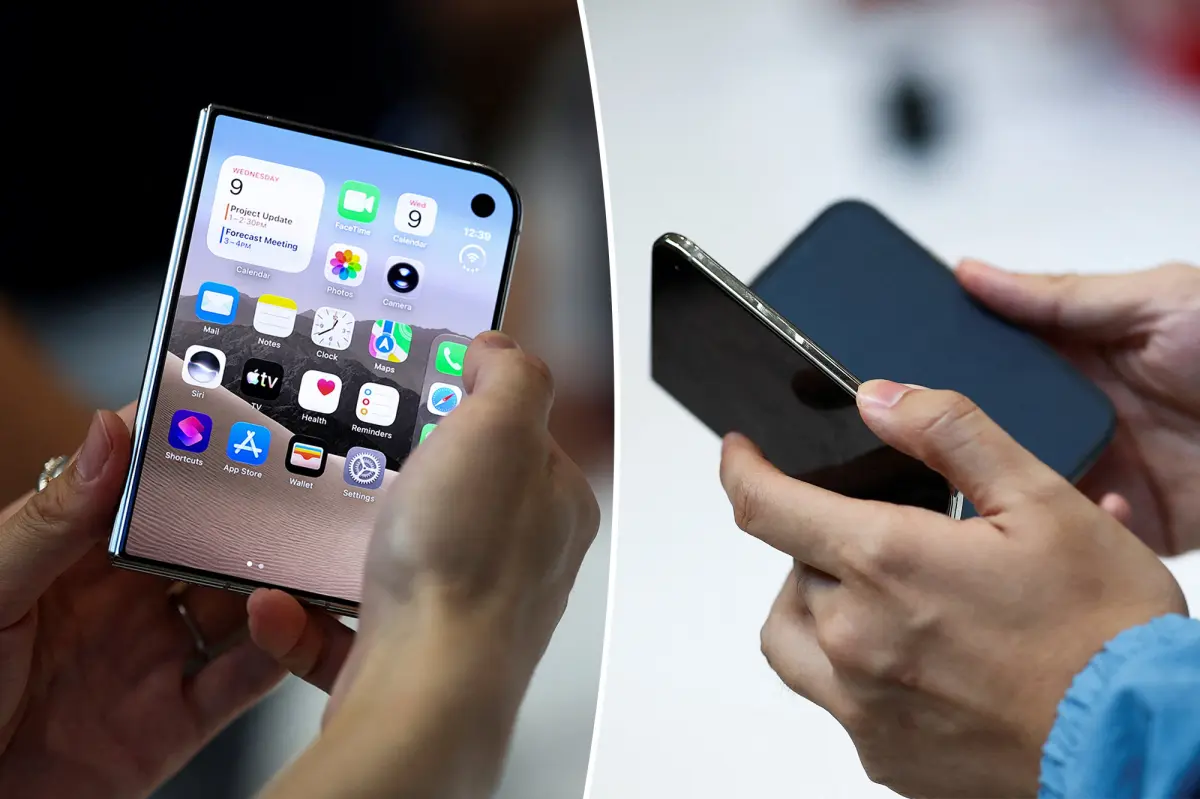
1. Apple has never been shy about rewriting the rules of its own iconic products, and this week the company took perhaps its boldest step yet with the reveal of the iPhone Duo, its first-ever foldable smartphone. It is, by any measure, the most dramatic physical transformation of the iPhone since the very first model changed the way we thought about phones back in 2007. The device is undeniably striking: a 7.6-inch inner display that opens up like a small tablet, a 5.4-inch outer screen for quick tasks, and a body made of titanium that folds down to just over three inches thick—small enough to slide into a pocket without feeling like you’re carrying a brick. It weighs just over half a pound, and Apple calls it “dynamic” and “compact and comfortable to hold.” The starting price, however, is far from compact: $1,999. That alone makes it a luxury item, but the people willing to spend that kind of money expect a near-perfect experience. And for a significant group of potential buyers, that experience may be complicated from the very first moment they pick it up. The Duo has two screens, yes, but its physical controls are arranged along one side of the device, including the new Touch ID button built into the side edge. That might sound like a minor design choice, but for left-handed users—people who naturally hold their phone in their left hand and reach with their left thumb—it raises a surprisingly emotional question: Easy to reach for whom, exactly? Apple says the controls are “easy to reach,” but the placement seems to assume a right-handed world. And lefties, as they always do, are quick to notice.
2. The concern is not about aesthetics. It’s about daily usability, muscle memory, and the quiet feeling of being overlooked. On a traditional iPhone, navigation bars and essential controls stretch horizontally across the top or bottom of the screen, so neither hand feels especially penalized. But the Duo moves key controls to one side, and that side feels like it was chosen with right-handed users in mind. For a left-handed person trying to operate the phone one-handed, that means stretching awkwardly across the display, repositioning the phone, or giving up on one-handed use altogether. On Reddit, users were quick to share their frustration. “Any other southpaws out there that use their phone one-handed with their left?” one person asked. “I’d love to have this phone, but I have a feeling they aren’t going to implement a left-handed mode.” That comment captures something important: the fear isn’t just about the current design, but about whether Apple will even acknowledge the problem. Another commenter worried that software alone wouldn’t fix it. “It’s more than just software,” they wrote. “The Touch ID button, the outer display, the cameras… they would have to manufacture a mirrored version for lefties to have the same experience as right-handed people.” That observation gets to the heart of the issue. A software toggle can flip a screen orientation, but it can’t physically move a button from one side of the phone to the other. It can’t change the position of the cameras or the outer display’s usable edge. For left-handed users, the Duo might feel like a device built for someone else—someone whose dominant hand happens to match the design team’s assumptions.
3. Beyond the everyday inconvenience, there is a deeper concern about accessibility and inclusion. If the iPhone Duo is genuinely difficult to use with the left hand, what does that mean for people who have no choice but to use their left hand? One left-handed YouTube commenter put it bluntly: “My first thought was how are they going to make it accessible for us? And what if someone has had a stroke or otherwise can’t use their right hand?” That question shifts the conversation from a matter of preference to a matter of necessity. Apple has long been a leader in accessibility, and the company did tout the Duo’s built-in accessibility features, including AssistiveTouch, Switch Control, Voice Control, and Eye Tracking, which are designed to help people with vision, mobility, hearing, speech, and cognitive needs. Those are genuinely valuable tools, and they can help many users interact with the phone in ways that don’t require a specific thumb. But no amount of software can change the physical reality of where a button lives. A person with limited use of their right hand shouldn’t have to rely on voice commands or assistive switches just to unlock their phone with Touch ID. They shouldn’t have to hold the phone upside down or awkwardly contort their hand because the hardware wasn’t designed with them in mind. The criticism isn’t that Apple ignored accessibility altogether; it’s that the physical design choices can still create barriers that software can’t fully solve. And for a company that prides itself on designing products for everyone, that feels like a meaningful blind spot.
4. And yet, for all the left-handed anxiety, the early hands-on impressions from people who have actually touched the Duo are surprisingly positive. Brian X. Chen, a consumer technology writer for the New York Times, described the device as extremely thin when opened, and when folded shut, he said it felt almost “dainty”—about the size of a passport, and noticeably less bulky in a pocket than other foldable phones he had tested. That kind of feedback matters because one of the biggest complaints about previous foldable devices has always been their thickness and weight. The Duo, by all accounts, feels refined, elegant, and portable in a way that earlier foldables did not. It’s not a novelty gadget; it feels like a real phone, albeit a very expensive one. The question is whether the design choices that make it feel so sleek will also make it feel exclusionary. The foldable phone market is still relatively small, accounting for less than 2% of global mobile sales, according to IDC data cited by The Times. But that could change quickly. Apple has a unique ability to normalize categories that were once considered niche, and research firms believe that Apple’s entry into the foldable space will spark consumer curiosity and drive higher sales across the industry. That means the Duo isn’t just a product for a few early adopters. It’s a statement about where smartphones are going. And if that future is built around a design that favors right-handed users, left-handed users may feel left behind in a way that becomes more pronounced as more people adopt the form factor.
5. It’s worth remembering, though, that handedness is not a simple binary. Roughly one in ten people is left-handed, but handedness exists on a spectrum, and many people use both hands for different tasks. Some left-handed users say they naturally use their right hand for their smartphone, simply because that’s what they’ve always done. “Yeah, I’m left-handed and I have a Fold 7,” one YouTube commenter wrote. “People will adapt. Truly not an issue.” That perspective is valid, too. Human beings are remarkably adaptable, and many of us have already adjusted to a world designed for right-handed people—scissors, desks, can openers, car dashboards. A smartphone is just another item on that list for some. But adaptability doesn’t mean the design shouldn’t be questioned. Not everyone wants to retrain their muscle memory after years of using their left hand. Not everyone has the dexterity or physical ability to simply switch hands. And even for lefties who do use their right hand for phones, there’s something slightly insulting about being told that the discomfort is just something to get used to. The argument isn’t that the iPhone Duo is unusable for left-handed people. The argument is that it could have been designed differently—or at least, that Apple should be transparent about whether a left-handed mode is coming. A simple acknowledgment would go a long way. Instead, left-handed users are left to wonder whether they’re being ignored, or whether the issue simply never crossed anyone’s mind.
6. For now, the debate remains largely theoretical. The iPhone Duo won’t arrive in stores until October 23, with preorders beginning October 16, and Apple has not yet announced any dedicated left-handed mode or alternative hardware layout. That leaves left-handed users in a strange limbo: excited about a genuinely new kind of device, wary of a design that might not serve them well, and unsure whether their concerns will be addressed before launch. Some will preorder anyway and hope for the best. Others will wait for reviews from left-handed tech writers who can test the experience honestly. And some may decide that $1,999 is too much money to spend on a phone that feels like it wasn’t designed for them. The broader lesson here is about the importance of inclusive design. The iPhone Duo is a marvel of engineering, a bold leap forward, and a beautiful piece of technology. But no amount of innovation can replace the feeling of being considered. When a company as influential as Apple makes a design choice, it shapes the entire industry. If the Duo succeeds, other manufacturers will follow, and the foldable form factor will become the new normal. That’s exactly why left-handed users are speaking up now. They know that this moment matters. They know that once the design is locked in, it may be years before anyone revisits it. And they know that the difference between a phone that feels great and a phone that feels like a compromise can come down to something as simple as which side the button is on. The iPhone Duo may be the future of smartphones, but left-handed users are waiting to see whether that future has a place for them.