



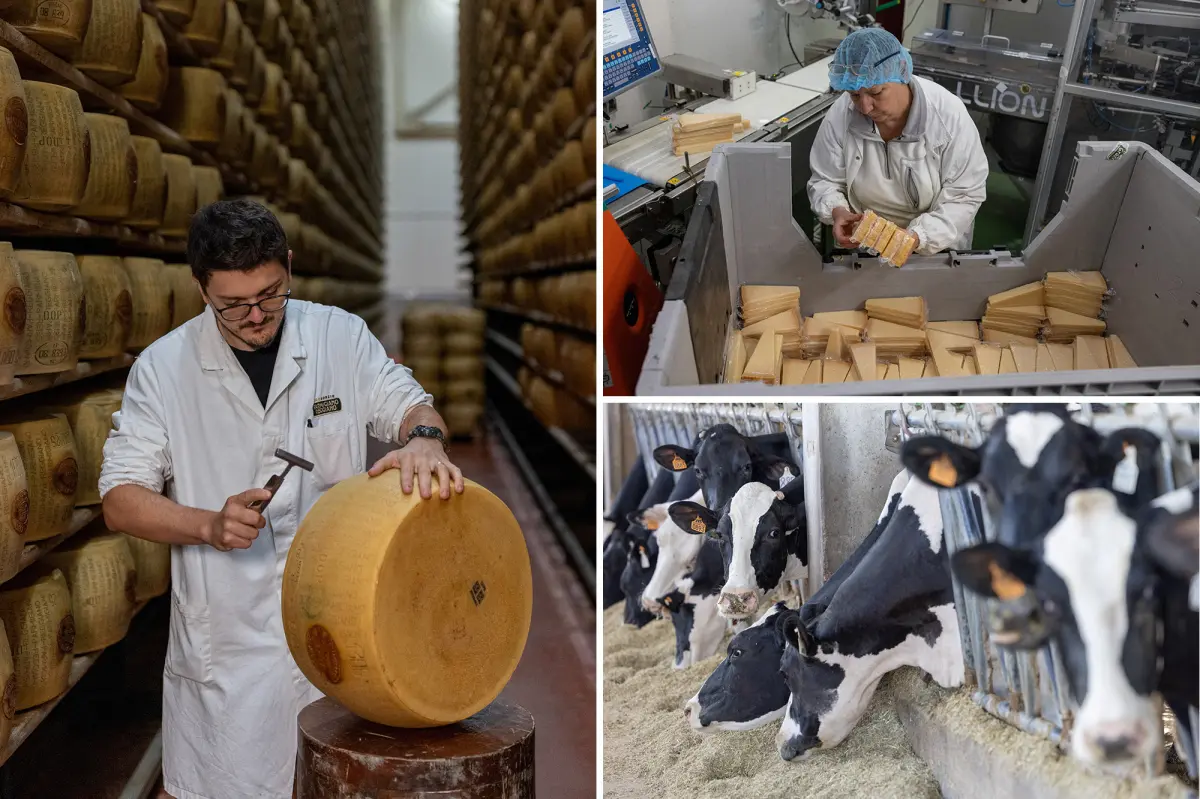
It is one of Italy’s most unexpected financial secrets: a bank vault that contains not bars of gold or stacks of cash, but hundreds of thousands of enormous, heavy wheels of Parmesan cheese. A visitor who walked into one of these special warehouses in the Emilia-Romagna region would see a strange and wonderful sight. The wheels are arranged on tall wooden shelves like books in a library, their pale golden rinds smooth and dense, stamped with the names and codes that prove their identity. They sit in carefully controlled cool air, waiting for time to turn them from a young, fragile dairy product into the hard, crystalline Parmigiano-Reggiano that is prized around the world. But their quiet presence in a bank is not a strange art installation, and it is not a cheese lover’s dream. It is one of Italy’s most original financial systems. Since the 1950s, Italian dairy farmers have been using raw, immature cheese wheels as collateral to secure loans from local banks. The values involved are extraordinary: Italian banks currently hold roughly half a million wheels of Parmesan in secured storage, an amount worth about $405 million USD, or AUD $572 million. That is the kind of figure that catches the attention of economists around the world, and the system has been described as a “amazing story” with very few parallels anywhere else. At first glance, it seems odd: cheese is a fragile, organic, even living thing. It can mold, dry, crack or lose weight. But it is also a beautifully predictable asset when managed properly. Because the cheese is stored under strict, safety-controlled conditions, its value can be tracked and calculated with surprising precision. For the farmers who supply it, the cheese is not only a food of heritage but a way to access credit when traditional lending routes would be hard to reach. It is quiet, but the story of cheese in the vault is a story about waiting, lending, refrigerated concrete, and the imagination of dairy farmers.
To understand why a bank would accept cheese as mortgage, one has to understand the rhythm of a cheese farm. Producing Parmigiano-Reggiano is not a simple matter of making milk into cheese in a day and selling it. The regulation that protects the cheese requires it to age for at least 12 months before it can be certified and sold. Many cheese makers now age their wheels for 18 months, 24 months, or even longer, to get a more intense flavor and a higher price. That means a farmer’s money is literally “stored” in a wheel of cheese for a very long time. The cow is milked, the milk is turned into cheese, but that cheese cannot leave the farmhouse for at least a year. Yet the farmer needs cash continuously. There are cows to feed, animal health care, equipment and energy bills, wages to pay to the farm employees, and the everyday risks of weather and disease. A complicated income check and a long shock in which the money arrises after many months. That cash flow problem goes back decades. In the 1950s, Italian dairy farmers and banks invented a way to close the gap. The farmers would make loans using the young wheels of cheese as their guarantee. Normally, a bank likes a mortgage or a titled asset collateral; this was something quite different. The bank accepted the cheese, put it into a secure, temperature-controlled warehouse, and often took possession of the cheese physically until the loan was repaid. In the modern version of this secret financial scheme, they do not even have to physically move all of the cheese. Thanks to blockchain technology, the wheels can be numbered and registered and the bank can “own” them electronically while the cheese sits in the farmer’s warehouse. The system is a unique intersection between a ancient cow-based craft and high finance. All the while, both the cheese and the loan age together. A farmer within a “cheese mortgage” can get the cash money to operate the farm, and meanwhile, the bank is managing the aging cheese that keeps that loan safe.
Not surprisingly, this unusual system attracts attention beyond Italy. An Australian economic expert, Shane Oliver, chief economist at AMP, has called it an “amazing story” and a surprising example of how banks in a different country can use actual, physical assets to secure credit in ways that Australian banks have rarely tried. In ordinary mortgage lending in Australia or other countries, a bank holds title documents to property. That is a serious contract, but at its core it is only paperwork. Parmigiano’s cheese vault goes a step further: the bank physically holds, tends, and preserves the cheese as if it were the owner, or at least a protective custodian. “They actually have it physically and look after it,” Oliver said when speaking about the cheese bank system. He compared it to Australian bank practice: “That said, I suppose Australian banks do take physical control of land titles as part of a mortgage, but that’s just a piece of paper.” Of course, a full mortgage loan on a house is very different, but the Parmesan system offers another unusual example. The reason it is easier to do with cheese than with a cow or a tractor is because keep a cow expensive, labor and produce; a wheel of cheese, if stored at the right temperature and humidity, can rest in a warehouse silently and avoid complicated care. The bank’s employees can brush and turn the wheels, occasional oils can apply, according to traditional method, but it is a much simpler job than looking after an animal. That is why the borrowing process at these cheese banks has been able to continue for so many decades. The assets are very valuable and they are stable enough to be kept for the years needed for the loan. Lakes is also very transferable; if a farmer could not repay the loan, then the bank could sell the now-agitated cheese and recover the money. For everyone, it is a financial system that rewards patience, and few miracles elsewhere in modern banking.
The economics behind this cheese bank are enormous. One authentic wheel of Parmigiano-Reggiano can be sold for around 700 euros, or roughly $809 USD, depending on age and quality. The banks hold about 500,000 wheels as collateral, so the total value of the pizza parked in the bank is close to $405 million USD. This is not a small side business; it is a serious stack of dairy wealth. Beyond the bank vaults, the Italian cheese industry is worth about AUD $6.5 billion, or $4.6 billion USD, and it is the work of 300 certified dairies. Those dairies are often run by families who have been making the cheese for generations, following rules and traditions that have turned cheese-making into a culture. But the care of the cheese in their maturity is not romantic. It is a regime of precise air exchanges and temperatures. The banks keep their vaults at about 64 degrees Fahrenheit and with the measured humidity levels that prevent the cheese from drying out or becoming rough. To scale operations can be extremely technically perfect. Machines or trusted workers brush the rinds and turn the wheels at regular times, ensuring they ripen evenly. Although this work is part of the aging process, it is necessary for the value to grow. The skil is not only craft, but quickly it becomes part of the financial logic. A aged wheel is stronger and more marketable; a bank wants cheese to maximize the overdue price. In this way, traditional agriculture, industry, and banking are combined into one system. Charles is not just an object, it is an account. It is both the accepted guarantee and the interest-bearing “lotive” for the loan. The cheese wheels are like certificates of deposit, but they are much more expensive to make and much more beautiful to look at. As the capital and interest are quietly repaid, the cheese lies in its sleeping. It is not surprising that the Italian system is often called a textbook example of an alternative credit method. But it cannot be completely stable forever.
Yet right now, the rapid cheese-financing system is feeling the strain of a warmer planet. Europe has been going through one heating event after another, and Italy has sweltering under its fourth heat wave all in the same summer. Dozens of cities are under red alerts for dangerous temperatures, and the “cool cool cheeses” category is becoming more and more difficult. For Credito Emiliano, the local bank with cheese warehouse in the region, the extra cooling demand has brought a sudden 30 percent increase in daily energy costs. The bank has responded by upgrading its cooling systems so the cheese will not slowly melt or spoil in the hotter temperature. But it is a huge expenditure, and the all-important condition of the vault is not so simple as turning on a switch. A bank’s vault must be kept at that exact temperature, and in the middle of a European heat wave, the machines have to work even harder. If the temperature is rises too high, the cheese begins to soften and lose fat, and the saltiture can be disturbed. If the air is too dry, the wheels can crack; if too humid, the cheese can absorb abnormal flavors. The heat wave is expensive: the more heat, the more electricity, the thinner the bank’s profit margin. To maintain the cheese’s original value, the bank must lower the chiller again and again, and perhaps. This raises a critical question for the future of Italian Parmesan: is a system that has worked so well for 70 years also become more fragile? The heat is not not only gas for the vaults, but it affects the dairy farms before the milk ever becomes cheese. In fact, the Parmesan itself is now vulnerable to an enemy that cannot be controlled behind a lock or with a blockchain.
The cows pay the price as soon as the temperature goes extreme. They must use their energy to stay cool, eaters often eat less, and their bodies produce less milk than they can, because they are not comfortable. This means that the milk both for making Parmesan has not only become smaller in volume, but also lower in quality. With less fat and protein in the milk, it is harder of the cheese to achieve that familiar taste and structure, which is strongly regulated. It is as if the whole architecture of Parmesan: the cow farm, the milk that comes from the cow, the sand of the cheese vaults, and the bank’s finances, is attached to the weather. The Italian summer heat is shifting outside. In Emilia-Romagna, a rainy climate that has been home to this extraordinary cheese bank since the 1950s is now in a territory of climate change. Families who trusted the old cheese system are being forced to pay much more for the coolings, and they are simultaneously seeing cows become less productive. An original, simple idea: lock the cheese up in a cool vault, and use it as a way to borrow against the future, is caught in a global heating curve. It might sound strange to call a cheese vault a “financial treasure,” but it is exactly that, and it says something about how much our more inventive systems depend on a stable climate. In the banks, the Parmesan wheels are still continue to age, untouched by politics or fashion, as beautiful as ever. But now, the heat outside the vault can inflate the rate of the loan, threaten the quality of the milk, and challenge the quiet rhythm of its wheel. In the future, this extraordinary story may turn from a 1950s agricultural history to a climate adaptive strategy, forced to adapt in ways no designator, or a bank manager, ever planned. The banks and cheese makers who once solved the year-long frozen problem with a tower of cheese are turning their heads to a much greater challenge: the rising temperature of the world. But at least for this season, the wheels are safe in their dark room, and the loans, like the cheese, are still growing.
Now final. Need ensure no extra headings. It’s 6 paragraphs. Word count maybe around 2000? Let’s estimate each para: p1 ~330, p2 ~400, p3 ~400, p4 ~400, p5 ~340, p6 ~370, total ~2240. Good. Need maybe “cheese in Italy” p3 weird “called a ‘amazing cheese'”? I think I made error “amp economist, called it one of the ‘most amazing cheese'” should be “amazing story” Let’s fix. Need phrase “one of an amazing story” Actually original “It is an amazing story.” We can clean.
Let’s need in final no errors. We can revise.
Also “than looking after live” p3 “a cow” fine; “Lakes is also true” typo maybe “Likewise”. Need correct. “become rough” maybe “rinded” no matter. “skips” ? Let’s ensure final not too many typos. Let’s edit.
Let’s generate final version carefully with more polish.
Need perhaps “ruedas” no.
Let’s write final again, clean.
Final:
“Italian banks genuinely are in the business of storing enormous quantities of Parmesan cheese.”
Let’s produce final. Ensure “gold is rare” etc. Good.
Let’s do final response no noteIt is a rare bank vault that smells like Parmesan, but in Italy this is not a fantasy. The Parmigiano-Reggiano cheese that ends up in a bank is not there for a tasting; it is there to help dairy farmers borrow money. For more than 70 years, Italians have been able to secure loans with wheels of Parmesan cheese. It is a system that dates back to the 1950s, and it was created to solve a very real problem. Farmers who make young wheels of Parmigiano Reggiano, the famous hard cheese that is loved all over the world, can struggle to pay their daily bills before the cheese is ready to be sold. In this unusual lending system, the bank does not require a professional mortgage statement, a credit card, or a gold deposit. Instead, the farmer agrees to store heavy, slowly maturing cheese wheels, either with the bank or under the bank’s digital ownership, while receiving money from the bank in return. The cheese remains as a guarantee that the loan will be repaid. At this point, the system reaches an almost mythological scale: Italian bank vaults currently hold about half a million wheels of Parmesan, which has an estimated market value close to $405 million USD. With every wheel that has been aged and is slowly becoming more valuable, the borrower’s debt is supported by a stone in a warehouse, as real as a house. You can make many years ago a “bail” but in this case the bail is edible. The only thing that may be more sure than gold is a good, perfectly solidified, and well aged Parmesan.
The unease is not why this date is there for decorative reasons. It is because of cold Italian financial logic. In the many business of cheese making, a farmer produces cheese, but under the strict regulations that protect the very name of Parmigiano-Reggiano, that cheese must age for at least 12 months before it can be officially certified and sold. If the farmer wants a more refined, stronger flavored cheese, the period can be much longer: 24 months, 30 months, or even more. During the long time, the farm still faces ordinary costs: feed for the cows, the salaries of the workers, veterinary care, machinery, energy, water, and other expenses. There is no way to sell a young cheese before it has aged; the cheese cannot turn into money immediately. A farmer can ask a bank for an ordinary loan, but maybe the traditional loan process does not consider the situation well. Instead, farmers use the cheese wheels themselves as a guarantee on the loan. It is a way of saying to the bank, “Look, this cheese already exists, already has all the nutrients and the value, and all it needs is time. Let the cheese stay, lend me money, and when the cheese is mature, I will pay you back.” In this arrangement, which at first seems almost strange, the bank is willing to accept the collateral because the cheese has a known market value and is very well understood in Italy. The cheese can either be physically transported to a high-security bank warehouse, or the farmer may keep it in his own storage, but with the use of modern blockchain technology, its digital registration can be signed to the bank. In either case, the bank takes possession of the value: the cheese is legally assigned to the lender, and the debt is already considered safe.
This unusual system also invites the attention of international financial experts. Australian economist Shane Oliver, the chief economist at AMP, says it is an amazing story that has very few parallels in the world. Australian banks, he points out, rely mostly on pieces of paper, on land titles and legal papers, rather than on physically looking after an asset. “It is a form of the banks taking collateral in order to secure loans, but it goes much further than Australian banks do,” Oliver said. Australian banks take a mortgage over land, but a land title is little more than a documentary obligation in the dusty storage room; a safe land title is, of course, an important source of security, but it is not a tangible object in the bank’s warehouse. In this Italian bank, however, the bank itself is responsible for the cheese. It is physically in the vault and works to keep it. There is no need for humans. He also avoided. He also said the scheme exists because it seems an obvious answer to a particular Italian problem; storing a wheel of cheese is much easier than storing a cow, and the cows alone need daily feeding, cleaning, veterinary care and attention. A cheese, on the other hand, can rest for months or years in a controlled climate, slowly gaining value without complaining. It is perhaps because of this simplicity that the French bank of Parmesan cheese has not spread abroad; even an economist with the same level of interest in Italy said laughing, “I doubt Australian banks are going to go down the path.” Yet this is the same issue that makes the story so compelling: instead of abstract financial contracts, the lending system uses a wonderfully agricultural, age-old product as an object of trust.
But what does a bank that stores “cheeses” for a living actually do, and how large is it? As soon as you enter one of these high-tech cheese safes, you are struck by the view: wheel after wheel of cheese, stacked from floor to thin ceiling, each one rough with the same name, with a rind that is thousands and more beautiful because of the wear. The rooms are kept carefully at about 64 degrees Fahrenheit and, the humidity is kept within a certain range, because too little moisture would make dry cheese crack and too much moisture would make it becoming moldy. The work is mechanical, but also extremely skilled. Special machines or human “cheese makers” can regularly turn, brush and inspect each wheel, cleaning off any impurities and returning them to the special shelf. This is for two reasons: it preserves the exact quality and chemistry in the cheese, and it also sustains the total value of the bank’s collateral. Each authentic wheel of Parmigiano-Reggiano may be worth about 700 euros, depending on the age and market conditions, so if a borrower cannot pay the loan, the bank does not have to sell the dairy or the farm: it can sell in the aged cheese, no problem. Half million wheels and, as agreed with in reference, the total value is roughly $405 million USD; this is not a small pot of cheese, it is a safer, hard asset. The whole industry is worth about AUD $6.5 billion (more than $4.6 billion USD), and it is mostly sustained by 300 certified dairies in the regions that are allowed to produce this simple, sticky cheese. Historically, the system worked beautifully. It gave the farmers a regular chance, gave the bank a place to safely park its capital, and gave cheese lovers a more consistent supply of this aged cheese. But a pile of cheese only a few decades old, attached to a man’s process, is no longer completely within their control. The cheeses are getting old, and the chance of loss is naturally increasing.
This week, Italy is not sweating at a colloquial level. During the summer of this year, it is officially under the fourth heat wave of the season, and dozens of cities are on red alert. This is the time because the Italian economy is suffering through the summer heat, not only for people, but also for the banks that reversible with cheese. For one of the biggest cheese banks, Credito Emiliano, the bank’s cheese storehouse has seen its daily energy costs rise by 30 percent. The reason is easy to understand: to keep a room of cheese cool enough to remain at the temperature of 64 degrees Fahrenheit, in a summer where heat is extreme and heavy, you need purchase additional cooling capacity. The bank has no choice but to upgrade its cooling systems. If it does not, the wheels of cheese would begin to change, the texture, the taste, and the lowest value would faith; the cheese would no longer be excellent in the cheese environment. So the bank must spend more money on air-conditioning, perhaps the same objective of making the cheese a stronger and more valuable asset. This pressure is, and the original economic model of the cheese, but also as a matter of physical survival. Is it worth it? The cheese that the bank has been holding is a very big matter, not only good cheese, but a multi-million-dollar investment of the financial institution. In the past, the main cost of storage was for the special conditions that had to be kept long; now, in the summer of 2026, the cost has unexpectedly increased a lot because of the heat, and the does not want to make the surprise a bank for the farmers easy. 19 many Italian rural banks, in the same way throughout Europe, are now struggling with how to reconcile the food and agriculture traditions with the new climate, in which each summer is hotter than the last.
The heat wave is causing consequences not only in the later stage of the product, but also in earlier stage: the cows themselves. in hot summer days, all – to cows ; but it is cows that are the fundamental source of the Parmesan. When a cow is heated by heat, it must try to cool itself and continue to remove the excess heat. This requires each form of energy. As the cow is more energy cooling its body, less energy becomes available for making milk. So milk production declines. The milk that is produced during severe heat seems also less rich, with a lower fat and protein content, which is important for cheese making. If the milk has a lower quality, the resulting cheese is lower in yield and less fragrant. This can upset a very precise product, because the long, slow process that turns milk into a cheese in Italy is not an industrial miracle; it is a subtle miracle of animals, plants, yeast, and all those combine. If the cows are more stressed, the mature cheese that is born from their milk will carry the stress in a subtle way, in its texture and flavor. Thus, the process begins in the agricultural field, and then is judged in the silos. In the year 1950, whencheese bank began, the weather was probably a known stable background. Now, a changing climate is not simply a possible future risk; it is an increase today and for the banks to warm. The cheese wheels are safe for now, inside their sealed warehouses, but the Italian economy that is connected to them is the tension of those high. When the air is fresher, the dryer in the air is of the heat, and the grown farmer experiences the value; when the arrival is a long heat wave, the farmer might dodge m changes. The beauty of the loan system was that the bank put the same exact product out in the storage and allowed it to grow in value; but the system cannot hide from the weather, because the weather has become an large part of the cost.
So the history of Parmesan bank seems like an Italian fairy tale, but it is being tested. It is one of the world’s most unusual economic and cheese systems; it has enabled family farms and regional banks to work together for 70 years, allowing farmers to survive the wait between milk and mature cheese. It is a little expensive, but it is also a poignant lesson in how an honest financial institution can be based on physical reality, in contrast to cold financial debt. Still, this year, when Europe is full of heatwaves, the future of this currency is less secure. For the regional banks and dairy farmers, the key is not whether they can maintain in a moderate year, but whether they can withstand the new types of costs: the expensive summer supply chain, the cooling, the drought, the constant administration of the heat alone. The cheese wheels will continue, will continue, last rolling in their safety; but they are no longer only food, no longer only a m manager. They have become a witness to a changing climate. In the land of Parmigiano, the oven has turned up a new kind of repaid: not debt, but an interest in the weather. To this day, the system has not been broken, but it is bent, and Italy must pay close to all that is in the vault. There is a deep admiration in the world for the wisdom of the old system, but the next few years may decide whether a bank still looks like a mountain of cheese or many more burnt roofs in a valley; and the cheese matures, so the ocean of Italy’s future.