


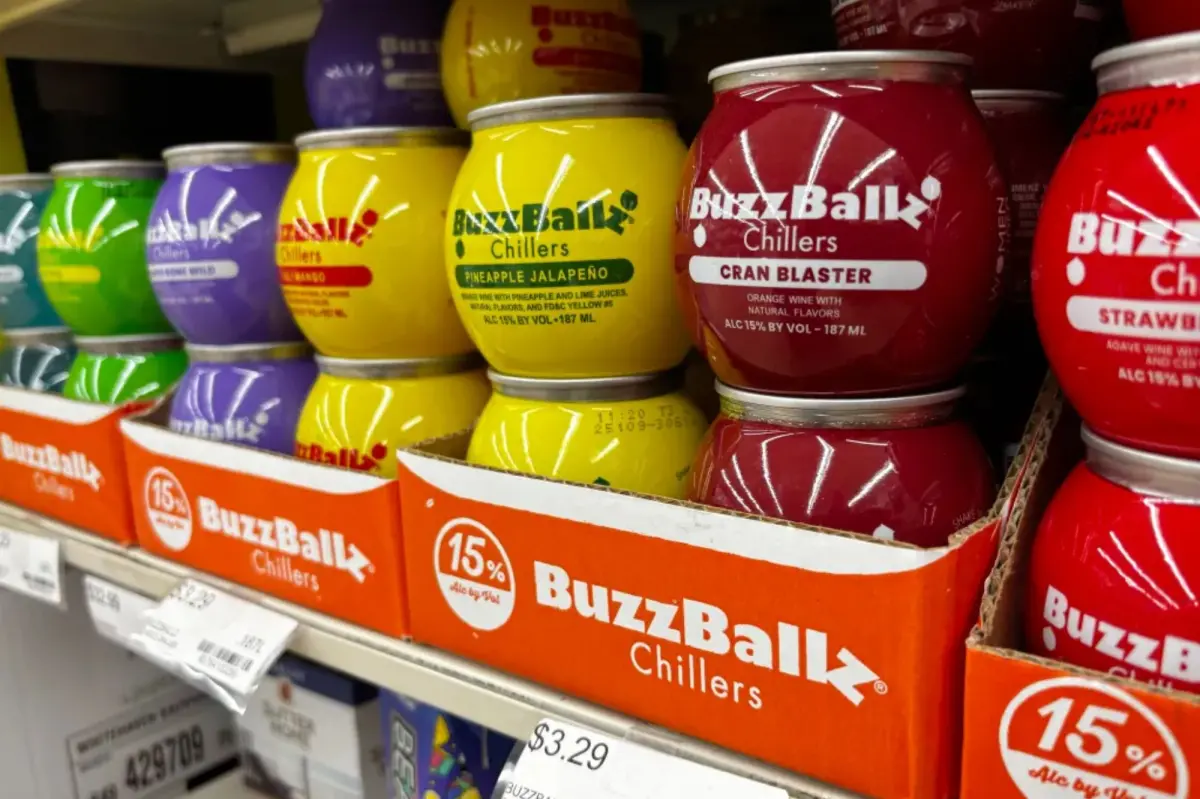
You know the scene: it’s a Friday night, your phone is buzzing with group chat messages about who’s driving, which bar has the least ridiculous cover charge, and whether anyone actually wants to spend eleven dollars on a mediocre vodka soda. Meanwhile, somewhere between the checkout counter and the cold case at a liquor store, a small, brightly colored sphere sits waiting—a tennis-ball-sized can of BuzzBallz, promising a 15 to 20 percent alcohol wallop for about the price of a fancy coffee. At first glance, it seems to contradict everything we thought we knew about Gen Z. This is, after all, the generation that proudly coined “sober-curious,” that cancels booze for Dry January, that asks for sparkling water at parties and talks about gut health and gym routines like they’re religion. But look closer, and a messier, more complicated story emerges. Young people haven’t actually broken up with alcohol, not really. They’ve just stopped drinking the way previous generations did—no more lingering over a glass of wine, no more casual beer with pizza. Instead, they’ve traded the expensive ritual of barhopping for the blunt efficiency of a tiny, powerful can that can be downed in a couple of sips before the Uber shows up. In an economy where every dollar matters, why nurse a twenty-dollar cocktail at a rooftop bar when you can get genuinely, satisfyingly buzzed on three dollars’ worth of “Berry Cherry Limeade” while still in your own living room?
The appeal isn’t just the price, though that’s certainly the hook. It’s about a generation that has learned to optimize everything, including its own intoxication. BuzzBallz get you where you want to go quickly, and they do it with a kind of playful, unpretentious charm that feels tailor-made for a social media feed. Each flavor has a name that reads like a meme, a bright, candy-colored can that looks less like a drink and more like a prop for a TikTok. Content creator Gizzelle Cade, who went viral after admitting that one single BuzzBallz got her drunk, captured the sentiment perfectly. She told the press, “Let’s be real, the economy is crap,” and she’s not wrong. For young people who came of age during a pandemic, a recession, and now the highest cost-of-living squeeze in decades, paying festival prices for watered-down drinks feels like an insult. Instead, they’ve become pregame professionals—drinking strategically in parking lots, at friends’ houses, or standing in the kitchen while the ice melts. BuzzBallz, with their small size and enormous alcohol content, make this strategy feel fun rather than desperate. There’s also something disarmingly nostalgic about them. The taste is less like a sophisticated mixology and more like a slurpee that snuck some vodka in, a nostalgic sugar rush that pairs perfectly with the way Gen Z likes to play with irony and earnestness at the same time.
That irony is everywhere online. Watch a dozen videos, and you’ll see the same arc: a young person holding up a tiny can with a skeptical eyebrow, claiming they’re just going to try one, and then cutting to themselves thirty minutes later, eyes glassy, laughing uncontrollably at absolutely nothing. One creator sat on a stool, a single BuzzBallz in hand, with text overlay reading, “Preparing for my Netflix documentary about why I love BuzzBallz so much.” Another filmed himself inside a liquor store, practically begging his friends to buy an entire case for the beach, gesturing wildly at the rainbow of flavors like a kid in a candy store. It’s a strange sort of community, built around a drink that was founded in 2009 by a Dallas schoolteacher, a detail that seems both random and somehow perfect. BuzzBallz wasn’t created by some corporate giant with a billion-dollar marketing budget; it was a passion project that slowly gained a cult following, and now that following has exploded into a full-blown movement. The company’s president, Jess Scheerhorn, credits the brand’s success to authenticity—to “bringing people together and unapologetic fun”—and there’s truth in that. The drink doesn’t pretend to be classy. It doesn’t ask you to sit down and savor it. It says, plainly: drink me, get buzzed, have fun. For a generation that often feels exhausted by the performance of adulthood, that’s a welcome relief. But there’s a darker current beneath the playful packaging, one that has little to do with colorful cans and everything to do with how Gen Z understands intoxication itself.
We have to talk about the numbers, because they tell a story that’s both nuanced and a little alarming. A 2023 Gallup survey found that the percentage of adults under 35 who drink alcohol dropped from 72% in the early 2000s to 62% in recent years. On its face, that seems like a victory for the wellness crowd. And yet, in the same period, high-alcohol, ready-to-drink beverages have surged in popularity, occupying an ever-expanding corner of the spirits market. By 2024, RTD cocktails made up 20% of the distilled spirits market, with revenue projected to grow from $903 million to $2.11 billion by 2030. The takeaway isn’t that Gen Z is drinking less. It’s that Gen Z is drinking less often but drinking much harder when they do. Think about the previous fads: BORGS, or Black Out Rage Gallons, where a gallon jug of water is mixed with an entire bottle of liquor, food coloring, and electrolyte powder, then sipped—or more accurately, guzzled—across a night. Think about the “Cutwater Challenge,” in which young adults attempt to finish an entire four-pack of 13% ABV canned cocktails in one sitting. It’s a pattern: not casual drinking, but deliberate, even competitive intoxication. Legions of young people identify as sober-curious, but another legion is quietly chasing a blackout. Some commentators have called it the new Four Loko, and that comparison isn’t far off. These drinks pack the equivalent of five or six beers into a single can, which means they’re not meant for sipping. They’re meant for impact.
The consequences are everywhere online, captured in the kind of self-deprecating videos that go viral and make you laugh while also wincing. Influencer Gage Briney, who took on the Cutwater Challenge, described the experience in gloriously vivid terms: after three Cutwaters, he’s “ready to throw my ass in a circle,” and after four, he’s “ready to crawl upstairs to order Taco Bell, but hoping I don’t pass out before I remember I ordered that Taco Bell.” Another user, who reportedly blacked out after just two cans, wrote in disbelief, “Who told you to put pain and agony in a can?” There’s a weird, twisted sense of pride that comes with surviving these challenges, a kind of digital badge of honor. But the underlying reality is less funny. Cutwater was actually intended to be diluted with water—hence the name—but those intentions were lost the moment people realized the cans were cheaper and stronger than anything at the bar. Instead of diluting, they’re chugging. Instead of pacing, they’re racing. And then there’s the “BBC Challenge,” which takes things to an even more terrifying level: chugging a BuzzBallz, a Beat Box, and a Cutwater all in succession. One creator filmed herself drinking the trio, then returned an hour later to announce, simply, “My head is banging, don’t do it.” There’s a kind of collective amnesia in each new generation, a belief that you’re the first to discover the power of strong, cheap alcohol, and that your body—unlike everyone else’s—will somehow handle it better.
So what are we to make of this strange moment? On one hand, it’s tempting to roll our eyes and call Gen Z reckless, pointing at the empty cans and the embarrassing videos as evidence of a generation that says one thing and does another. But that would be too simple. This is a generation that has grown up against a backdrop of crushing economic anxiety, environmental dread, and a pandemic that taught them that everything can be taken away at any moment. They’re not naive. They know exactly what they’re doing when they buy an $8 BuzzBallz and Cutwater combo for a night out instead of two $16 cocktails. They’re doing the math. They’re also doing something else, something more human than the statistics suggest. They’re searching for connection, for a reason to let loose even when the world feels heavy. They want to be part of a shared experience, to have something to post about, to laugh about with friends, to feel like a single night can belong to them. The brand marketing, with its emphasis on “unapologetic fun,” taps into a deep need for release. That doesn’t excuse the dangers of binge drinking, of course—blackouts are scary, and no amount of memes can erase the risk. But if we’re going to talk honestly about Gen Z and alcohol, we have to acknowledge that this isn’t just about self-destruction. It’s about resilience, too. It’s about a generation that has learned to squeeze every drop of joy out of an expensive, uncertain world. They’re not sober, and they’re not lying about being sober-curious. They’re just holding both truths at once: the desire for health and the need to escape, the fitness influencer and the girl who drank three BuzzBallz before leaving the house. Maybe that’s not hypocrisy. Maybe that’s just what survival looks like when you’re young and broke and still desperate to remember what it feels like to be alive.