


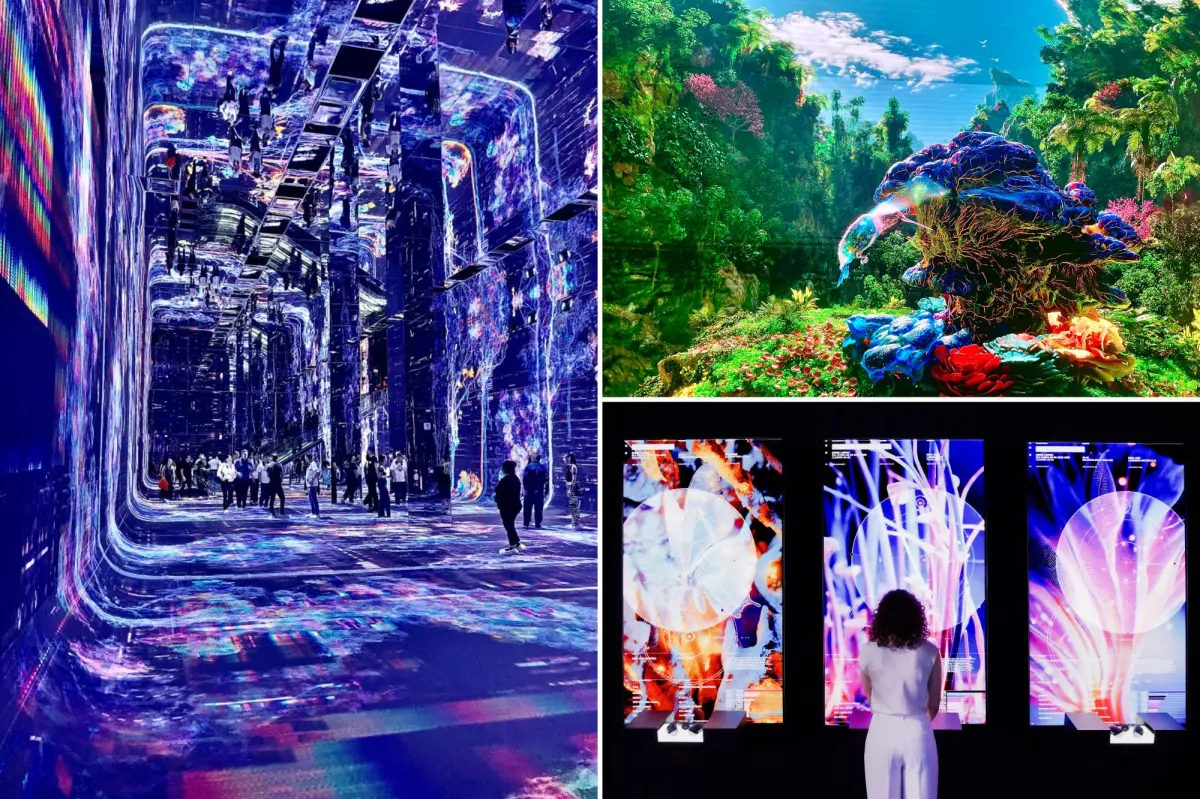
Step inside the bustling heart of downtown Los Angeles, away from the concrete noise, and you will find yourself suddenly plunged into a breathing, pulsing digital sanctuary where the natural world is reborn through the lens of artificial intelligence. This is Dataland, heralded as the world’s very first Museum of AI Arts, making its spectacular grand debut at the prestigious Grand LA complex. The flagship exhibition, “Machine Dreams: Rainforest,” is a visceral, mind-bending experience that transcends traditional canvases, surrounding visitors with a 360-degree sensory envelope where life surges from every angle—above your head, beneath your feet, and deep into your peripheral vision. Inside this windowless Data Pavilion, the boundaries of physical reality blur as a titanic digital canvas illustrates the inner matrix of trees, revealing the secret, invisible pathways of sap coursing through branches like neon bloodlines. The colossal images are powered by an astonishing 1.2 billion live-fed data prompts harvested from sixteen distinct rainforests scattered across the entire globe, turning the gallery into a living, breathing ecosystem of its own. It is an experience that does not merely demand to be seen, but deeply felt; a brilliant tapestry of enveloping music, mossy and floral scents, and even the subtle, sharp tang of ozone and electricity drifting through the air. For co-founder Efsun Erkılıç, who designed this modern-day Shangri-La alongside her partner, the world-renowned media artist Refik Anadol, the emotional gravity of the space is overwhelming. Watching visitors journey through the mesmerizing Infinity Room—a space designed to zoom the human eye into the breathtaking complexity of nature’s architectures—Erkılıç frequently finds herself moved to tears by the profound fragility and sublime beauty captured within these shifting algorithms. Far from a cold or detached techno-gimmick, this is machine-created art that possesses a beating heart—one that resonates with a strange, dreamlike intelligence that makes the digital jungle feel as alive and vulnerable as the real forests it mirrors.
The magic of Dataland lies in its invisible infrastructure, an incredibly sophisticated synthesis of human curiosity, natural science, and monumental computational horsepower that orchestrates an unprecedented, real-time dialogue between the wilderness and the viewer. Spread across an expansive 25,000-square-foot exhibition floor—bolstered by an additional 10,000 square feet hidden from view to house the massive server arrays, heavy hardware, and complex cooling systems—the museum functions less like a static gallery and more like a living, breathing, thinking organism. Upon crossing the threshold, visitors are offered an optional wearable sensory wristband that detects intimate biological shifts, capturing fluctuating body heat, emotional arousal, and resting heart rates as they navigate the shifting digital landscapes. This bio-data is fed directly into the surrounding environment, meaning that as you stand in awe of a towering virtual canopy, the installation itself is actively observing, adapting, and responding to your physical and emotional presence. Simultaneously, the gigantic wall-to-wall screens and highly reflective mirrored floors are constantly mutating in response to live telemetry streamed directly from remote wilderness regions across the globe. Anadol and his team are pulling data straight from the living tissue of the trees themselves—capturing microscopic shifts in soil root humidity, sudden temperature oscillations, and even the subtle, mysterious electromagnetic signals that trees use to communicate with one another through subterranean mycorrhizal networks. By translating these ancient, silent forest conversations into shimmering, hyper-saturated cascades of light and color, Dataland allows everyday urbanites to visually eavesdrop on the secret vocabulary of the natural world. This beautiful marriage of deep ecological research and advanced computer science creates a multi-sensory landscape where the gallery actually alters its climate, emitting carefully synthesized floral and earthy odors in tandem with the forest’s actual breath, collapsing the vast distance between concrete jungles and real, endangered biological hot spots that are currently facing unprecedented ecological threats from modern industrial development.
This technological marvel emerges at a highly contentious turning point in modern cultural history, as society grapples with the mounting anxieties, legal battles, and ethical dilemmas surrounding artificial intelligence and creative ownership. Historically, the swift rise of AI-generated content has sparked fierce outrage across the creative industries, with artists, writers, and musicians rightly raising the alarm over rampant copyright infringement and the unauthorized scraping of intellectual property to feed corporate algorithmic models. Many fear that the unchecked rise of these systems will result in a tasteless deluge of generic “AI art slop”—soulless, derivative content that cheapens the profound value of human craftsmanship and dilutes the cultural landscape. Leaders in the traditional art world, such as Jenn Singer, the founder of Manhattan’s prestigious Jenn Singer Gallery, have spent years passionately defending artists’ copyrights against these aggressive digital invasions, urging creators and institutions to critically evaluate the ethical implications of using automated tools. Anadol himself is deeply sensitive to these criticisms, recognizing that artificial intelligence is a powerful double-edged sword that requires rigorous artistic integrity, transparency, and a respectful relationship to its source material. Rather than scraping the internet for stolen human paintings and copyrighted photography, Anadol has pioneered a profoundly ethical approach by constructing custom data models through transparent, reciprocal partnerships with scientific institutions, global tech giants like Nvidia and Google, and the historic Smithsonian in Washington, D.C. All of the ecological data and image resources collected for “Machine Dreams: Rainforest” are entirely open-source and free to the public, ensuring that the local communities and research institutions that shared their vital data can utilize the advanced AI models for their own scientific conservation efforts. By sourcing his algorithms from the raw metrics of the natural world rather than the intellectual labor of other living artists, Anadol demonstrates that AI can be cultivated as a collaborative, respectful tool of discovery rather than an engine of creative displacement.
This ethical foundation inevitably invites a profound philosophical inquiry that lies at the very heart of the modern creative movement: is an image generated by an algorithm truly “art,” and who deserves the title of the artist—the programmer, the complex machine, or the natural world itself? For veteran art collector and legendary gallery founder Jeffrey Deitch, who previously showcased Anadol’s groundbreaking “Living Paintings” exhibition, the answer is remarkably clear and uncomplicated: Refik Anadol conceived the intellectual vision, designed the structural framework, and directed the entire technological symphony, making him undeniably the artist. Deitch asserts that artificial intelligence is simply a highly advanced, ultra-modern paintbrush—a tool that, like photography or digital synthesizers before it, is only as profound, provocative, or interesting as the human mind operating it. While lesser applications of technology can result in uninspiring, flat digital animations, Anadol elevates the medium by infusing his algorithmic tapestries with deep environmental consciousness, narrative weight, and social relevance. The fluid, churning shapes splashing across the gallery walls are not just arbitrary patterns of light; they are visual representations of the world’s rapidly vanishing ecosystems, illustrating the tragic, accelerated loss of hundreds of plant and animal species that slip into extinction every single year. By using AI to visualize the delicate, complex beauty of coral reefs and ancient rainforests, the exhibit acts as an urgent, highly emotional call to action, fostering a deep empathy for the natural world that traditional dry statistics and news reports often fail to evoke. Erkılıç shares this romantic vision of art as a bridge of universal connection, expressing a whimsical dream of one day welcoming legendary naturalist David Attenborough into the exhibition, longing to witness how the sensitive, responsive artificial machines would capture and translate the presence of a centenarian human who has spent his entire life documenting the wonders of our planet.
Yet, despite the undeniable beauty and critical acclaim of Anadol’s work, pioneering a massive, high-tech museum dedicated entirely to digital AI art remains an incredibly risky and polarizing venture within the broader, often conservative artistic establishment. Major cultural pillars such as Los Angeles’s Hammer Museum, the Los Angeles County Museum of Art, and London’s prestigious Serpentine Galleries either declined or remained completely silent when asked to comment on the project, reflecting a lingering, cautious skepticism that still shadows the rapidly evolving digital art landscape. This institutional reticence is likely a hangover from the volatile, speculative rise and spectacular, dizzying crash of the early 2020s NFT boom, which left many traditional galleries deeply wary of digital commodities and wondering how to practically sell, preserve, and display fluid, ever-changing media art that lacks a physical canvas. Furthermore, operating a sprawling physical facility inside the prestigious Grand LA complex, packed to the brim with cutting-edge supercomputers, high-fidelity projection mapping systems, and custom scent-dispensing machinery, requires an enormous, continuous stream of capital that traditional visual arts spaces often find difficult to secure. To offset these monumental overhead costs and maintain their state-of-the-art infrastructure, Dataland has developed a highly structured, modern commercial model, offering a range of diverse admission tiers designed to cater to casual tourists, local tech enthusiasts, and wealthy art patrons alike. Standard entry tickets start between forty-nine and seventy-nine dollars, priority access tickets are priced up to one hundred and twenty-nine dollars, and exclusive annual memberships range all the way from three hundred and fifty dollars to an impressive fifteen hundred dollars, proving that even the most ethereal, dreamlike digital landscapes must still be anchored by a highly calculated and pragmatic business model that secures the museum’s long-term operational survival in an increasingly expensive urban art market.
To truly bridge the gap between the virtual and the tangible, Dataland concludes its sensory voyage with an extraordinarily innovative, deeply personal gift shop that completely redefines the concept of a museum souvenir. Far from the standard, mass-produced plastic keychains, cheap keyrings, and generic posters found in traditional tourist gift shops, visitors are invited to purchase unique, custom-made items that are physically generated by their own physiological presence and emotional experience within the dynamic exhibit. By utilizing the biometric data harvested from your wearable wrist sensor throughout your journey, the museum’s advanced computers can translate your specific heart rate fluctuations, stress levels, and thermal signatures into a one-of-a-kind t-shirt design, rendering a visual representation of your internal state directly onto premium fabric in real time. If you prefer a unique olfactory keepsake, the custom scent-emitting systems can even analyze your physical and nervous system reactions to the diverse climates and synthesize a highly personalized, custom cologne or perfume, bottled on the spot for you to take home as a permanent sensory memory of your deep-forest experience. The true crown jewel of this interactive marketplace is Qualia, a gentle, contemplative, and highly precise robotic arm that operates as a mechanical portrait artist, gracefully dipping its brush into physical paint to translate your unique biological rhythms into physical brushstrokes on paper. Rather than painting a traditional, realistic depiction of your facial features, Qualia paints an evocative, abstract portrait of your actual heartbeat and fleeting emotional state, capturing a physical snapshot of your subconscious mind during your time in the digital jungle. This final, whimsical interaction beautifully serves as a window into the core philosophy of Dataland: a visionary space where technology is no longer viewed as a cold, isolating force, but rather as an intimate, deeply human medium that has the power to connect us to our own bodies, to each other, and to the breathtaking, fragile beauty of the natural world that surrounds us all.