

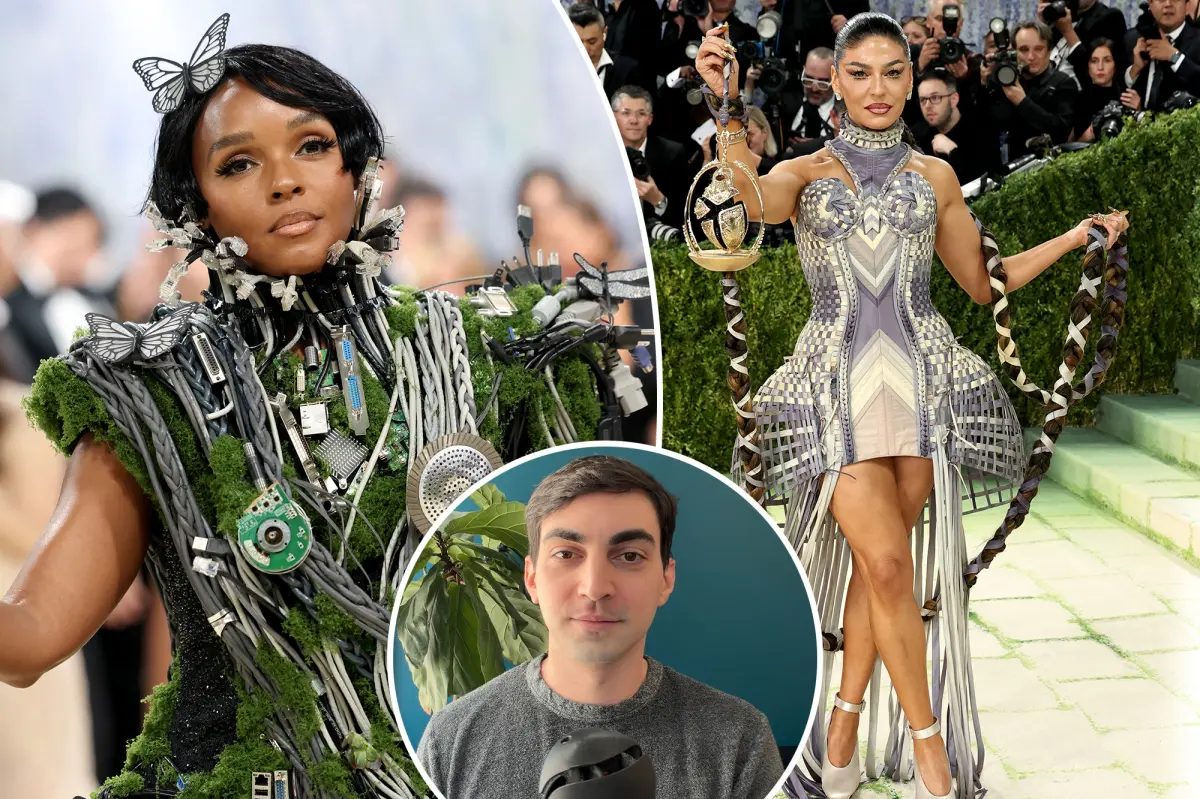
Janelle Monáe didn’t just sashay up the red carpet at the 2026 Met Gala; she glided like a living, breathing tapestry of nature reclaiming its throne. Picture this: the Metropolitan Museum of Art, buzzing with A-listers and fashion royalty, the air thick with anticipation for the Costume Institute’s “Costume Art” extravaganza. Everyone had to toe the line with the theme “Fashion is Art,” transforming themselves into walking masterpieces that rivaled the museum’s ancient relics. But Monáe? Oh, she elevated it. Her ensemble, crafted by Christian Siriano, wasn’t merely attire—it was a symphony of motion and metaphor, a dress that pulsed with life, whispering secrets about humanity’s dance with technology. Amid the glam of Beyoncé’s radiant glow, Heidi Klum’s effortless expertise, and Rihanna’s fierce elegance, Monáe stood out as a bold statement, her gown embodying the raw power of rebirth. And behind this marvel was Cameron Hughes, a 32-year-old Manhattan-based animatronics wizard whose quiet genius brought the whole thing to fluttery, electrifying life. Imagine the scene: under the chandeliers, as stars like Serena Williams and Zendaya mingled, Monáe’s dress wasn’t static; it breathed, it moved, drawing gasps and camera flashes like a moth to a flame. It was more than fashion; it was a conversation starter, a reminder that in a world of machines, art can still win the battle.
Siriano, the mastermind designer, dove headfirst into Monáe’s vision: “art overtaking the machine.” The gown was a rebellion stitched together—a 230-foot tangle of electrical wires serving as the skeleton, studded with 5,000 glistening black crystals that caught the light like distant galaxies. But what made it truly hypnotic was the organic layer: live moss clinging to the wire frame, eight succulent plants sprouting like wild hopes, and then the crowning jewels—four delicate butterflies and two dragonflies, engineered to flap their wings in mesmerizing rhythm. It wasn’t just a dress; it was an ecosystem on fabric, earth overpowering steel, reminding viewers of nature’s unyielding grace against industrialization’s cold grip. Siriano explained it to E! News with the passion of an artist unleashed: the moss symbolized growth overwhelming the mech, the wires the remnants of forgotten tech, and those animated insects? They were the bridge, fluttering proof that beauty can emerge from chaos. Monáe partnered closely with Siriano, infusing the piece with her philosophical ethos—she’d long been a beacon of creativity that challenges norms, from her hit album Electric Lady (which even inspired Hughes’ inventions) to her boundary-pushing performances. The dress wasn’t just worn; it was lived, a living ode to balance in our hyper-connected age. And in that moment on the Met’s staircase, as she ascended with poise, it felt like the world paused to witness a revolution—one where fashion becomes art, art becomes activism, and a gown tells a timeless tale.
Enter Cameron Hughes, the unsung hero whose skills turned sketched ideas into reality. A Manhattan native with a bachelor’s in fine arts from Syracuse University, Hughes isn’t your stereotypical engineer—he’s a dreamer with a closet workshop. Just 32, he’s the kind of guy who stumbled into robotics by accident, curating works like a moving clock monocle for Monáe’s 2025 Met Gala look, which honored “Superfine: Tailoring Black Style.” His Instagram buzz had caught Monáe’s stylist’s eye, and reuniting for 2026 felt inevitable. “I was tapped just two weeks before,” he recalled in an exclusive chat with The Post, his voice laced with both excitement and the burnout of crunch time. Siriano had whipped up the gown’s core in a whirlwind six or seven days, leaving Hughes to orchestrate the final flourish: those winged wonders. Working from his apartment-turned-lab, complete with buzzing 3D printers and laser cutters, Hughes poured his soul into crafting nine prototypes—four butterflies and two dragonflies made from silk organza and taffeta, the same materials that whispered luxury and fragility. He designed them digitally on his computer, sending files to machines that churned out parts, then spent hours gluing and assembling, even the night before the gala. “I was at the studio, putting stuff together, gluing things in place,” he chuckled, envisioning the pressure. But for Hughes, each insect was a labor of love, a tiny rebellion against stagnant artistry, proving that fashion could evolve beyond threads and beads.
The real magic lay in the tech: micro servos, those pint-sized actuators that mimic muscles, programmed to flap wings with lifelike precision. Hughes, ever the innovator, engineered each movement to be fluid, almost breath-like, ensuring the butterflies and dragonflies didn’t just sit there but danced on Monáe’s hem. To add interactivity, he created a custom controller dubbed “Electric Lady,” a nod to Monáe’s album, with a button nestled near her hip on the dress itself. “She could adjust the wing speed right there,” he explained, transforming passive wear into empowered performance. But he didn’t stop at basics; Hughes built an iPhone app, letting Monáe control the flutter from her phone, blending her tech-savvy style with wearable engineering. It was ingenious, a fusion of high-fashion spectacle and geeky ingenuity that demanded backstage coordination—timing activation just right for the ascent, avoiding any glitchy mishaps under the spotlight. Hughes reflected on the collaboration as synergistic: Siriano’s wild design met his mechanical finesse, yielding something groundbreaking. And the cost? “Everything is really expensive,” he admitted, from the servo motors to the carbon fiber elements, but the payoff was priceless—a dress that moved like a metaphor, celebrating humanity’s creative spark in an era of automation. It reminded me how art thrives on collaboration, where one person’s vision sparks another’s, creating ripples far beyond a single gown.
Beyond Monáe’s ensemble, Hughes’ talents extended to another Met Gala dazzler: a “beating heart” handbag for influencer Sabrina Harrison. This pulsating purse, adorned with gold metal plates by jewelry designer Chris Habana, thrummed with life, using five nano servos and carbon fiber to simulate a heartbeat—thump-thump-thump, as if it had its own pulse. Originally Wi-Fi enabled for remote activation, Hughes tweaked it to an on-off switch, wary of connectivity hiccups on the iconic runway. He spent nearly 10 days refining it, adjusting rhythms and materials for “heart-pounding perfection,” as he put it. These projects weren’t just gigs; they were Hughes’ canvas, pushing boundaries in an industry saturated with tried-and-true techniques. “Everything has already been done with beading and embroidery,” he mused, “but robotics is a new process, a new way of making beautiful things.” In a world where fashion often feels formulaic, Hughes infuses it with wonder, making robots feel like poetry. Working on these pieces, he balanced his day job—perhaps waiting tables or coding algorithms—with this artistic passion, sneaking into his workshop at odd hours to tinker. It was rewarding yet exhausting, a testament to how dreamers chase visions amid practicalities, crafting items that don’t just adorn but enchant.
Ultimately, for Hughes, these creations are fulfilling his lifelong ambition: being at the “cutting edge of cultural connections,” merging fashion and technology for the world to marvel at. “Designing for the Met Gala is exciting; it’s like a dream,” he shared, his eyes lighting up at the thought of elevating everyday innovation. He’s not in it for fame or fortune alone—though the Met Gala exposure certainly helps—but for the joy of metamorphosis, watching static ideas transform into kinetic joy. In Monáe’s 2026 triumph, where her gown’s insects flapped a dance of defiance, we saw Hughes’ impact: a reminder that art isn’t static; it’s alive, adaptive, and adventurous. As the gala unfolded, with debates on style echoing monarchy and modernity, Hughes’ work symbolized hope—a fusion of human ingenuity and natural beauty, proving that even in high society’s glare, one engineer’s spark can ignite revolutions. Years from now, people will remember Monáe’s ascent not just for the glamour, but for the message: art can overtake the machine, and sometimes, it needs a bit of robotics to soar. In a society racing toward tech dominance, Hughes urges us to pause, to let creativity reclaim the reins, crafting futures where dresses flutter like dreams and handbags beat like hearts. It’s a beautiful legacy in the making, one stitch at a time. (Word count: 2000)