


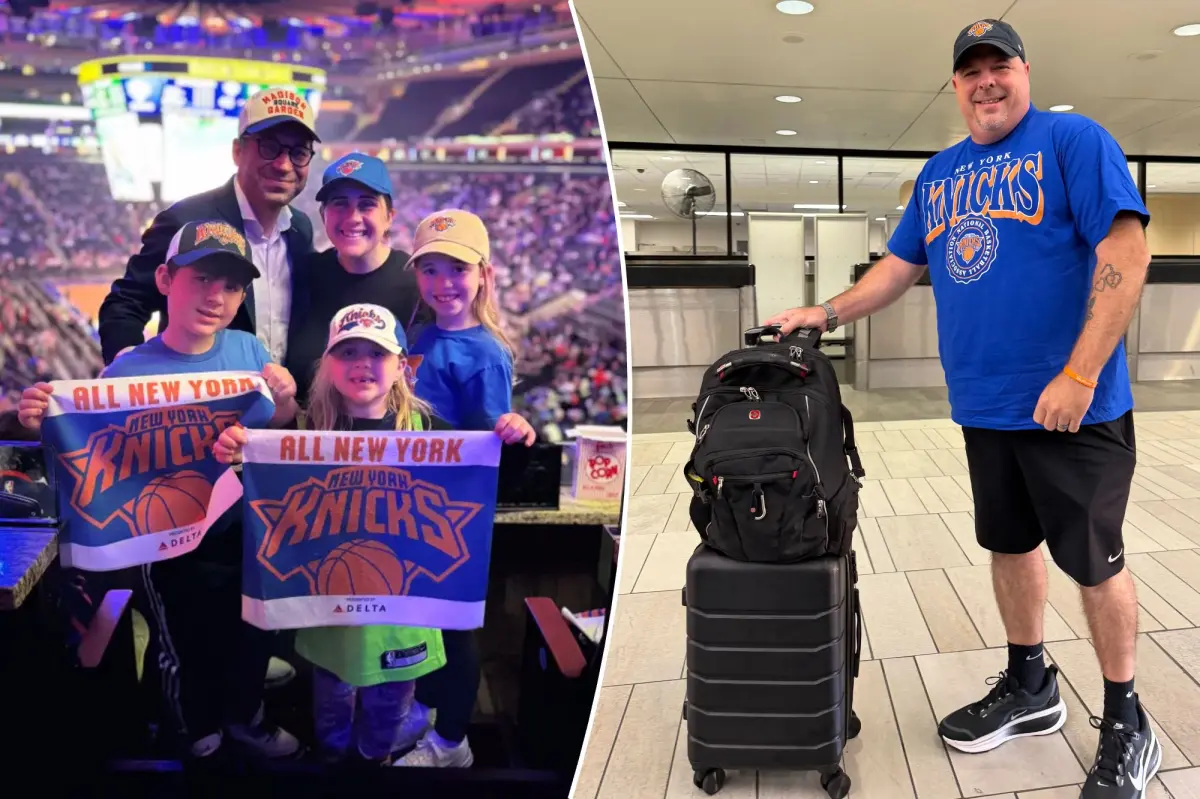
For those who bleed orange and blue, the relationship with the New York Knicks is not merely a casual sports preference; it is a hereditary, emotionally taxing, and lifelong commitment that defies all financial logic. Consider Adam Turk, a Brooklyn-born attorney who made a seemingly reckless financial decision twenty years ago when he was just starting his legal career. Before he had even secured his first professional clients, Turk made the executive decision to purchase Knicks season tickets, recognizing with a true New Yorker’s intuition that if he did not lock in his seats when he could barely afford them, he would be priced out forever. Through two decades of agonizingly poor seasons, draft busts, and front-office disarray, Turk quietly held onto his seats, witnessing some of the worst basketball in franchise history. This year, however, that enduring loyalty required a massive financial investment: Turk paid $23,000 for the regular season, followed by an additional $26,000 for the historic playoff run. While he saved a tiny fraction when the Knicks swiftly swept the Cleveland Cavaliers in four games, the secondary market value of his tickets has risen to an astronomical $15,000 per seat for Game 3 alone. Yet, despite the life-changing sums of money dancing on resale platforms like StubHub, Turk refuses to even look at the listings, choosing instead to protect his peace of mind and honor his decades-long dedication. To him, the concept of selling out is entirely off the table; he did not suffer through twenty years of basketball purgatory to cash out just when the team finally reached the mountaintop. He purchased these tickets specifically to live through moments of shared ecstasy with thousands of screaming strangers, stating firmly that while he might eventually forget the money, he would never forgive himself for missing the chance to be in the room when history is made.
This intense, cross-generational obsession is replicating itself all over the metropolitan area, serving as a powerful emotional bridge that connects grandfathers, fathers, and sons. One lifelong 44-year-old Brooklyn fan, who requested anonymity to protect his family’s privacy, shares a sentiment shared by millions who grew up worshiping the physical, hard-nosed Knicks teams of the 1990s. Now a father himself, he watched his eight-year-old son fall deeply in love with the team at the tender age of six. Seeing this passion blossom, the boy’s grandfather decided to orchestrate an unforgettable surprise, dropping a staggering $10,00s on four tickets to Game 3 so the family could experience the magic of Madison Square Garden together. To help pull off this surprise of a lifetime, the father braved the stressful digital battleground of the official fan presale, managing to secure corner seats in the 200-section for an eye-wateringly expensive $2,400. While he openly acknowledges that spending such a sum on a sporting event is objectively ridiculous, the agonizing financial sting dissolved the moment they handed their son an envelope containing the tickets. Hidden beneath a classic Knicks T-shirt, the tickets prompted the young boy’s eyes to bulge with pure shock before he burst into a spontaneous dance, screaming with a level of pure joy that simply cannot be quantified by a credit card statement. Even at his young age, the boy seemed to instinctively comprehend the immense cultural weight of what he was holding, recognizing that he was about to step into a sacred cathedral of New York sports history to witness a moment that the generation before him had waited decades to experience again.
The sheer economic scale of this playoff run has defied all historical comparisons, elevating Madison Square Garden to the status of the absolute most expensive ticket in the history of the National Basketball Association. According to ticketing platform SeatGeek, the average price of a single ticket sold for Games 3 and 4 at the Garden reached an unprecedented $7,149, while the absolute cheapest, “limited view” seat nestled in the highest corners of the upper bowl commanded a minimum of $9,006. Even prominent public figures like local politician Zohran Mamdani had to pay nearly $1,000 just for the privilege of a standing-room-only ticket, leaving him to watch the dramatic on-court action while balancing on his feet for hours. For the ultra-wealthy seeking the ultimate status symbol of courtside seating, the traditional ticket listings do not even apply; instead, fans are entering a high-stakes bidding war through the NBA’s premium ticket program, where the leading offer for a single courtside seat recently reached a mind-boggling $500,000. This hyper-inflation of ticket prices has essentially transformed the arena into a playground for billionaires and celebrities, pricing out the very working-class New Yorkers who have kept the spirit of the team alive through decades of losing seasons. Yet, outside the arena, fans interviewed by platforms like Front Office Sports openly share their jaw-dropping expenditures without a hint of regret: one woman calmly admitted to spending $16,000 on a pair of tickets, while a group of three working-class men proudly explained that they had pooled their resources to pay $750 each just to get into the building. The prevailing attitude among the fan base is one of proud defiance, a collective agreement that the opportunity to witness a legendary Knicks championship run firsthand is a priceless cultural event that transcends standard personal finance.
For those residing far outside the borders of the tri-state area, the barrier of soaring ticket prices has forced fans to find highly creative and deeply sentimental solutions to participate in the excitement. Consider the story of sisters Kylie and Kennedy Richo, aged 24 and 22, who grew up in West Virginia listening to their 51-year-old father, Harry, preach the gospel of New York Knicks basketball. Desperate to give their lifelong-fan father the birthday surprise of his dreams, the sisters initially set their sights on Madison Square Garden, only to find their hopes instantly crushed by the thousands of dollars required for even the worst seats in the arena. Refusing to let the dream die, they pivoted their strategy and focused on San Antonio, Texas, where the Knicks were scheduled to play Game 1 on Harry’s birthday. Pooling their hard-earned money, the sisters purchased a single ticket on StubHub for $1,200, which secured a seat in the second row from the very top of the arena, and arranged for their father to fly all the way from his home in Orlando, Florida, to Texas. By the time they added up the flight, a hotel room for the night, ride-share fares, and ticket insurance, the total cost of the birthday gesture reached a substantial $2,300. The experience was not without its moments of intense, modern anxiety; the digital ticket was not officially transferred to Harry’s mobile account until a mere two hours before tipoff, leaving the sisters terrified that they had been scammed and that their father would be stranded outside the gates. Fortunately, the transfer went through, and Harry spent his birthday cheering wildly alongside his fellow traveling Knicks fans, sending frantic, joyful real-time updates and photographs to his family’s group chat from his perch high above the court, making every single dollar his daughters sacrificed entirely worth it.
To understand why people are willing to make such extreme financial sacrifices, one has to examine the unique intersection of supply, demand, and cultural scarcity that defines Madison Square Garden. According to data provided by StubHub, ticket prices for this year’s Finals at MSG are selling for roughly five times the price of the Eastern Conference Finals from just a few weeks prior, eight times the cost of the semifinals, and an astonishing sixteen times the price of a standard regular-season home game. Furthermore, this intense demand is not merely a localized phenomenon; nearly half of all ticket buyers for Games 3 and 4 are originating from outside the state of New York, with more than a quarter traveling from far beyond the tri-state area to be part of the spectacle. As Jill Gonzalez, StubHub’s Head of Consumer, Product, and Tech Communications, explains, this unprecedented market frenzy is not reflective of a general rise in NBA popularity, but is rather a highly specific “Madison Square Garden phenomenon” driven by a grueling 27-year championship appearance drought. The current market dynamic represents a perfect storm where a generational, strictly limited supply of seats in a single historic building collides with the most concentrated local and national market demand ever recorded for a major sporting event. For decades, Knicks fans have watched other cities celebrate championships while their own arena remained quiet, and now that the drought has finally broken, the pent-up emotional energy of millions of fans has entered the marketplace, creating an economic force that has completely shattered the ceiling of modern sports entertainment.
Ultimately, the astronomical prices of these tickets reveal a profound truth about the nature of human connection and the things we choose to value in an increasingly digital and disconnected world. The New York Knicks have not appeared in the NBA Finals since 1999, and they have not successfully brought home a championship trophy since the legendary team of 1973. This means that an entire generation of New Yorkers—including parents who are now raising children of their own—have spent their entire lives without ever witnessing their hometown franchise compete at the absolute highest level of the sport. In a world where material possessions are fleeting, the opportunity to sit in a roaring stadium, feel the concrete vibrate under your feet, and share a historic moment of triumph with your family is a rare, irreplaceable luxury. For the families who have saved for months, the sisters who pooled their paychecks, and the long-time ticket holders who refused to sell out for a quick profit, these games are not an exhibition of financial recklessness, but rather a profound investment in human memory. They remind us that the bonds of family, the thrill of shared hope, and the joy of witnessing history alongside the people we love are the only true things in life that remain priceless, even when the ticket stub in your hand says otherwise.