


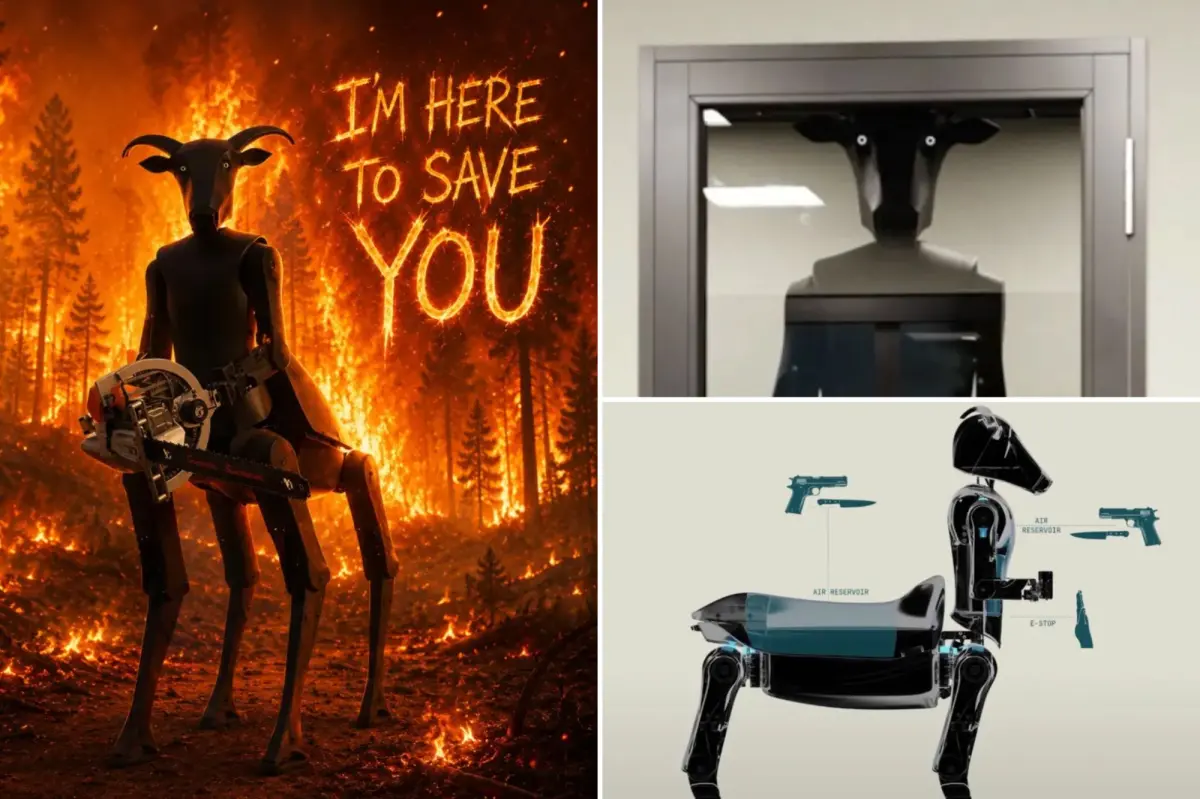
It looks like the ultimate manifestation of a modern techno-dystopian nightmare: a towering, seven-foot-tall mechanical beast sporting sharp horns and wielding a heavy, roaring chainsaw. When a video of this strange, mythological contraption was posted to social media, it instantly caught fire, racking up over ten million views on X and sparking a wave of online panic, dark humor, and apocalyptic memes. Users quickly spun up AI-generated imagery depicting the metallic centaur clutching its chainsaw in front of a wall of raging flames, paired with the deeply ironic caption, “I’m here to save you.” Yet, behind this seemingly terrifying, viral spectacle is Beau G., a thoughtful 40-year-old California engineer and startup founder who envisions this mechanical creature not as an agent of doom, but as a friendly, futuristic helper designed to protect human lives. Beau is the founder of Satyress—pronounced see-dar-is, a name inspired by the female counterpart of the mythical, forest-dwelling satyr—and he chose to construct his creation in the image of a lady faun to challenge the sterile, utilitarian designs of traditional robotics, imagining a world where industrial machines can be expressive, unique, and deeply integrated into daily human life.
At first glance, the anatomy of this creation, officially dubbed “Threehalves,” seems like an eccentric design choice, but it represents a highly logical and sophisticated approach to robot engineering. The name itself is a playful nod to its mythical anatomy—being jokingly comprised of “half human, half goat, and half horse”—but the underlying mechanics combine the absolute best of two structural worlds. By pairing a sturdy, four-legged quadruped base with a highly dexterous, human-like upper torso, Threehalves achieves an exceptional balance of stability and utility. Traditional humanoid robots struggle to remain balanced on uneven, outdoor terrain, while standard four-legged robodogs lack the arm span and reach required to interact with human environments and tools. Furthermore, those menacing horns that have caused so much online alarm are actually clever structural solutions; they serve as elevated mounting points for high-definition cameras, giving operators a clear, redundant view of the robot’s limbs and tools in case internal tracking sensors experience a system glitch.
Far from being an autonomous artificial intelligence acting on its own free will, Threehalves is built on a philosophy of human-in-the-loop control, known in the industry as teleoperation. It is designed to act as an avatar, directly controlled by a human worker utilizing a joystick and camera feedback from a safe distance, turning hazardous manual labor into a high-tech, remote task. Beau’s primary target for this technology is the incredibly dangerous forestry and utility line-clearing industry, where workers routinely risk their lives scaling tall trees and working in close proximity to high-voltage power lines. By letting the robot handle the physical weight of a heavy chainsaw and navigate precarious positions, human operators can perform the exact same skilled labor they have always done, but without the constant threat of a falling tree limb landing on them. Through this intuitive setup, seasoned industrial workers can remain active in their fields for far longer, protecting their bodies from the intense wear and tear of physical labor while leveraging their decades of practical expertise from a secure, grounded control station.
The spark of inspiration for this ambitious project was born out of real-world necessity and a long-dormant childhood passion for mechanics. Beau had spent much of his youth tinkering with robotics, but like many, he drifted away from the hobby as adulthood and his career as a professional engineer took over. However, in 2020, massive winter storms battered California, knocking down massive, ancient oak trees on his newly acquired property near the majestic Tahoe National Forest. Getting his hands dirty with the subsequent cleanup introduced him directly to the gritty, physically punishing world of professional tree care. By 2022, he noticed the colossal, near-endless volume of tree-trimming work being undertaken by utility giants like PG&E, who work tirelessly to keep branches clear of electrical lines to prevent catastrophic wildfires. Recognizing a desperate logistical and safety need, and noticing that powerful industrial actuators—the mechanical joints that move robot limbs—were becoming cheaper and more accessible, Beau decided it was time to dust off his old passion and build a solution.
Bringing a giant, mythical robot to life in a private workshop is a labor of love that requires immense patience, financial investment, and a healthy dose of transparency. Over the last year and a half, Beau has poured more than $150,000 of his own money into sourcing parts and specialized equipment, recently partnering with an engineering friend to help accelerate the building process. He is incredibly candid about the current state of Threehalves, openly acknowledging that the robot is still in its early prototype phase and does not yet have its walking legs fully functional. In an era dominated by polished, hyper-edited corporate tech demonstrations, Beau’s refreshing honesty shines through, as he actively encourages the public to maintain a healthy skepticism toward viral robotics. He maintains that anyone looking at humanoid robots online should assume they are at least partially simulated or staged until they can see them operating in person, choosing to build trust through raw, unvarnished progress rather than misleading marketing hype.
Ultimately, Satyress represents a deeply humanist vision of technology, aiming to create “win-win” scenarios where advanced hardware lifts up the human workforce instead of displacing it. Beau envisions a future where robots are viewed less like cold, sterile appliances—such as the smartphones we carry today—and more like customizable, character-rich sidekicks, akin to how people view and personalize their cars. By shifting dangerous tasks to robotic surrogates, companies can drastically reduce the astronomical costs associated with workers’ compensation insurance and injury lawsuits, funnelling those savings right back into higher wages for the skilled operators who navigate these machines. In Beau’s eyes, the goal of automation should not be a cold pursuit of maximum corporate efficiency at the cost of human dignity, but rather the creation of a safer, more sustainable world where workers can go home to their families healthy and whole at the end of every single day.