


A Father’s Fight: How One Family’s Desperate Hope Became a Lifeline for Millions
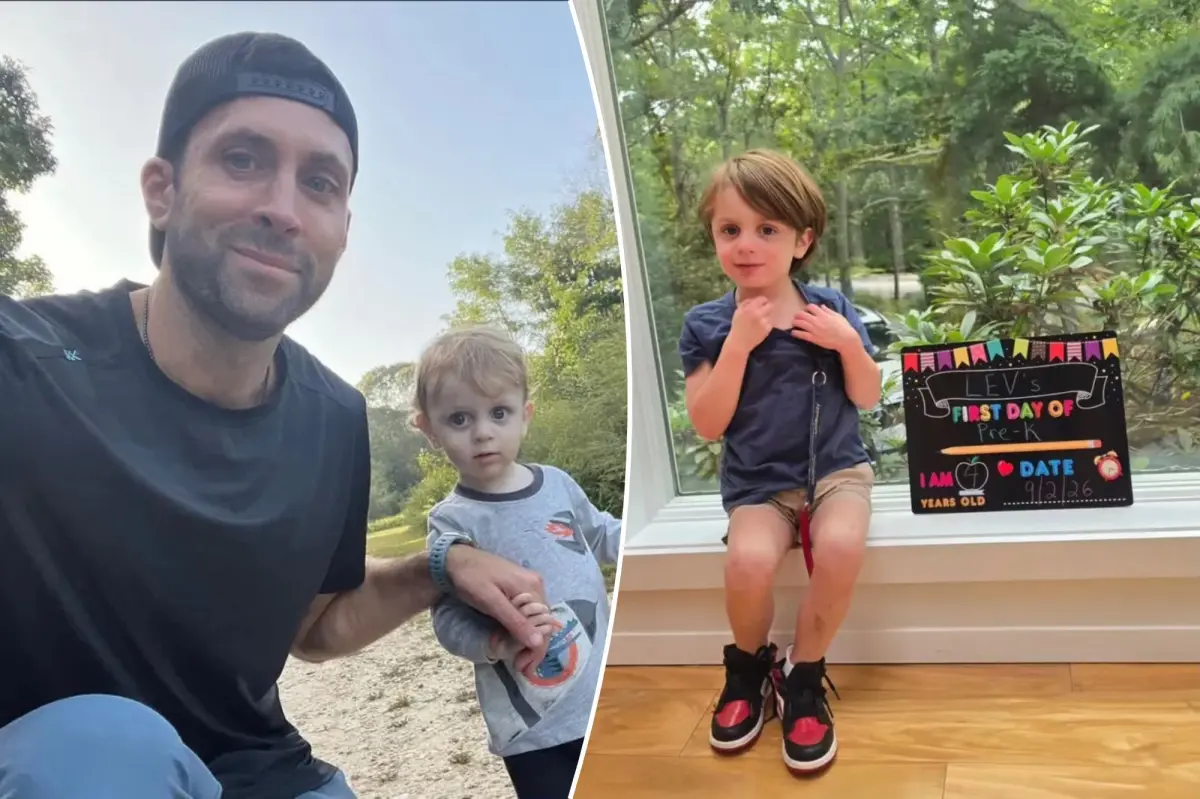
At just four and a half years old, Lev Bielski is every bit the golden-haired little boy you might imagine—a vivacious “surfer bro” who lives for splashing through the waves at surf camp, who practices spelling his favorite word “pool” on his letter board, who tries on his father’s volunteer firefighter gear with wide-eyed wonder, and who melts into his parents’ arms during family movie nights. To see him now, laughing and reaching out for hugs, you would never guess the darkness from which he emerged. Just four short months ago, Lev’s world was one of profound isolation and unrelenting suffering. He was trapped in a body and mind that seemed determined to hurt itself, scratching and hitting himself until his skin bloomed with black-and-blue marks. He could not bear to meet anyone’s eyes, retreating instead to a corner where he would rock and hide from a world that overwhelmed him. His severe autism left him incapable of basic functioning, and his future looked terrifyingly bleak—a future that seemed destined to include a punishing protective helmet and heavy antipsychotic medications to keep him from harming himself. The symptoms had appeared before his first birthday, and for years, his parents, Gabriella and Matthew Bielski, had crisscrossed the country chasing every specialist, every therapeutic intervention, every shred of hope—only to come up empty-handed time and time again. There was no medication approved to address the core symptoms of autism, and the family was running out of options. “Half my day was running a business and half was holding him down and trying to keep him from hurting himself—we had no solution,” Matthew recalls, the exhaustion of those dark years still evident in his voice. They were drowning, desperate for a lifeline that seemed impossible to find.
That lifeline finally came through an unexpected door: research that led the anguished couple to Yamo Pharmaceuticals, a decade-old biopharmaceutical company dedicated to treating the core symptoms of autism spectrum disorder with an investigational oral therapy called L1-79. Through the FDA’s expanded-access program, which allows patients with serious or life-threatening conditions to access investigational drugs before approval, the Bielskis managed to secure the treatment for their son. What happened next defied everything they had been told to expect. “It was the next day,” Matthew says, his voice still carrying the wonder of that moment. “It was right away, and other people in all the phases said the same thing.” The transformation was nothing short of miraculous. “He went from the least affectionate kid to the most affectionate kid almost overnight,” his father beams. The little boy who had once hidden in corners, who couldn’t bear human connection, suddenly began seeking it out—reaching for hugs, making eye contact, engaging with the world around him. “It changed everything for us,” Matthew adds, describing Lev’s “life-changing transformation.” This is the story of what happens when science, desperation, and parental love collide—when a family’s refusal to give up unlocks something that could transform the lives of millions of families facing the same devastating isolation. It’s a story that has its roots not just in a laboratory, but in a remarkable family history of defiance against impossible odds, and it carries the weight of generations of fighting spirit. Matthew Bielski, a 42-year-old Wall Street executive, is a descendant of the legendary Bielski partisans—four Jewish brothers who rescued 1,200 Jews from certain death during the Holocaust, hiding deep in the Belarussian Naliboki forest while eliminating Nazis and fighting for survival. Their incredible story was immortalized in the film “Defiance,” with Liev Schreiber portraying Matthew’s fearless grandfather, Zus. “I grew up with stories of survival and fighting back,” Matthew says of those formative memories that shaped his worldview. Now, that same determination has become a mandate he carries with him daily in his fight for Lev and for the scores of other children and families desperately seeking a better life.
What makes L1-79 so revolutionary—and so different from anything that has come before—is its fundamental approach to autism treatment. Rather than simply managing the challenging behaviors that surround autism, the investigational oral therapy targets the brain signaling involved in social interaction itself. It goes to the root of the condition, addressing why individuals with autism struggle to connect, communicate, and engage with others, rather than merely trying to suppress the symptoms that arise from those struggles. The results from early trials have been nothing short of extraordinary. Phase 2 findings from a 12-week study presented last year showed what Yamo describes as “unprecedented” gains in socialization, along with critical strides in communication skills and speech patterns. Dr. Tom Megarian, a veteran pediatric neurologist and Chief Medical Officer at Yamo, who has spent three decades practicing in this space, says he has never witnessed anything like it. “I’ve never seen that level of improvement in that short a period of time,” he says. “I haven’t even seen that level of improvement in that many children over years of therapy.” Perhaps even more significant is the drug’s remarkable safety profile—a key distinction from the antipsychotic medications that have long been the only option for severe autism, despite their potentially serious side effects. “The benefit has been almost miraculous, and there have been no serious side effects,” reports Dr. Eric Bartky, a child, adolescent, and adult psychiatrist who treats Lev. With the FDA’s fast track designation already in hand, Yamo says L1-79 is poised to become the first FDA-approved therapy for the core symptoms of autism, carrying the potential to transform the lives of millions. The numbers are staggering: with roughly one in every 31 children now diagnosed with autism, the “groundbreaking” drug could reshape the landscape of autism care for generations to come. One of the most profound aspects of this drug’s story is hearing how it has transformed not just the children but entire families whose lives have been upended by autism’s most severe manifestations.
Across the country, other families who participated in the trials tell strikingly similar stories of overnight transformation. Jarret Niesse, his voice thick with emotion, recalls that it was “a couple of days” before he witnessed his daughter Payton’s revolutionary shift—the moment when the daughter he had struggled so desperately to reach suddenly began reaching back. Payton’s mother, Corrie, cried as she described the miracle of her daughter’s voice filling their home. “She wouldn’t stop talking,” she said, tears of joy still fresh at the memory. “I could have a conversation with her. It was wonderful.” For Payton herself, now a teenager, the dream is simple: “I want to be back on that medicine.” She thinks constantly about the potential to help countless others navigate through life with the same newfound connection. Chris Milcsik describes feeling like he was trapped in a washing machine agitator before his one-month trial—an overwhelming chaos that consumed his entire existence. But during those four short weeks, he transformed from angry to “amicable,” from a boy lost in a storm to one who could finally find his footing. Maria, a mother whose child participated in a Phase 2 trial, shares the moment that brought her to tears: “For the first time in seven years, my son looked me in the eyes and said ‘good morning.'” Those seven words, so simple and ordinary to most families, represented a miracle she had nearly stopped believing was possible. And for little Lev, the drug has opened up an entirely new world. He’s eating solid food for the first time in his life—including vegetables, a seemingly mundane milestone that his father describes as one of “a lot of massive big wins that I didn’t expect for decades.” Taking the oral formula twice a day has become a highlight for the boy, according to his dad. “He’s excited to take it because he kind of knows it’s helping him.” Lev, which means “heart” in Hebrew, is certainly living up to his name now—a little boy who “loves to hug and be engaged with the world around him,” who has blossomed from the least affectionate child into the most affectionate child his family has ever known.
But this remarkable progress faces an enormous hurdle. Despite the FDA fast track designation and the stunning trial results, Yamo still needs $75 million in funding to advance to the pivotal Phase 3 trials and manufacture enough medication to support the full study. Yamo’s Chief Medical Officer is candid about the challenge: “Our biggest barrier right now is getting the funding that we need to move forward.” Matthew Bielski, however, is not waiting on the sidelines. Drawing on the same resolve that built his successful business—Defiance ETFs, which grew to a staggering $15 billion enterprise—he is betting big on the revolutionary drug. Along with his wife, Gabriella, he is personally investing in Yamo. “I vowed to put the same energy and focus as I did into building my $15 billion business and help this drug company take its best shot at improving countless lives,” he explains. “That includes the single mother raising a child with profound autism who may not have access to specialists.” His determination has taken on tangible form in the financial world as well. He decided that Defiance would launch the first-of-its-kind Autism Impact ETF—symbol ASD—in which all net advisory profits for the first two years are donated directly to autism-related causes. “The capital markets need to be opened up to autism drug development,” he argues with the conviction of a man who has lived through the desperation of having no options. “Developing drugs for autism is difficult, risky, and expensive. But if investors don’t finance those risks, promising treatments may never receive the trials they need.” It’s a call to action rooted in his family’s legacy of fighting against impossible odds. His grandfather and great-uncles were forced to fight for their very survival in the forests of Belarus, and now Lev faces a different kind of battle—a fight for his health, his connection to the world, and his future. “He’s my miracle kid,” Matthew says, and he predicts that this drug will become the “Ozempic of autism”—a treatment so transformative that it reshapes everything we thought we knew about what’s possible.
As L1-79 moves closer to the crucial Phase 3 trials, the Bielskis are determined to see this through, driven by the knowledge that every day of delay means another family struggling without hope. The stakes could not be higher. For the roughly one in 31 children currently diagnosed with autism—and for the millions of adults living with the condition—an FDA-approved treatment targeting core symptoms would be unprecedented. Dr. Bartky, who witnesses these transformations firsthand, finds the future looking brighter than ever before in his long career. “Now there is more hope for families of children with autism, as there is always hope,” he says. And then he offers a vision that encapsulates the staggering potential of what has been unleashed: “Imagine multiplying one Lev by millions—imagine that world.” It’s a world where children who once hid in corners can look their parents in the eyes and say good morning. A world where families can have conversations instead of battles, where simple pleasures like family movie nights become reality instead of distant dreams. A world where the isolation that defines severe autism gives way to connection, affection, and engagement. For the Bielski family, that world is already here, one beautiful morning at a time. “For the first time in seven years, my son looked me in the eyes and said ‘good morning,'” shared one mother, and that simple moment encapsulated everything at stake. Every child deserves a chance to connect with their parents, the Bielskis say. Every family deserves to know the joy of a child reaching out for a hug, the wonder of a spontaneous conversation, the beauty of seeing a child simply be a child. Little Lev—all 35 pounds of him—may not have the physical stature of his legendary great-grandfather and the Bielski brothers who defied the Nazis, but his father asserts that he possesses the same indomitable spirit in his own battle for health and connection. And in that fight, he is not alone. He carries forward a legacy of survival, a community of families who share his struggle, and a growing movement to open up the capital markets to autism drug development. The road ahead remains challenging, and the funding gap is real, but the Bielskis have faced impossible odds before—and they have the history to prove that determination can move mountains. With the FDA’s cooperation and the continued support of those who believe in this mission, they hope to see the day when no family has to hear the words “there’s nothing we can do.” For now, they celebrate the victories, both big and small: a “good morning” spoken with eye contact, a hug offered freely, a little boy eating his vegetables, a child laughing at movie night. These are the miracles they fought for, and they are proof that hope, when combined with science and relentless determination, can change everything. “We hope that the FDA works closely with Yamo because right now there’s zero solutions, and this has the best shot of being that,” Matthew concludes. And in that hope lies the promise of a new world for millions of families—a world where every child, like Lev, has a heart that is free to love and be loved.