


For thousands of families living across the bustling metropolitan areas of New York, New Jersey, Connecticut, and Florida, the annual migration of their children to prestigious sleepaway camps nestled in the scenic Poconos and Catskills mountains is a deeply cherished rite of passage. Parents willingly shell out astronomical sums—often hovering around $19,000 per child for a single seven-week session—anticipating a summer filled with pristine waterskiing, character-building triumphs, lifelong friendships, and the legendary, highly anticipated color wars that mark the season’s end. This year, however, the idyllic summer dream quickly dissolved into a visceral, chaotic nightmare that no family could have possibly budgeted for. Instead of witnessing their children thrive in nature, parents received shocking, stomach-churning dispatches from the front lines of what can only be described as a full-scale gastrointestinal invasion. A relentless and highly contagious stomach virus swept through several of these secluded, high-end camp sites, throwing pristine cabins into total disarray and sending hundreds of campers, counselors, and support staff members desperately sprinting toward the nearest latrines. The expected joy of the summer’s final weeks was instantly replaced by a grim battle for basic hygiene, transforming pristine campgrounds into makeshift quarantine zones and leaving expensive, picturesque summer retreats grappling with a sudden, overwhelming, and highly disruptive sanitation crisis.
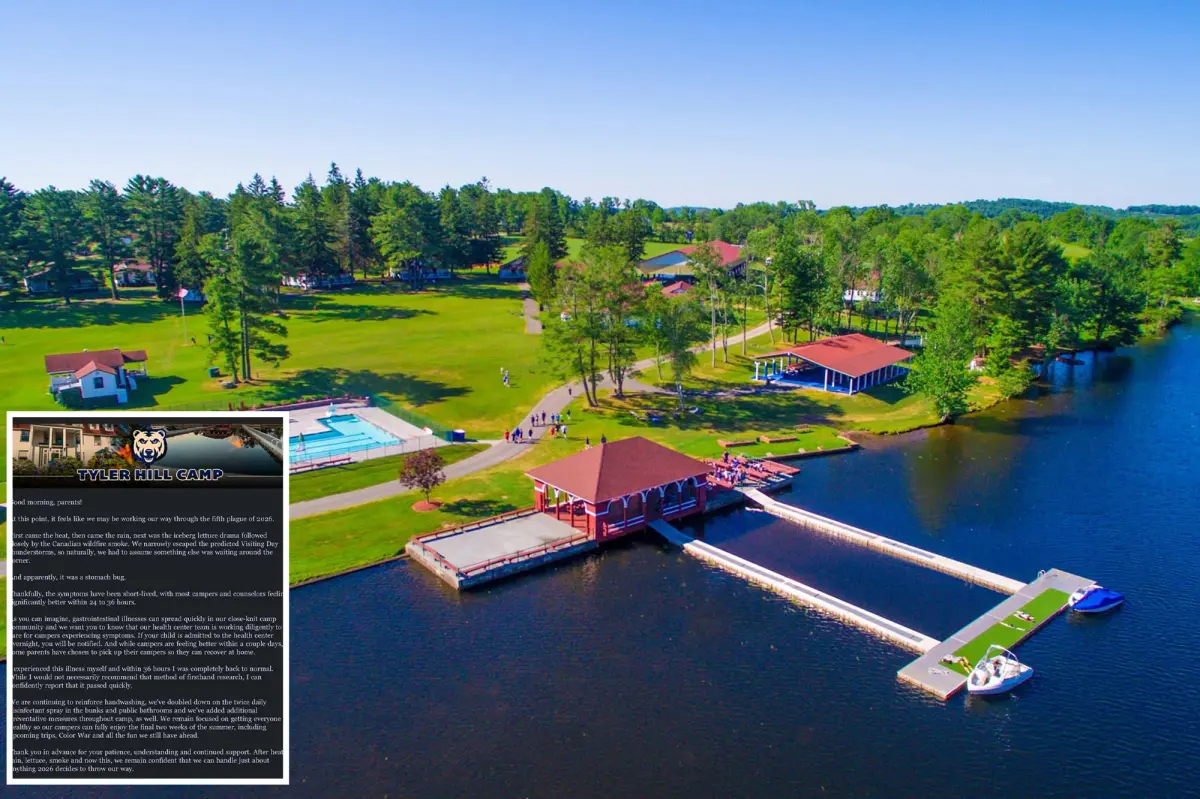
The epicenter of this seasonal catastrophe, which parents quickly and grimly dubbed “camp zero,” was Tyler Hill Camp, a sprawling facility located in Wayne County, Pennsylvania, that accommodates nearly 500 campers during the summer and charges a hefty tuition of $18,475. According to frustrated and deeply concerned parents who chose to speak anonymously, the vicious outbreak began to take hold shortly after the camp’s visiting day in mid-July, spreading with frightening speed through the tightly packed bunkhouses. The scale of the outbreak was staggering; one parent reported hearing that approximately half of the entire camp population had fallen ill, utterly overwhelming the camp’s medical infrastructure. The health center rapidly ran entirely out of beds, and campers quite literally ran out of functional toilets to throw up in as the stomach bug ran its merciless course. For the parents who rushed to rescue their ailing children, the scene upon arrival was shocking and deeply upsetting. One mother, who drove directly to the camp after learning that the infirmary was completely overrun by the “puke apocalypse,” described entering a cabin that looked like the devastating aftermath of a chaotic fraternity party. Sick, exhausted campers lay strewn across the bunkhouse alongside buckets of vomit, with dampness clinging to every surface in a scene of pure, unadulterated distress that stood in stark contrast to the glossy brochures families had trusted.
Naturally, nothing unites a community of highly invested East Coast camp parents quite like a shared crisis, and as the virus spread, so did a tidal wave of panic and communication. Digital screenshots of frantic camp emails, emergency updates, and anxious text threads circulated among parent group chats far faster than the stomach bug itself, turning what might have once been a discreetly managed camp mishap into an explosive, public scandal. What used to stay whispered in private circles was suddenly broadcasted to the world as anonymous Instagram gossip accounts, dedicated to sleepaway camp drama, began posting anonymous tips, real-time updates, and raw descriptions of the unfolding chaos. In an attempt to manage the growing PR disaster, Tyler Hill’s owner, Andy Siegel, sent out a mass email detailing his own personal bout with the illness, assuring parents that it generally burned itself out within 24 to 36 hours while dryly noting that he would “not recommend first-hand research.” The camp’s director even attempted to inject a dose of lighthearted humor into the grim situation, announcing to families that it felt as though they had miraculously survived “the fifth plague of 2026,” having already battled intense heat, torrential rain, Canadian wildfire smoke, and a previous scare involving contaminated lettuce, only to be brought low by a classic, devastating stomach bug.
The contagion, however, did not remain isolated to a single campground, quickly leaping across state lines into the Catskill Mountains of New York to infect Timber Lake Camp, an elite facility boasting an $18,225 tuition for its upcoming season. Directors there initially hoped the sudden wave of gastrointestinal distress was merely the predictable result of children overindulging in the massive piles of junk food left behind by parents after Visiting Day. However, as the vomiting spread to fifteen campers and staff members, primarily among the younger age groups, administrators were forced to admit that a genuine biological agent was at play, likely transmitted during a multi-camp basketball tournament. In response, Timber Lake launched an aggressive, round-the-clock “disinfecting campaign” that saw housekeeping staff patrolling the grounds with specialized backpack sprayers, looking remarkably like the Ghostbusters as they misted the cabins with heavy-duty antiviral agents designed to kill pathogens on contact. In a further bid to halt the virus, the camp’s administration humorously claimed to have “commandeered most of this month’s Florida lemon crop,” forcing campers to down one-ounce shots of fresh lemon juice at breakfast, alongside elderberry gummy vitamins, in a spirited, if scientifically unproven, effort to boost immunity that somehow turned a medical emergency into a festive morning ritual.
This sudden desperation to distribute immunity-boosting supplements highlights a broader, fascinating shift in the landscape of modern sleepaway camps, where infirmaries have evolved from simple first-aid stations into complex, highly regulated mini-pharmacies. Today’s campers routinely arrive with highly individualized, daily medication and vitamin regimens, making the management of camp health an incredibly demanding logistical feat even under normal circumstances. Timber Lake, for instance, revealed that over twenty percent of its campers were already taking daily elderberry gummies, forcing directors to issue opt-out warnings to parents overwhelmed by the sudden barrage of wellness initiatives. Meanwhile, the viral outbreak claimed yet another casualty in Beach Lake, Pennsylvania, at Trail’s End Camp—a premier co-ed destination costing $18,625 per season—where seven campers fell violently ill immediately following a lacrosse tournament hosted at Tyler Hill. This direct link forced the immediate suspension of all intercamp sports tournaments, severing the vital social and athletic connections that define the close-knit, highly overlapping ecosystem of Northeast summer camps, where siblings, friends, and staff constantly interact across different sites.
For the parents who sacrificed a small fortune to secure a peaceful, enriching summer for their offspring, this entire ordeal has been an exhausting, anxiety-ridden nightmare that completely disrupted their sense of security. Instead of happily logging onto camp websites each evening to excitedly browse through daily photo galleries in search of a smiling face or a game-winning goal, parents spent their agonizing weeks glued to their phones, praying they wouldn’t receive a call from an overwhelmed camp nurse. Yet, if there is any silver lining to be found in this messy summer saga, it is the remarkable, unwavering resilience of the children themselves. Many of the campers who were abruptly evacuated by their parents to recover in the comfort of their own homes have already packed their bags once more, eager to return to the cabins, rejoin their friends, and finish out the summer season they love so much. While the corporate offices of Tyler Hill, Timber Lake, and Trail’s End ultimately chose to remain silent in the face of media inquiries, the children have proven that not even a dramatic, highly publicized “puke apocalypse” can permanently damp the enduring spirit of summer camp.