



Paragraph 1: The Expedition Begins
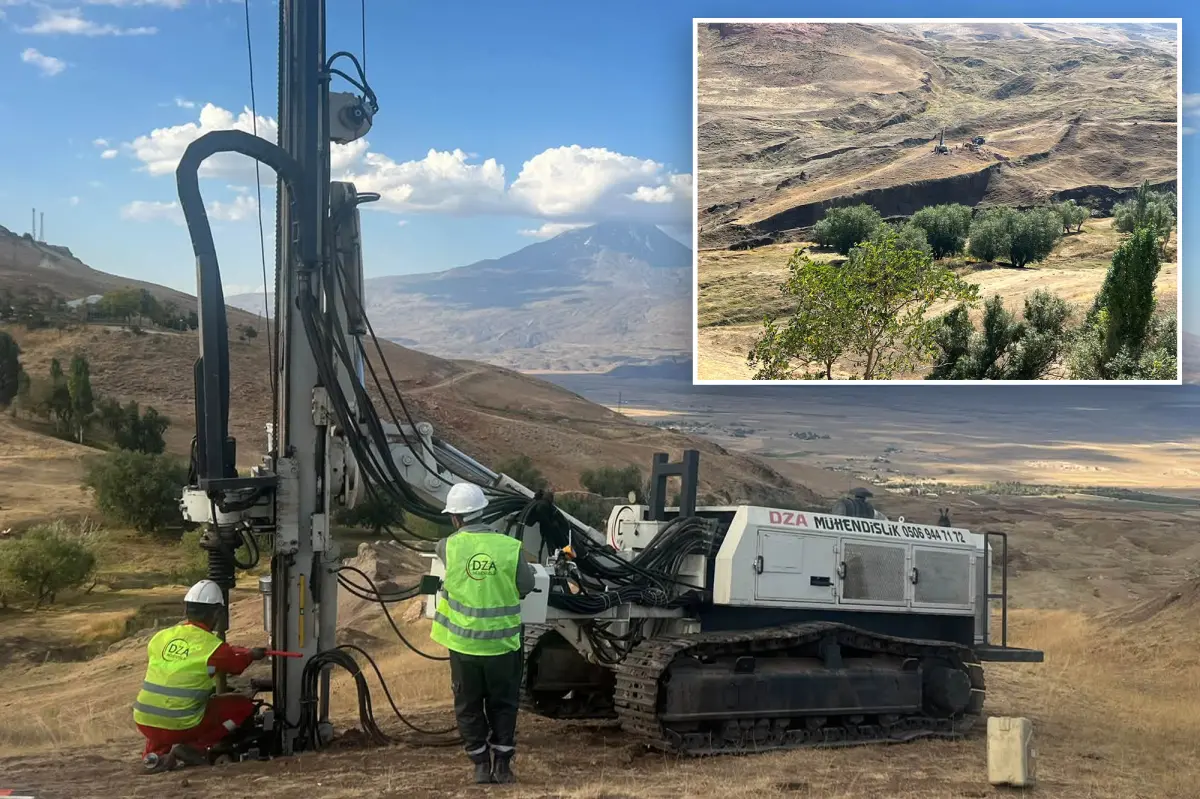
Deep in the rugged, windswept mountains of eastern Turkey, a team of researchers has begun drilling into a strange, boat-shaped formation that has fascinated and divided the world for decades. This is the Durupinar formation, a massive geological feature near Mount Ararat that a group called the Noah’s Ark Scans expedition believes could be the final resting place of the biblical Noah’s Ark. The project’s marketing and fundraising director, Lauren Witzke, announced the start of drilling with an unmistakable blend of fervor and defiance. “Good morning from the outer rims of Noah’s ark,” she wrote, adding that core drilling had begun and that “the big bang evolutionists are already in damage control mode.” The tone is characteristic of Witzke, a controversial Christian activist and former U.S. Senate candidate who has described herself as a flat-earther, expressed support for QAnon, and once called the Covid vaccine a “satanic plot.” Yet beyond the provocative rhetoric, the expedition insists it is serious, claiming to have official approval from the Turkish government and oversight from local universities. Witzke herself makes sensational predictions, saying that when the work is complete, university curricula will need to be rewritten and Darwinism dismantled, because “this is the place where creation began anew.” For many, such language immediately raises alarm bells, but for the team behind the project, this is not a publicity stunt—it is the culmination of years of investigation into a site that has stubbornly refused to give up its secrets. The question remains whether the drilling will reveal genuine archaeological remains, or simply another layer of sediment in a story that has always been more about belief than science.
Paragraph 2: The People Behind the Project
It would be easy to dismiss the entire expedition as fringe pseudoscience, especially with Witzke as its public face. However, the team also includes credentialed academics, and that mix of faith, science, and spectacle makes the Durupinar project uniquely complicated. The project director is Dr. Cenker Atila, a geologist from Sivas Cumhuriyet University in Turkey, and the group’s website promises that “some of the most brilliant minds in the world” are participating. There are bona fide archaeologists, geologists, and engineers involved, including Australian robotics expert Dr. Robert Ross from La Trobe University, who designed the underground robot being used to explore the formation. The involvement of real scientists gives the expedition a veneer of legitimacy, even as Witzke’s fiery statements dominate the headlines. The tension between these two worlds—careful, methodical inquiry and passionate, belief-driven advocacy—has defined the Durupinar formation since it first came to public attention. Witzke’s role is to fundraise and generate excitement, and she does that with tremendous energy, but her presence makes it harder for the scientific community to take the project seriously. The expedition’s claim that they will “dismantle Darwinism” is not something any mainstream geologist would endorse, and it raises the question of whether the team is truly interested in evidence or simply in confirming what they already believe. Still, the fact that Turkish authorities allowed the drilling suggests that the site retains official interest, and the researchers involved may genuinely believe they are on the brink of a discovery that could rewrite history. Only the data will tell, but the mix of motives makes this one of the most unusual archaeological investigations in recent memory.
Paragraph 3: A Long and Checkered History
The Durupinar formation has never been a quiet place. It was officially discovered in 1959, when a Turkish Army captain named İlhan Durupınar was mapping the area from the air and photographed a striking, boat-shaped ridge in the mountains. The image sparked immediate excitement, because the location was not far from Mount Ararat, the traditional resting place of Noah’s Ark in biblical tradition. Local researchers soon visited the site and began digging, surveying, and even setting off dynamite to uncover what lay beneath the surface. But their efforts yielded no archaeological evidence—no wood, no ancient tools, no signs of human construction. Their conclusion was that the formation was a natural anomaly: a ridge of limestone and volcanic clay sculpted by centuries of erosion into something that, from the air, looked uncannily like a ship. Modern geologists have largely agreed with this assessment, viewing the formation as a fascinating accident of nature rather than the remains of an ancient vessel. Yet the idea never died. The site has attracted a long line of researchers, adventurers, and true believers, each drawn by the possibility that this could be the most important archaeological discovery in history. The formation’s dimensions are certainly suggestive: it measures about 164 meters in length, which is close to the 300 cubits (roughly 157 meters) that the Bible gives for Noah’s Ark. That matching length has kept hope alive for decades, even when every careful investigation has failed to find anything concrete. The story is a testament to how powerful a compelling narrative can be, especially when it touches on faith, identity, and the deepest questions of human origins.
Paragraph 4: The Fasold Era and Its Aftermath
In the 1980s, the Durupinar formation got its most famous champion: American salvage expert David Fasold. Fasold was not a scientist by training, but he was an experienced adventurer, and he became convinced that the site was the fossilized remains of Noah’s Ark. Using ground-penetrating radar, he claimed to have detected structures beneath the surface that looked like the upper deck of a ship, and he measured the formation at 164 meters, matching the biblical length so closely that he considered it irrefutable proof. He also found what he called “drogue stones”—large, carved rocks scattered to the northwest of the site, each with holes cut through its upper end. Fasold believed these were ancient sea anchors that had been cut loose from the ark when the floodwaters receded. For years, he promoted the site as the true resting place of the ark, publishing books and giving interviews that attracted international attention. But skepticism was fierce, and critics pointed out that the drogue stones were more likely ancient memorial markers or tombstones. More damningly, Fasold eventually seemed to change his mind. In later years, he publicly repudiated his own ark theory, reportedly calling it “absolute BS.” His Australian friend and biographer June Dawes, however, insisted that Fasold went to his grave still believing he had found the ark. This contradiction is typical of the Durupinar story: the line between conviction and doubt is always blurred, and even those closest to the site cannot agree on what it means. Fasold’s legacy is a cautionary tale for the current expedition, which now hopes to use modern technology to settle the question once and for all.
Paragraph 5: Modern Technology and the Robot Gopher
The current Noah’s Ark Scans expedition represents the first serious attempt to investigate the Durupinar formation with cutting-edge technology. The team has already used ground-penetrating radar to map what they describe as corridors and chambers beneath the surface, including one hallway that reportedly runs more than 250 feet. Their next step was to drill narrow cores down into those spaces and send in a robot called Gopher, an underground vehicle designed to go where a person cannot. Gopher was built by Dr. Robert Ross, an Australian engineer who originally created robots for wildlife ecologists to explore wombat burrows and armadillo burrows. He repurposed the design for this archaeological mission, equipping it with high-resolution cameras and the ability to collect soil samples from deep beneath the surface. The robot’s journey could potentially provide the first legitimate photographic evidence of what actually lies inside the formation. But the expedition has faced significant financial hurdles. The project required an estimated $600,000 to begin drilling, and as of the most recent update, they had raised only a small fraction of that amount. Despite this, drone footage shared by Witzke appeared to show that drilling had commenced, raising questions about how the work was being funded and whether the team had cut costs or found an alternative source of money. The researchers are also racing against the onset of winter, which will freeze the ground and force operations to stop until the spring thaw. If the robot cannot finish its work in time, the mystery of Durupinar will remain unsolved for at least another year, and the expedition will have to endure the long, cold months waiting in uncertainty.
Paragraph 6: What Could It All Mean?
At the heart of the Durupinar mystery is a question that goes far beyond geology or archaeology: what does it mean to hope for a discovery that might confirm the stories of our ancestors? For the believers involved in the Noah’s Ark Scans expedition, this project is not just about dirt and rocks—it is about validation. They want to prove that the Bible contains true history, and that the ark is not a myth but a physical object that still exists somewhere on the slopes of a Turkish mountain. Their certainty is unshakable, and no amount of skeptical commentary will change their minds. On the other side, mainstream scientists see a natural rock formation that has been mythologized by people who lack the training to recognize what they are looking at. The previous investigations, including Fasold’s eventual repudiation, only reinforce their view that the site is a geological curiosity, not an archaeological treasure. But the new expedition does offer something different: the possibility of definitive evidence. If Gopher the robot crawls into those underground chambers and finds nothing but dirt and stone, the ark theory will likely collapse for good. If, on the other hand, it finds something unusual—a beam, a carving, a layer of ancient organic material—the world will have to pay attention. The odds are against such a discovery, given the history of failed attempts, but the human desire to find meaning in the landscape is powerful. The Durupinar formation has already survived six decades of scrutiny, and it will likely survive this expedition as well. Yet even if the drill cores come up empty, the search itself is a reminder of how deeply people want to believe that the stories of their faith are written into the very earth beneath their feet. Whether the mystery is ever truly solved or not, the journey of those who seek to uncover it is a profoundly human one—full of hope, doubt, belief, and wonder.