




A Flight to Remember: The Accidental Shoulder Nap
In the world of air travel, there’s a universal struggle familiar to all frequent flyers – the awkward head bob as you drift between consciousness and sleep, desperately seeking comfort in the confined spaces of economy seating. We’ve all been there, fighting against gravity and the limitations of airline seats, trying to find that perfect position where our necks won’t punish us upon waking. For one unsuspecting traveler, this ordinary flight challenge turned into a viral moment of unintended intimacy and social media controversy that resonates with anyone who’s ever accidentally crossed personal boundaries while traveling.
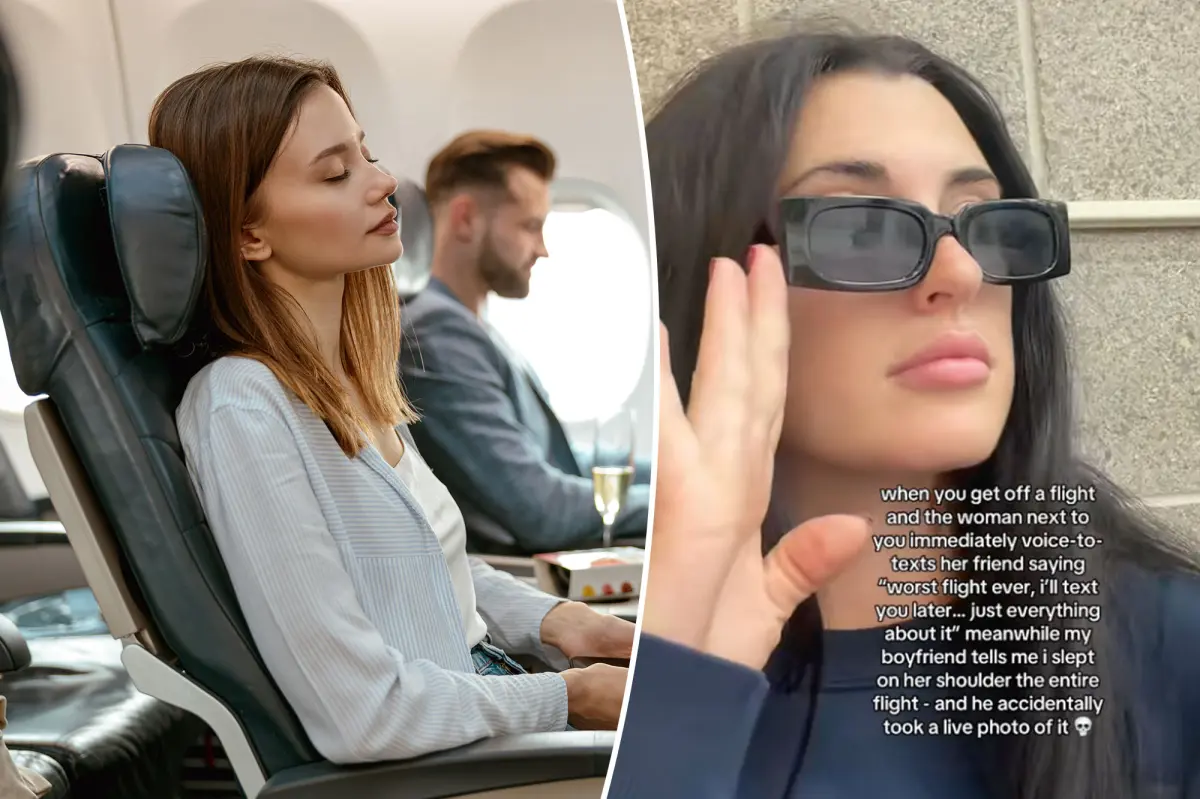
The incident, which garnered nearly 2 million views on TikTok, tells the story of a woman who fell asleep on her neighbor’s shoulder during a flight – completely unaware of her breach of personal space until after deplaning. The situation took an awkward turn when she discovered that her seatmate had immediately voice-texted a friend complaining about having “the worst flight ever” with a promise to share details later. Adding to the embarrassment, the woman’s boyfriend had not only allowed this situation to unfold without intervention but had documented the moment with an accidental flash photo. Her TikTok confession, delivered behind the shield of sunglasses, resonated with viewers who immediately recognized the mortification of such an unwitting social faux pas. The combination of unintended invasion of personal space, the seatmate’s obvious displeasure, and the boyfriend’s passive observation created the perfect recipe for a travel moment most would rather forget.
The response to this airborne awkwardness was swift and decisive, with viewers directing their criticism primarily at the boyfriend who witnessed the situation without taking action. Comments flooded in questioning his decision to let his girlfriend inadvertently impose on a stranger rather than gently redirecting her head to his own shoulder. “We aren’t mad enough at the boyfriend,” one commenter noted, while others were more direct: “Why did he let this happen?” and “I’d be so mad at my bf bro.” The consensus among viewers seemed clear – while accidentally falling asleep on a stranger might be understandable, a partner watching it happen and documenting it rather than intervening represented a separate category of relationship transgression. The social judgment extended to both parties in the situation, with one commenter declaring, “Why did he let you do that?” and another concluding, “They’re both the villains here,” acknowledging that neither the sleeping woman nor her uncomfortable seatmate had received proper consideration.
The story touches on something fundamentally human about air travel – our vulnerability while sleeping in public spaces. When we fly, we surrender certain aspects of control and privacy, finding ourselves in intimate proximity with strangers for hours at a time. Physical boundaries become more challenging to maintain in these shared spaces, and unspoken social contracts govern how we navigate this temporary coexistence. For the woman in this story, her unconscious breach of these norms resulted in embarrassment once she realized how her actions had affected her seatmate’s experience. Yet despite the awkwardness, many viewers noted an undeniable silver lining – at least she had managed to actually sleep during her flight, an achievement that eludes many travelers who spend hours staring at cabin ceilings, struggling against the discomfort and noise.
For those who identify with the struggle to find sleep at 35,000 feet, experts offer techniques that might help avoid both insomnia and accidental shoulder napping. Dr. Rachel Keene, a travel expert quoted in relation to the story, recommends the 4-7-8 breathing technique as a method for inducing sleep during flights. This approach involves inhaling for four seconds, holding the breath for seven counts, and then slowly exhaling for eight seconds. When repeated for approximately two minutes, this breathing pattern effectively slows the heart rate and signals to the body that it’s safe to rest. The technique works by activating the parasympathetic nervous system, which controls the body’s ability to relax and digest – essentially telling your brain that despite being strapped into a metal tube hurtling through the sky, it’s actually an appropriate time for deep rest.
The science behind these breathing techniques is supported by Dr. Melissa Young, an integrative medicine specialist who explains that yogic breathing practices help calm both the body and mind, creating a state conducive to relaxation. These methods work particularly well in the challenging environment of an airplane, where anxiety, unfamiliar surroundings, and physical discomfort often combine to create the perfect storm of sleeplessness. By focusing the mind on the rhythmic pattern of breathing rather than worries about work, connecting flights, or the stranger whose personal space you might accidentally invade, travelers can create a mental state more conducive to restful sleep. As Dr. Young notes, these techniques provide “a way to focus your mind on something other than your worries,” offering a practical strategy for those who find themselves wide awake when they’d rather be sleeping – preferably upright and within their own personal space, rather than creating the next viral travel moment by dozing off on an unsuspecting seatmate’s shoulder.