

Raoul’s: Half a Century of French Bistro Charm in Soho
A Defiant Beginning in a Different Manhattan
When brothers Guy and Serge Raoul opened their French bistro in Soho fifty years ago, they faced challenges that today’s restaurateurs could hardly imagine. Beyond the typical concerns of making rent and attracting customers, the French duo encountered demands for protection money from local mob enforcers. As Serge’s son Karim recounts, 1975 Manhattan presented a starkly different landscape—deserted streets, vacant buildings, and an atmosphere where people sometimes mysteriously disappeared. When the brothers boldly refused to pay the extortion money, mobsters retaliated by bombing the restaurant. Remarkably, as Karim tells it, only the windows were damaged in the attack, and the resilient diners simply continued enjoying their meals amid the chaos. This spirit of defiance would become part of Raoul’s enduring character.
Creative Solutions and Famous Clientele
Journalist Serge eventually devised an ingenious solution to their mob problem. Using his media connections, he staged a fake TV news story outside the restaurant, complete with bright lights illuminating the broken windows. The ploy brilliantly leveraged the mafia’s aversion to publicity, and the extortion attempts ceased. This creative approach to adversity reflected the restaurant’s unique position in New York’s culinary landscape. Unable to afford real estate in Manhattan’s upscale uptown districts where French restaurants like La Grenouille thrived, the brothers created their own niche on Prince Street near Sullivan. The location proved fortuitous, as Serge’s connections from French television naturally brought in the artists he interviewed. Andy Warhol counted among Raoul’s earliest patrons, followed by prominent gallerists, models, and actors who appreciated Chef Guy’s more casual approach to French cuisine compared to his previous uptown haute cuisine experience.
A Cultural Haven Through the Decades
As the years passed, Raoul’s continued to attract cultural luminaries across generations. The restaurant briefly counted future culinary star Thomas Keller among its chefs in the early 1980s. Artists Keith Haring, Jean-Michel Basquiat, and Jeff Koons frequented the bistro, as did photographer Richard Avedon. Hollywood royalty including Johnny Depp, Kate Moss, Quentin Tarantino, Julia Roberts, Al Pacino, and Robert De Niro became regulars. “Saturday Night Live” consistently hosted after-parties there, entertaining everyone from creator Lorne Michaels to the late John Belushi. This cultural significance continues today—the recent 50th anniversary celebration hosted by Chloë Sevigny and Lauren Santo Domingo attracted contemporary stars like Jennifer Lawrence and her gallerist husband Cooke Maroney. Throughout New York’s dramatic transformations, with Soho evolving from an artistic frontier to a luxury shopping destination, Raoul’s has remained remarkably unchanged, cultivating an atmosphere that transcends trends.
A Time Capsule with Culinary Consistency
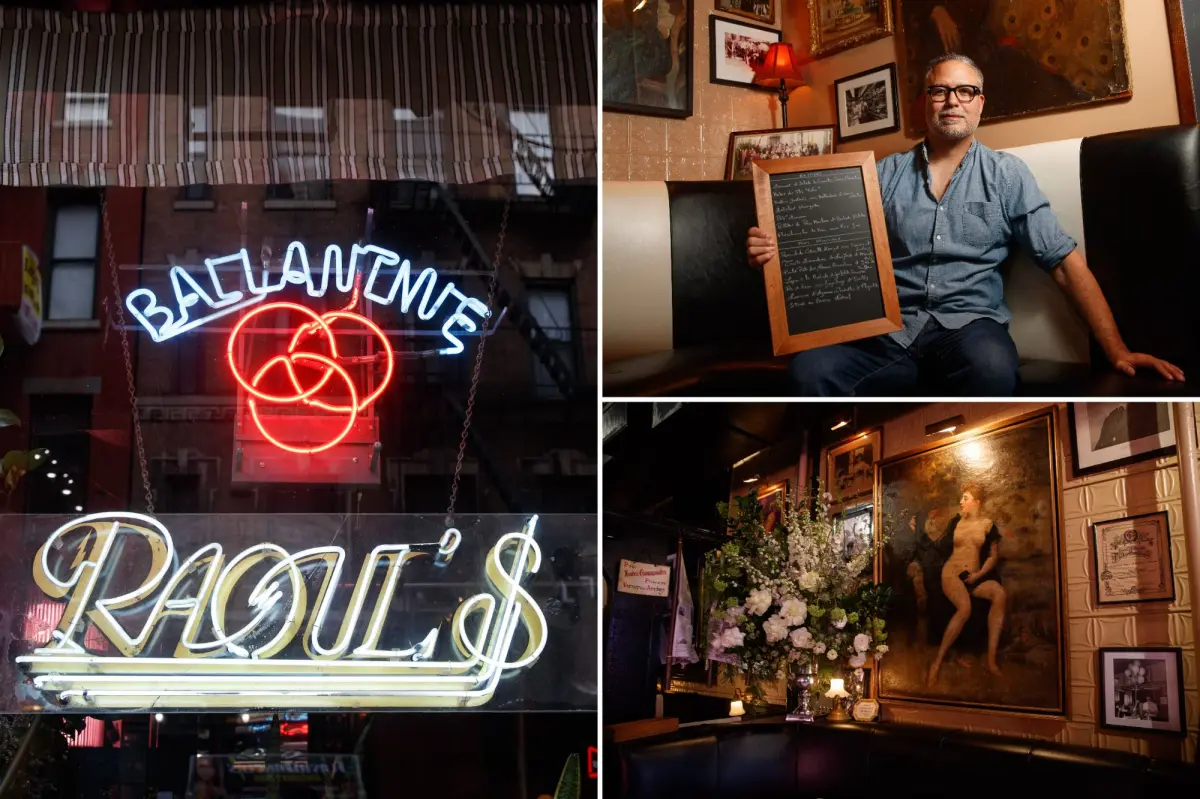
Part of Raoul’s enduring appeal lies in its physical space, which Karim notes has remained largely untouched for half a century—and even before that, when it operated as an Italian restaurant. The bistro has become as famous for its distinctive architectural elements as for its signature dishes. Housed in a century-old former tenement building that previously contained an Italian restaurant and a Portuguese dance hall, Raoul’s features a tiny spiral staircase, a tarot card reader upstairs, original tin ceilings, vintage leather booths, and a bar dating back to the 1930s Sears catalogue era. The steak au poivre has never left the menu in fifty years, becoming the restaurant’s most iconic dish. The culinary approach has come full circle, according to Karim. The restaurant began with traditional French classics like beef bourguignon, shifted toward lighter New American cuisine in the 1990s, and has now returned to its French roots with contemporary interpretations of classics including rabbit and sweetbreads.
The People Behind the Success
Perhaps more important than the physical space or menu is Raoul’s remarkable staff continuity. Maitre d’ Eddie Hudson has been with the restaurant for an astonishing 47 years—nearly its entire existence. The establishment has long been known for its colorful and expressive personnel, including drag queens encouraged to embrace their identities, along with bartenders, busboys, and servers who were artists pursuing their own creative endeavors. This sense of authenticity and personal expression stands in stark contrast to the carefully calculated atmospheres of many contemporary dining establishments. “There has always been a certain freedom at Raoul’s,” Karim explains. “People were able to express themselves through their art—selling it—having drag shows at the bar, whatever. That’s what made it different, and an entertainment place, not just a restaurant.”
An Enduring Legacy in a Changed City
As Raoul’s celebrates its golden anniversary, its significance extends beyond merely surviving in Manhattan’s notoriously difficult restaurant landscape. While the surrounding streets have transformed dramatically into what Karim describes as “a giant designer shopping mall,” the bistro maintains its unpretentious charm and culinary integrity. “It’s never become the ‘in,’ hip place,” Karim reflects. “It has always flowed under the radar, never the hottest place in the city. It’s consistent, not trying to be the best restaurant in New York.” This commitment to authenticity rather than trendiness has paradoxically made Raoul’s one of the city’s most enduring culinary institutions. The restaurant stands as a living testament to a bygone New York—one where artistic communities flourished in affordable neighborhoods, where family-owned businesses could resist both corporate chains and organized crime, and where a restaurant’s character was defined not by Instagram potential but by the genuine experiences of its patrons and staff. In a city constantly reinventing itself, Raoul’s represents the power of consistency, authenticity, and the human connections fostered over countless meals shared across five remarkable decades.